East St. Louis in St. Clair County, Illinois — The American Midwest (Great Lakes)
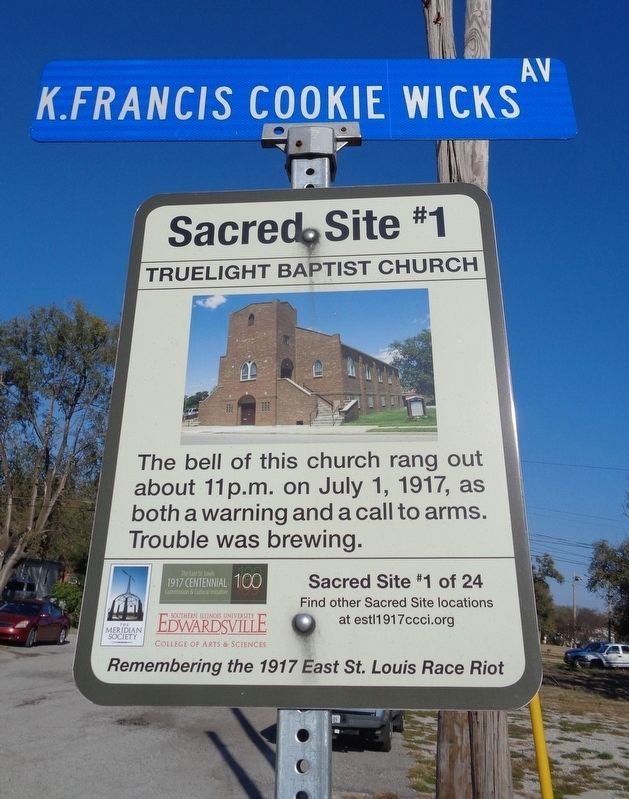
Truelight Baptist Church
Remembering the 1917 East St. Louis Race Riot
Photographed by Jason Voigt, November 5, 2019
1. Truelight Baptist Church Marker
Erected 2017 by The East St. Louis 1917 Centennial Commission & Cultural Initiative, the Meridian Society, Southern Illinois University Edwardsville. (Marker Number 1.)
Topics and series. This historical marker is listed in these topic lists: African Americans • Religion & Religious Structures. In addition, it is included in the Illinois, Remembering the 1917 East St. Louis Race Riot series list. A significant historical date for this entry is July 1, 1917.
Location. 38° 36.49′ N, 90° 9.392′ W. Marker is in East St. Louis, Illinois, in St. Clair County. It is at the intersection of South 16th Street and Tudor Avenue, on the right when traveling east on South 16th Street. Marker is across the street from Truelight Baptist Church. Touch for map. Marker is at or near this postal address: 1535 Tudor Avenue, East Saint Louis IL 62207, United States of America. Touch for directions.

Regionally, this marker is in Greater St. Louis. It is also in the American Midwest, in the Lewis & Clark Corridor, in the
this page online
Other nearby markers. At least 8 other markers are within one mile of this marker, measured as the crow flies: 1700 Bond Avenue (approx. ¼ mile away); 10th Street and Piggott Ave. (approx. 0.6 miles away); 10th Street and Trendley Ave. (approx. 0.6 miles away); Home of Miles Davis (approx. 0.7 miles away); S. 8th St. and Brady Ave. (approx. 0.9 miles away); S. 8th St. and E. Broadway (approx. one mile away); East St. Louis Race Massacre, July 1917 (approx. one mile away); 700 East Broadway (approx. one mile away). Touch for a list and map of all markers in East St. Louis.
Regarding Truelight Baptist Church. On Monday, July 2, 1917, black and white residents of industrial East St. Louis, Illinois, witnessed their city plunged into a second round of racial violence, just 35 days after the eruption of racial conflict on May 28.
Photographed by Jason Voigt, November 5, 2019
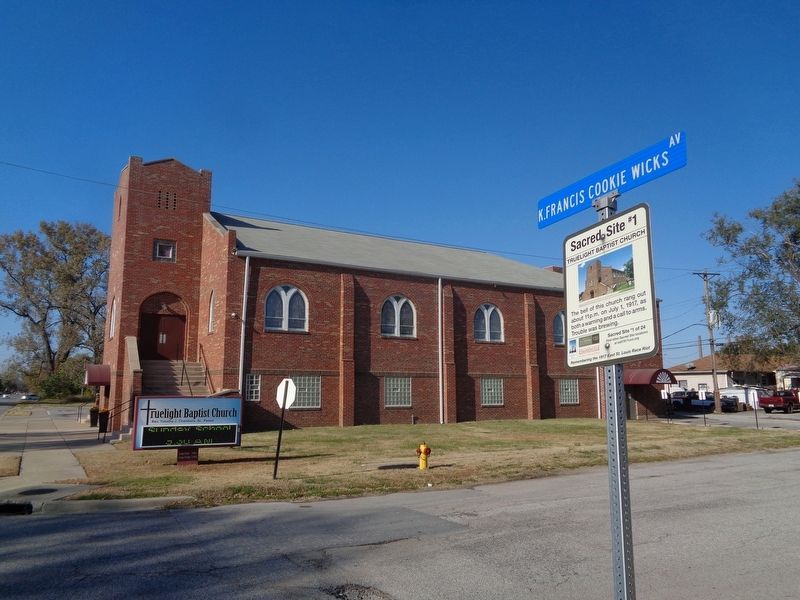
2. Truelight Baptist Church Marker
Church is in the background
The violence that erupted on July 2 was long-simmering. For months, the African-American community prepared for the possibility of violence, and church bells were used as a warning to be ready. Whites attacked the South End neighborhood regularly that summer. On the night of July 1, a car of assailants drove along Market Street firing shots into homes. As the church bell rang out, armed African Americans gathered to defend their neighborhood. The response was presented at trial as evidence that African Americans, not whites, started the conflict.
(Sources: See "Race Riot at East St. Louis - 1917," excerpted by Bill Nunes from material of John Cobb (formerly of State Community College in East St. Louis) and Elliott Rudwick; included in East St. Louis, Illinois, Year-by-Year Illustrated History by Bill Nunes (Dexter MI: Thompson-Shore, 1988), pp. 166-167 [the account presented in this source cannot be verified by SIUE researchers]. See also: "Riot Jury Told Negroes Began Race Outbreak," St. Louis Star and Times, 03 Oct 1917, p. A1. See also Malcolm McLaughlin, Power, Community, and Racial Killing in East St. Louis (New York: Palgrave MacMillan, 2005) pp.126-127.
Additional keywords. 1917 Race Riot
Credits. This page was last revised on November 6, 2019. It was originally submitted on November 5, 2019, by Jason Voigt of Glen Carbon, Illinois. This page has been viewed 1,006 times since then and 47 times this year. Photos: 1, 2. submitted on November 5, 2019, by Jason Voigt of Glen Carbon, Illinois. • Devry Becker Jones was the editor who published this page.
