Dover Air Force Base in Kent County, Delaware — The American Northeast (Mid-Atlantic)
C-119G
Flying Boxcar
| — | S/N 10-870 | — |
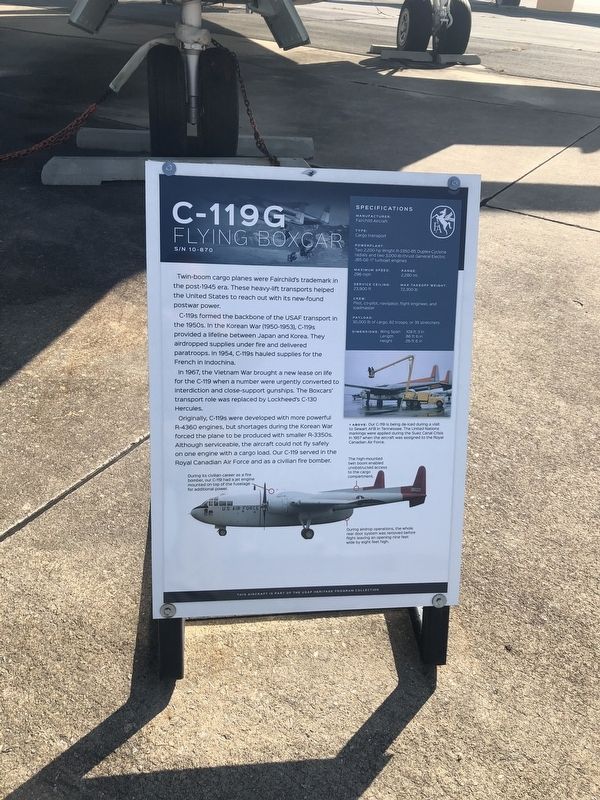
Twin-boom cargo planes were Fairchild's trademark in the post-1945 era. These heavy-lift transports helped the United States to reach out with its new-found postwar power.
C-119s formed the backbone of the USAF transport in the 1950s. In the Korean War (1950-1953), C-119s provided a lifeline between Japan and Korea. They airdropped supplies under fire and delivered paratroops. In 1954, C-119s hauled supplies for French in Indochina.
In 1967, the Vietnam War brought a new lease on life for the C-119 when a number were urgently converted to interdiction and close-support gunships. The Boxcars' transport role was replaced by Lockheed's C-130 Hercules.
Originally, C-119s were developed with more powerful R-4360 engines, but shortages during the Korean WAr forced the plane to be produced with smaller R-3350s. Although serviceable, the aircraft could not fly safely on one engine with a cargo load. Our C-119 served in the Royal Canadian Air Force and as a civilian fire bomber.
Specifications
Manufacturer: Fairchild Aircraft
Type: Cargo transport
Powerplant: Two 2,200-hp Wright R-350-85 Duplex-Cyclone radials and two 3,000-lb-thrust General Electric J85-GE-17 turbojet engines
Maximum Speed: 296 mph
Range: 2,280 mi.
Service Ceiling: 23,900 ft
Max Takeoff Weight: 72,300 lb
Crew: Pilot, co-pilot, navigator, flight engineer, and loadmaster
Payload: 30,000 lb of cargo, 62 troops, or 35 stretchers
Dimensions:
Wing Span: 109 ft 3 in
Length: 86 ft 6 in
Height: 26 ft 6 in
[Captions:]
Above: Our C-119 is being de-iced during a visit to Stewart AFB in Tennessee. The United Nations markings were applied during the Suez Canal Crisis in 1957 when the aircraft was assigned to the Royal Canadian Air Force.
During its civilian career as a fire bomber, our C-119 had a jet engines mounted on top of the fuselage for additional power.
The high-mounted twin boom enabled unobstructed access to the cargo compartment.
During airdrop operations, the whole rear door-system was removed before flight leaving an opening nine feet wide by eight feet high.
Topics.
this page online
Location. 39° 7.066′ N, 75° 27.476′ W. Marker is in Dover, Delaware, in Kent County. It is in Dover Air Force Base. It can be reached from Heritage Road 0.7 miles west of Bayside Drive (Delaware Route 9), on the left when traveling west. Touch for map. Marker is at or near this postal address: 1301 Heritage Road, Dover AFB DE 19902, United States of America. Touch for directions.

Regionally, this marker is in the American Mid-Atlantic, on the Delmarva Peninsula, and on the Eastern Seaboard. Globally, it is in the North Atlantic Region, North America, the Western Hemisphere, the Western World, and the Anglosphere. Historically, it finds itself in what was once New Netherland, one of the original Thirteen Colonies, and the Antebellum South.
Other nearby markers. At least 8 other markers are within walking distance of this marker: C-119C (a few steps from this marker); C-123K (within shouting distance of this marker); C-124A (within shouting distance of this
Credits. This page was last revised on September 17, 2023. It was originally submitted on November 13, 2019, by Devry Becker Jones of Washington, District of Columbia. This page has been viewed 364 times since then and 20 times this year. Photos: 1, 2. submitted on November 13, 2019, by Devry Becker Jones of Washington, District of Columbia.
