Elko in Elko County, Nevada — The American Mountains (Southwest)
Growth and Industry
Photographed by Theresa Hilton Small, November 14, 2019
1. Growth and Industry Marker
Inscription.
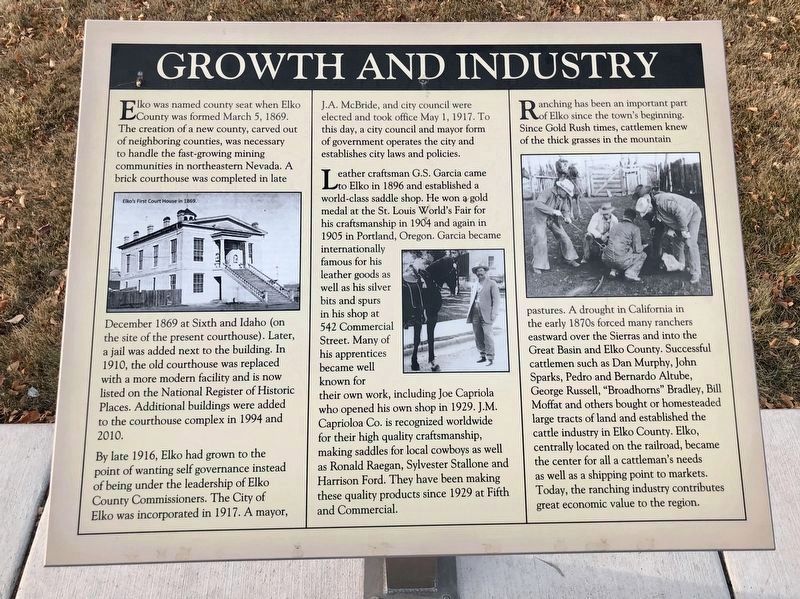
Growth and Industry. . Elko was named county seat when Elko County was formed March 5, 1869. The creation of a new county, carved out of neighboring counties, was necessary to handle the fast-growing mining communities in northeastern Nevada. A brick courthouse was completed in late December 1869 at Sixth and Idaho (on the site of the present courthouse). Later, a jail was added next to the building. In 1910, the old courthouse was replaced with a more modern facility and is now listed on the National Register of Historic Places. Additional buildings were added to the courthouse complex in 1994 and 2010.
By late 1916, Elko had grown to the point of wanting self governance instead of being under the leadership of Elko County Commissioners. The City of Elko was incorporated in 1917. A mayor, J.A. McBride, and city council were elected and took office May 1, 1917. To this day, a city council and mayor form of government operates the city and establishes city laws and policies.
Leather craftsman G.S. Garcia came to Elko in 1896 and established a world-class saddle shop. He won a gold medal at the St. Louis World's Fair for his craftsmanship in 1904 and again in 1905 in Portland, Oregon. Garcia became internationally famous for his leather goods as well as his silver bits and spurs in his shop at 542 Commercial Street. Many of his apprentices became well known for their own work, including Joe Capriola who opened his own shop in 1929. J.M. Caprioloa Co. is recognized worldwide for their high quality craftsmanship, making saddles for local cowboys as well as Ronald Raegan, Sylvester Stallone and Harrison Ford. They have been making these quality products since 1929 at Fifth and Commercial.
Ranching has been an important part of Elko since the town's beginning. Since Gold Rush times, cattlemen knew of the thick grasses in the mountain pastures. A drought in California in , the early 1870s forced many ranchers eastward over the Sierras and into the Great Basin and Elko County. Successful cattlemen such as Dan Murphy, John Sparks, Pedro and Bernardo Altube, George Russell, “Broadhorns” Bradley, Bill Moffat and others bought or homesteaded large tracts of land and established the cattle industry in Elko County. Elko, centrally located on the railroad, became the center for all a cattleman's needs as well as a shipping point to markets. Today, the ranching industry contributes great economic value to the region.
Elko was named county seat when Elko
County was formed March 5, 1869.
The creation of a new county, carved out
of neighboring counties, was necessary
to handle the fast-growing mining
communities in northeastern Nevada. A
brick courthouse was completed in late
December 1869 at Sixth and Idaho (on
the site of the present courthouse). Later,
a jail was added next to the building. In
1910, the old courthouse was replaced
with a more modern facility and is now
listed on the National Register of Historic
Places. Additional buildings were added
to the courthouse complex in 1994 and
2010.
By late 1916, Elko had grown to the
point of wanting self governance instead
of being under the leadership of Elko
County Commissioners. The City of
Elko was incorporated in 1917. A mayor,
J.A. McBride, and city council were
elected and took office May 1, 1917. To
this day, a city council and mayor form
of government operates the city and
establishes city laws and policies.
Leather craftsman G.S. Garcia came
to Elko in 1896 and established a
world-class saddle shop. He won a gold
medal at the St. Louis World's Fair for
his craftsmanship in 1904 and again in
1905 in Portland, Oregon. Garcia became
internationally
famous for his
leather goods as
well as his silver
bits and spurs
in his shop at
542 Commercial
Street. Many of
his apprentices
became well
known for
their own work, including Joe Capriola
who opened his own shop in 1929. J.M.
Caprioloa Co. is recognized worldwide
for their high quality craftsmanship,
making saddles for local cowboys as well
as Ronald Raegan, Sylvester Stallone and
Harrison Ford. They have been making
these quality products since 1929 at Fifth
and Commercial.
Ranching has been an important part
of Elko since the town's beginning.
Since Gold Rush times, cattlemen knew
of the thick grasses in the mountain
pastures. A drought in California in ,
the early 1870s forced many ranchers
eastward over the Sierras and into the
Great Basin and Elko County. Successful
cattlemen such as Dan Murphy, John
Sparks, Pedro and Bernardo Altube,
George Russell, “Broadhorns” Bradley, Bill
Moffat and others bought or homesteaded
large tracts of land and established the
cattle industry in Elko County. Elko,
centrally located on the railroad, became
the center for all a cattleman's needs
as well as a shipping point to markets.
Today, the ranching industry contributes
great economic value to the region.
Location. 40° 50.013′ N, 115° 45.633′ W. Marker is in Elko, Nevada, in Elko County. It is at the intersection of Railroad Street and 7th Street, on the right when traveling north on Railroad Street. Located in Elko Railroad Park. Touch for map. Marker is at or near this postal address: Railroad Street, Elko NV 89801, United States of America. Touch for directions.
Regionally, this marker is in Elko Country. It is also in the American Mountain West. Globally, it is in North America, the Western Hemisphere, the Western World, and the Anglosphere. Historically, it finds itself in what was once New Spain and also Mexico’s Alta California.
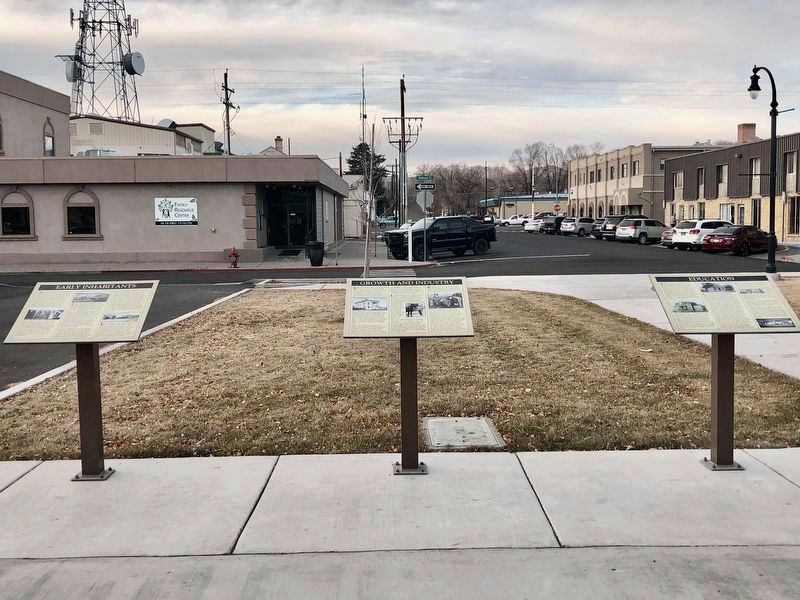
Other nearby markers. At least 8 other markers are within walking distance of this marker: Early Inhabitants (here, next to this marker); Education (here, next to this marker); The Railroad (within shouting distance of this marker); Entertainment (within shouting distance of this
Photographed by Theresa Hilton Small, November 14, 2019
More about this marker. 7th Street, between Commercial & Railroad Streets, was closed off to combine the two portions of the park.
Photographed by Mark Parker, October 11, 2023
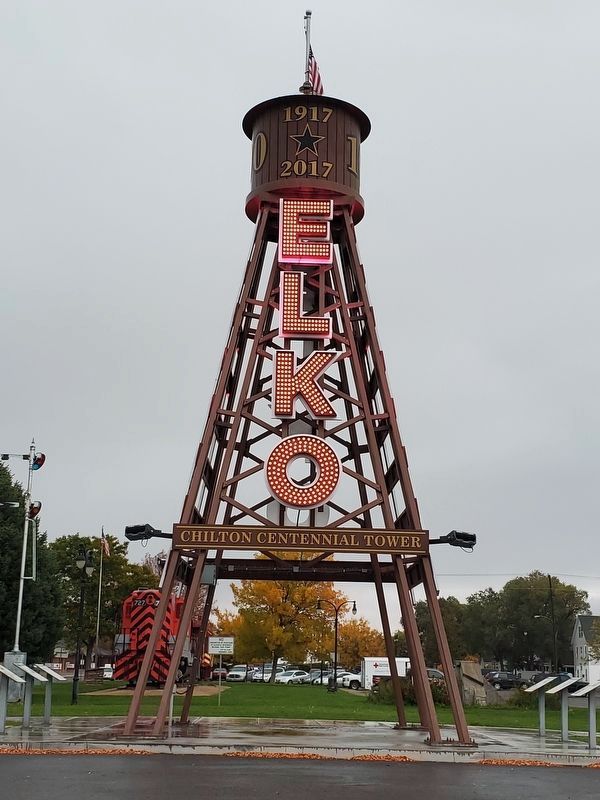
3. Elko Centennial Tower, Growth and Industry marker is to the left
Credits. This page was last revised on September 6, 2024. It was originally submitted on November 14, 2019, by Mark Hilton of Montgomery, Alabama. This page has been viewed 430 times since then and 31 times this year. Photos:1, 2. submitted on November 14, 2019, by Mark Hilton of Montgomery, Alabama. 3. submitted on August 27, 2024, by Mark Parker of Hickory, North Carolina.