Culbertson in Roosevelt County, Montana — The American West (Mountains)
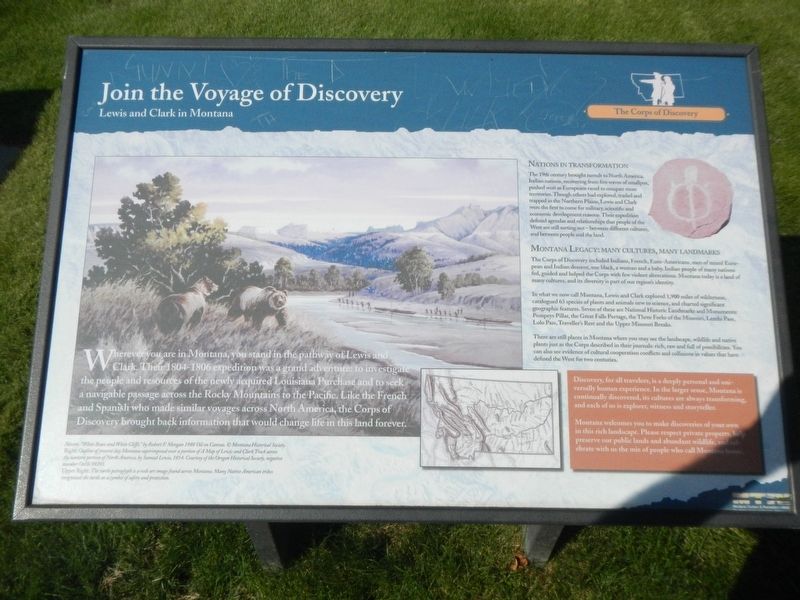
Join the Voyage of Discovery
Lewis and Clark in Montana
Photographed by Barry Swackhamer, August 16, 2019
1. Join the Voyage of Discovery Marker
Nations in Transformation
The 19th century brought tumult to North America. Indian nations, recovering from five waves of smallpox, pushed west as Europeans raced to conquer more territories. Though others had explored, traded and trapped in the Northern Plains, Lewis and Clark were the first to come for military, scientific and economic development reasons. Their expedition defined agendas and relationships that people of the West are still sorting out - between different cultures, and between people and the land.
Montana Legacy: Many Cultures, Many Landmarks
The Corps of Discovery included Indians, French, Euro-Americans, men of mixed European and Indian decent, one
this page online
In what we now call Montana, Lewis and Clark explored 1,900 miles of wilderness, catalogued 63 species of plants and animals new to science, and charted significant geographic features. Seven the these are National Historic Landmarks and Monuments: Pompeys Pillar, the Great Falls Portage, the Three Forks of the Missouri, Lemhi Pass, Lolo Pass, Traveller's Rest, and the Upper Missouri Breaks.
There are still places in Montana where you may see landscape, wildlife and native plants just as the Corps described in their journals: rich, raw and full of possibilities. You can also see evidence of cultural cooperation, conflicts and collisions in values that have defined the West for two centuries.
(sidebar)
Discovery, for all travelers, is a deeply personal and universally human experience. In the larger sense, Montana is continually discovered, its cultures are always transforming, and each of us is explorer, witness
Photographed by Barry Swackhamer, August 16, 2019
2. Join the Voyage of Discovery Marker
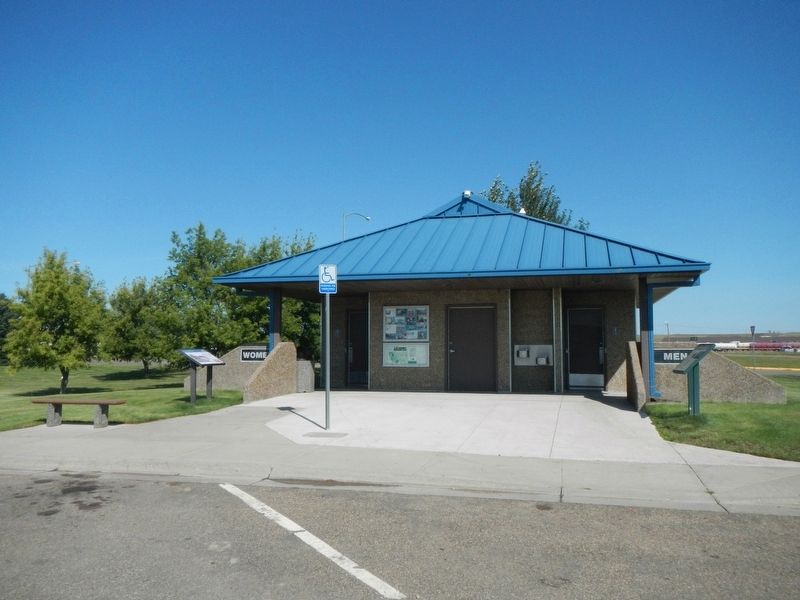
The marker is on the women's side.
Montana welcomes you to make discoveries of your own in this rich landscape. Please respect private property, help preserve out public lands and abundant wildlife and celebrate with us the mix of people who call Montana home.
Erected by Montana Department of Transportation.
Topics and series. This historical marker is listed in this topic list: Exploration. In addition, it is included in the Lewis & Clark Expedition series list.
Location. 48° 8.867′ N, 104° 30.251′ W. Marker is in Culbertson, Montana, in Roosevelt County. It is on U.S. 2 near 6th Avenue East, on the right when traveling east. Touch for map. Marker is in this post office area: Culbertson MT 59218, United States of America. Touch for directions.

Regionally, this marker is in Montana’s Missouri River Country. It is also in the American Mountain West, in the Lewis & Clark Corridor, on the prairies, on the Great Plains, and specifically on the Northern Plains. Globally, it is in North America, the Western Hemisphere, the Western World, and the Anglosphere. Historically, it finds itself in what was once Rupert’s Land and also the Louisiana Purchase.
Other nearby markers. At least 3 other markers are within walking distance of this marker: Coal, Oil, and Natural Gas (here, next to this marker); In Tribute to Veterans Who Were Killed in Action While Serving Their Country (approx. half a mile away); Coal Mine Cars (approx. half a mile away).
More about this marker. This marker is located in the Culbertson Roadside Rest at the east end of Culbertson. This maker is also found at several Montana Lewis and Clark sites.
Credits. This page was last revised on November 27, 2019. It was originally submitted on November 27, 2019, by Barry Swackhamer of Brentwood, California. This page has been viewed 323 times since then and 18 times this year. Photos: 1, 2. submitted on November 27, 2019, by Barry Swackhamer of Brentwood, California.
