Near Williston in Williams County, North Dakota — The American Midwest (Upper Plains)
A Beaver Boom
Missouri-Yellowstone Confluence Interpretive Center
Photographed by Barry Swackhamer, August 16, 2019
1. A Beaver Boom Marker
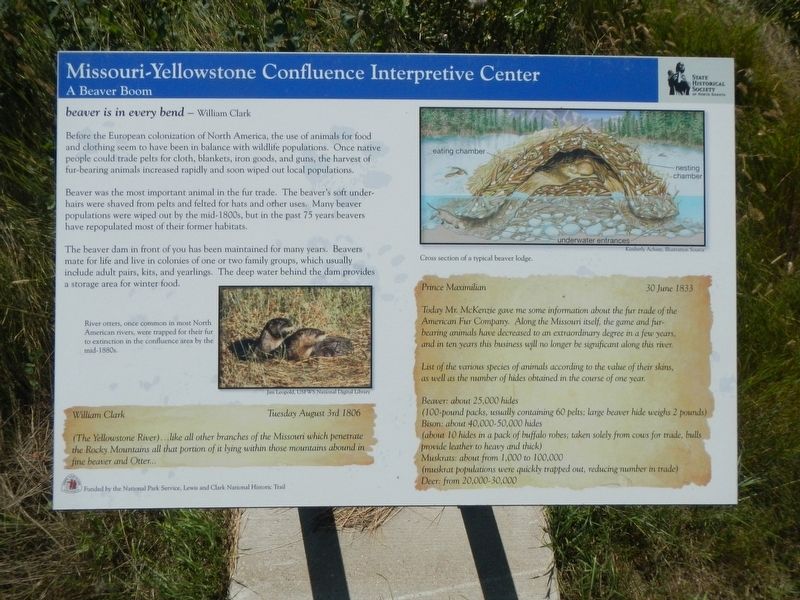
Captions: (middle left) River otters, once common in most North American rivers, were trapped for their fur to extinction in the confluence area by the mid-1800s.; (top right) Cross section of a typical beaver lodge.
beaver is in every bend -- William Clark
Before the European colonization of North America, the use of animals for food and clothing seemed to have been in balance with the wildlife population. Once native people could trade pelts for cloth, blankets, iron goods and guns, the harvest of fur-bearing animals increased rapidly and soon wiped out local populations.
Beaver was the most important animal in the fur trade. The beaver's soft under-hairs were shaved from pelts and felted for hats and other uses. Many beaver populations were wiped out by the mid-1800s, but in the past 75 years beavers have repopulated most of their former habitats.
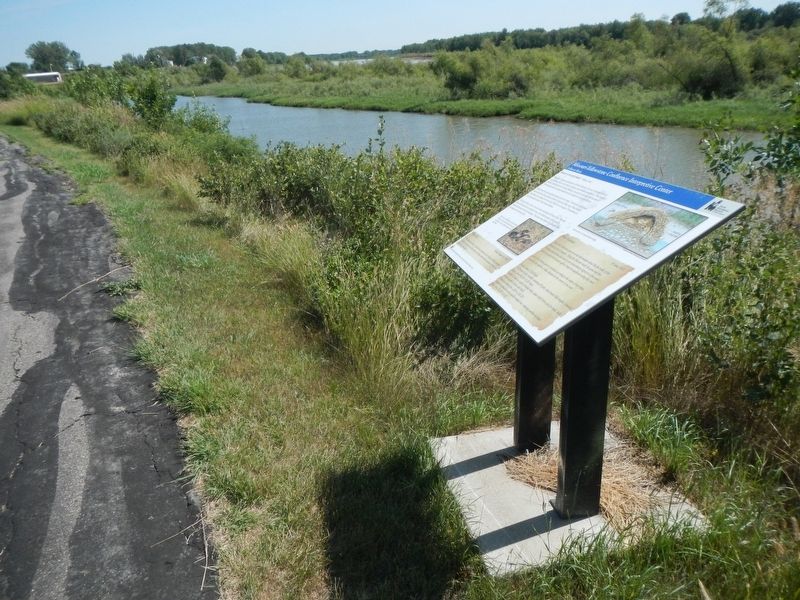
The beaver dam in front of you (what dam? ed.) has been maintained for many years. Beavers mate for life and live in colonies of one or two family groups, which usually include adult pairs, kits, and yearlings. The deep water behind the dam provides a storage area for winter food.
(The Yellowstone River)…like all other branches of the Missouri which penetrate the Rocky Mountains all that portion of it lying within those mountains abound in fine beaver and Otter… -- WilliamClark, Tuesday August 3 1806
Click or scan to see
this page online
Today Mr. McKenzie gave me some information about the fur trade of the American Fur Company. Along the Missouri itself, the game and fur-bearing animals have decreased to an extraordinary degree in a few years, and in ten years the business will no longer be significant along this river.
List of various species of animals to the value of their skins, as well as the number of hides obtained in the course of one year.
Beaver: about 25,000 hides
(100-pound packs, usually containing 60 pelts; large beaver hide weighs 2 pounds)
Bison: about 40,000-50,000 hides
(about 10 hides in a pack of buffalo robes; taken solely from cows for trade, bulls provide leather to heavy and thick)
Muskrat: about from 1,000 to 100,000
(muskrat populations were quickly trapped out, reducing number in trade)
Deer: from 20,000-30,000 -- Prince Maximilian, 30 June 1833
Erected by State Historical Society of North Dakota.
Topics and series. This historical marker is listed in these topic lists: Animals • Industry & Commerce. In addition, it is included in the Lewis & Clark Expedition series list. A significant historical date for this entry is June 30, 1833.
Location. 47° 59.089′ N,
Photographed by Barry Swackhamer, August 16, 2019
2. A Beaver Boom Marker

Regionally, this marker is in the Bakken Oil Patch. It is also in the American Lewis & Clark Corridor, on the prairies, and on the Northern Plains. Globally, it is in North America, the Western Hemisphere, the Western World, and the Anglosphere. Historically, it finds itself in what was once Rupert’s Land and also the Louisiana Purchase.
Other nearby markers. At least 8 other markers are within walking distance of this marker: Missouri-Yellowstone Confluence (within shouting distance of this marker); Missouri-Yellowstone Confluence Area (within shouting distance of this marker); Mosquitoes (about 300 feet away, measured in a direct line); Oxbow Wetland (about 300 feet away); Lewis & Clark's America (about 400 feet away); The Confluence (about 400 feet away); Fur Trade Forts (about 400 feet away); Buford-Trenton Project (about 400 feet away). Touch for a list and map of all markers in Williston.
More about this marker. The marker is on the grounds of the Missouri-Yellowstone Confluence Interpretive Center.
Credits. This page was last revised on June 11, 2024. It was originally submitted on November 28, 2019, by Barry Swackhamer of Brentwood, California. This page has been viewed 375 times since then and 29 times this year. Photos: 1, 2. submitted on November 28, 2019, by Barry Swackhamer of Brentwood, California.
