Port Gibson in Claiborne County, Mississippi — The American South (East South Central)
Lil Green
| — | Mississippi Blues Trail | — |
Photographed by Cajun Scrambler, November 30, 2019
1. Lil Green Marker
Side 1
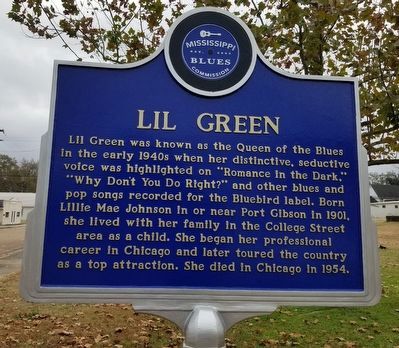
Lil Green was known as the Queen of the Blues in the early 1940s when her distinctive, seductive voice was highlighted on “Romance in the Dark,” “Why Don’t You Do Right?” and other blues and pop songs recorded for the Bluebird label. Born Lillie Mae Johnson in or near Port Gibson in 1901, she lived with her family in the College Street area as a child. She began her professional career in Chicago and later toured the country as a top attraction. She died in Chicago in 1954.
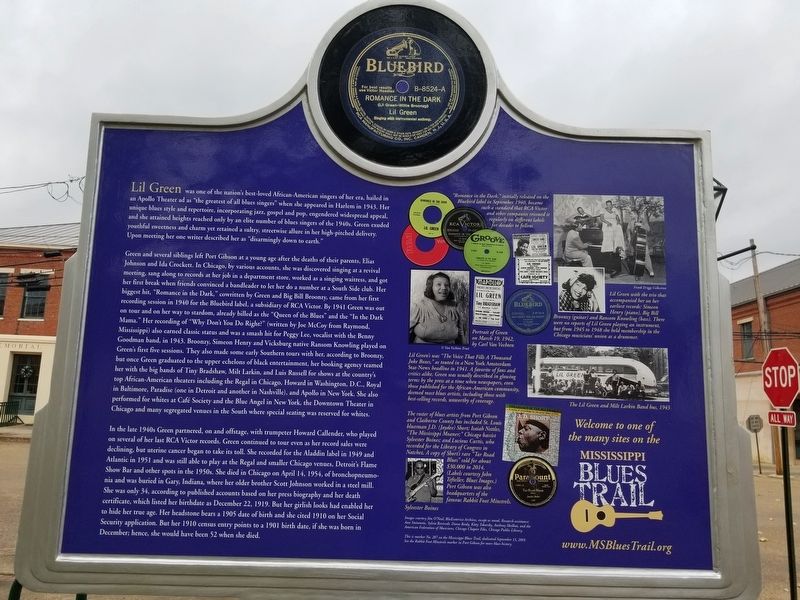
Lil Green was one of the nation’s best-loved African-American singers of her era, hailed in an Apollo Theater ad as “the greatest of all blues singers” when she appeared in Harlem in 1943. Her unique blues style and repertoire, incorporating jazz, gospel and pop, engendered widespread appeal, and she attained heights reached only by an elite number of blues singers of the 1940s. Green exuded youthful sweetness and charm yet retained a sultry, streetwise allure in her high-pitched delivery. Upon meeting her one writer described her as “disarmingly down to earth.”
Green and several siblings left Port Gibson at a young age after the deaths of
this page online
November 30, 2019
2. Lil Green Marker
Side 2
In the late 1940s Green partnered, on and offstage, with trumpeter Howard Callender, who played on several of her last RCA Victor records. Green continued to tour even as her record sales were declining, but uterine cancer began to take its toll. She recorded for the Aladdin label in 1949 and Atlantic in 1951 and was still able to play at the Regal and smaller Chicago venues, Detroit’s Flame Show Bar and other spots in the 1950s. She died in Chicago on April 14, 1954, of bronchopneumonia and was buried in Gary, Indiana, where her older brother Scott Johnson worked in a steel mill. She was only 34, according to published accounts based on her press biography and her death certificate, which listed her birthdate
Photographed by Cajun Scrambler, November 29, 2019
3. Lil Green Marker
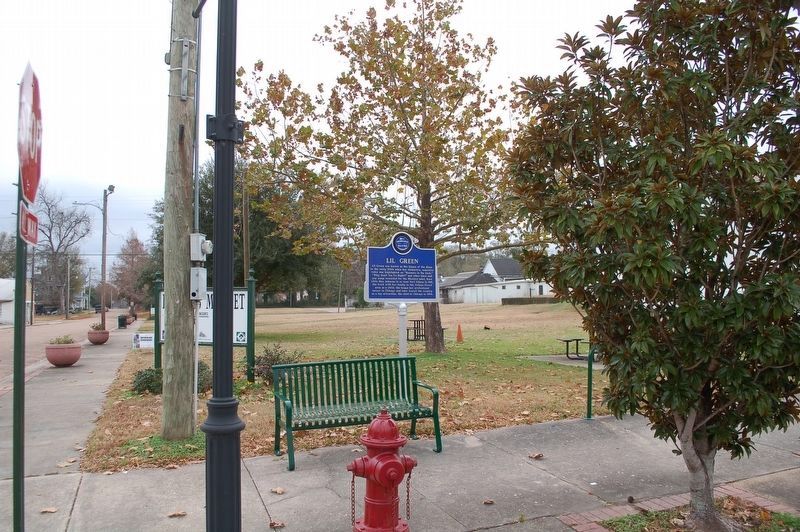
Side 1 distance shot
Erected 2019 by Mississippi Blues Commission. (Marker Number 207.)
Topics and series. This historical marker is listed in these topic lists: African Americans • Arts, Letters, Music • Entertainment. In addition, it is included in the Mississippi Blues Trail series list.
Location. Marker is missing. It was located near 31° 57.663′ N, 90° 59.045′ W. Marker was in Port Gibson, Mississippi, in Claiborne County. It was at the intersection of Fair Street and Market Street, on the right when traveling east on Fair Street. Touch for map. Marker was in this post office area: Port Gibson MS 39150, United States of America. Touch for directions.

Regionally, this marker was in Southwest Mississippi, in Natchez Trace Corridor, and in Greater Jackson. It was also in the American
Photographed by Cajun Scrambler, November 29, 2019
4. Lil Green Marker
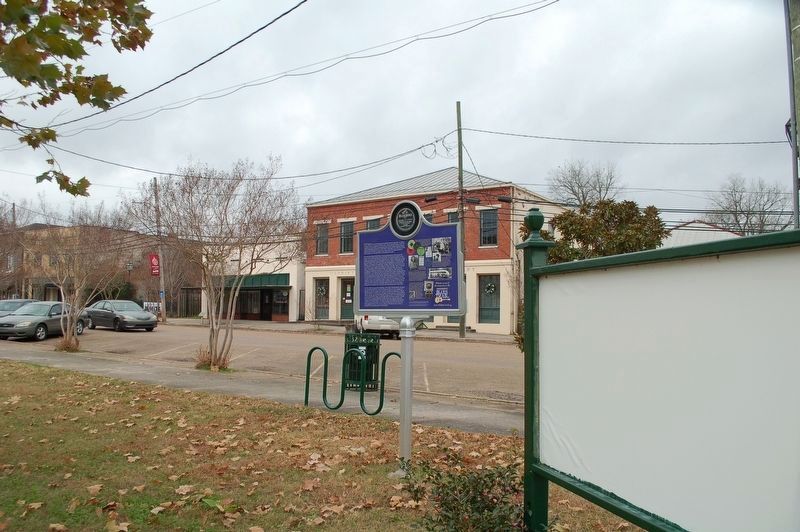
Side 2 distance shot
Other nearby markers. At least 8 other markers are within walking distance of this location: Commercial Buildings (within shouting distance of this marker); Claiborne County (about 400 feet away, measured in a direct line); The Bernheimer Complex (about 400 feet away); Claiborne County Courthouse (about 400 feet away); Port Gibson Bank (about 400 feet away); Lightfoot Park (about 500 feet away); First Baptist M.B. Church (about 500 feet away); The Port Gibson Boycott (about 500 feet away). Touch for a list and map of all markers in Port Gibson.
More about this marker. Market Street is also know as Main Street.
Additional commentary.
1. Missing plaque
As of January 12,2026 the plaque is missing
— Submitted January 12, 2026, by Lori Marvin of Philadelphia, Pennsylvania.
Credits. This page was last revised on February 3, 2026. It was originally submitted on December 1, 2019, by Cajun Scrambler of Assumption, Louisiana. This page has been viewed 383 times since then and 34 times this year. Photos: 1, 2, 3, 4. submitted on December 1, 2019, by Cajun Scrambler of Assumption, Louisiana.
