Innenstadt I in Frankfurt am Main, Hesse, Germany — Central Europe
Theodor Heuss
Photographed by Andrew Ruppenstein, September 23, 2019
1. Theodor Heuss Marker
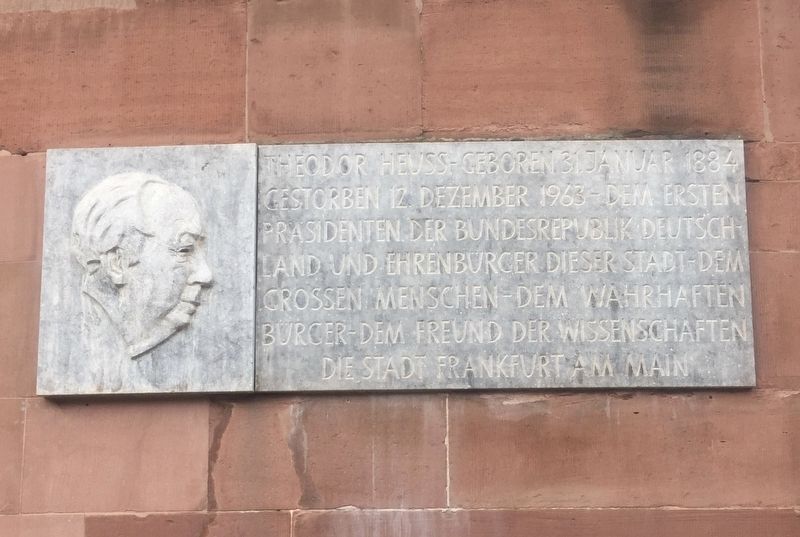
Inscription. Geboren 31. Januar 1884 · Gestorben 12. Dezember 1963
- dem Ersten
Präsidenten der Bundesrepublik Deutschland und Ehrenbürger dieser Stadt - dem
Grossen Menschen - dem Wahrhaften
Bürger - dem Freund der Wissenschaften
-
(English translation:)
Born January 31, 1884 · Died December 12, 1963
The first President of the Federal Republic of Germany and honorary citizen of this city - a great person - a true citizen - a friend of science
Topics. This historical marker is listed in this topic list: Government & Politics. A significant historical year for this entry is 1884.
Location. 50° 6.673′ N, 8° 40.864′ E. Marker is in Frankfurt am Main, Hessen (Hesse). It is in Innenstadt I. It can be reached from Paulsplatz. Touch for map. Marker is at or near this postal address: Paulsplatz 11, Frankfurt am Main HE 60311, Germany. Touch for directions.
Regionally, it is in Europe, the European Union, Atlantic Europe, Central Europe, the Schengen Area, Western Europe, and the Western World. Historically, it finds itself in what was once the Roman Empire, the Holy Roman Empire, and the former West Germany.
Also see . . . Theodor Heuss. "Theodor Heuss (31 January 1884 – 12 December 1963) was a West German liberal politician who served as the first President of the Federal Republic of Germany from 1949 to 1959. Beside the stern chancellor Konrad Adenauer, Heuss' cordial manners largely contributed to the stabilization of democracy in West Germany during the Wirtschaftswunder years. Prior to his career as a politician, he was a political journalist....Heuss shaped
Photographed by Andrew Ruppenstein, September 23, 2019
2. Theodor Heuss Marker - wide view
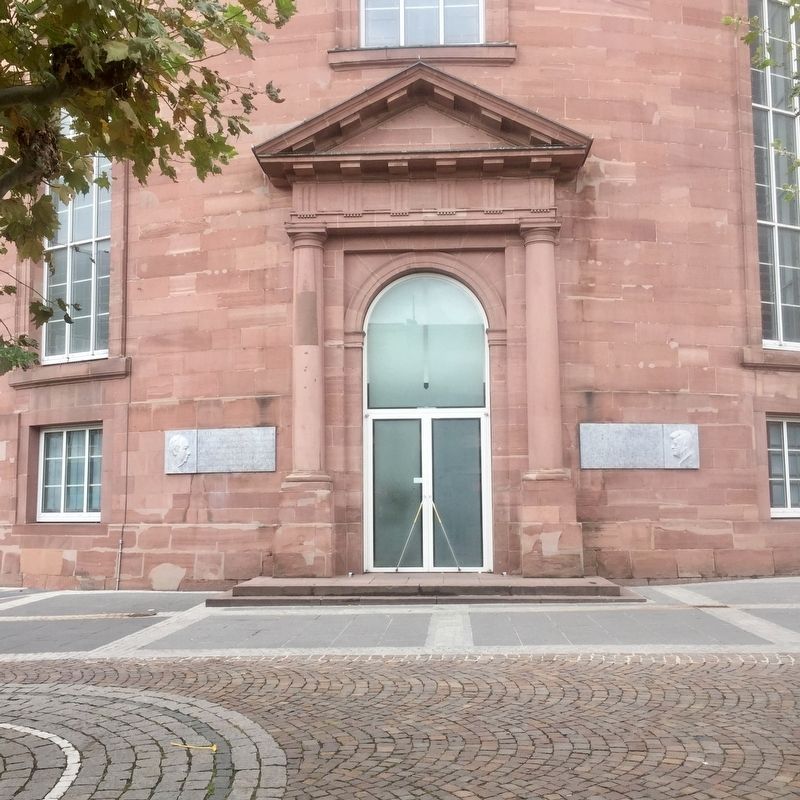
The marker is located on the east side of Paulskirche (St. Paul's Church), to the left of the side entrance (with the John F. Kennedy Speech marker to the right of same entrance.)
the office of president by his non-partisan governing. As a representative of the democratic-liberal and cultural traditions of Germany, he was a symbol of confidence in the German post-war republic in the international community. His further state visits to Turkey, Italy, Canada, the United States, and the United Kingdom contributed greatly to the increase of appreciation toward the still young Federal Republic of Germany. He was opposed to re-armament and the founding of the new West German Army in 1955, but had no power to stop it. His ironic speech at the swearing in of the first new soldiers, "Nun siegt mal schön!" ("Happy war-winning!"), is well remembered. In 1959, Heuss was awarded the prestigious Friedenspreis des Deutschen Buchhandels. In addressing the memory of Nazism and the Third Reich, Heuss introduced the concept of collective shame as opposed to collective guilt. His rhetoric encouraged the Germans to never forget the Holocaust and precisely described the crimes against the Jews but he refrained from citing those who were responsible for their suffering" (Submitted on December 16, 2019, by Andrew Ruppenstein of Lamorinda, California.)
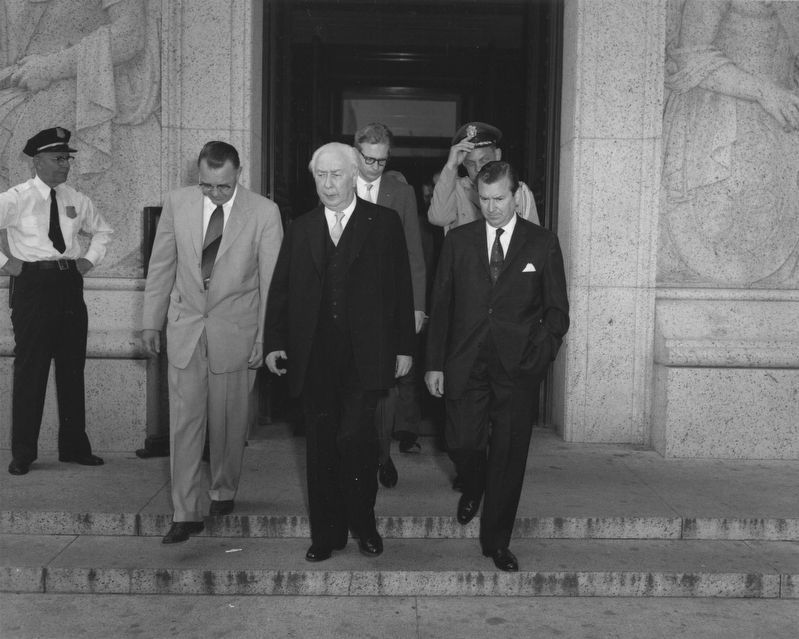
US General Services Administration, National Archives and Records Service, June 5, 1958
3. Photograph of National Archives Visit by Theodor Heuss, President of the Federal German Republic
Credits. This page was last revised on January 28, 2022. It was originally submitted on December 14, 2019, by Andrew Ruppenstein of Lamorinda, California. This page has been viewed 254 times since then and 22 times this year. Photos:1. submitted on December 14, 2019, by Andrew Ruppenstein of Lamorinda, California. 2, 3. submitted on December 16, 2019, by Andrew Ruppenstein of Lamorinda, California.