Near Lewistown in Fergus County, Montana — The American West (Mountains)
Armament Building
Lewistown Satellite Airfield Historic District
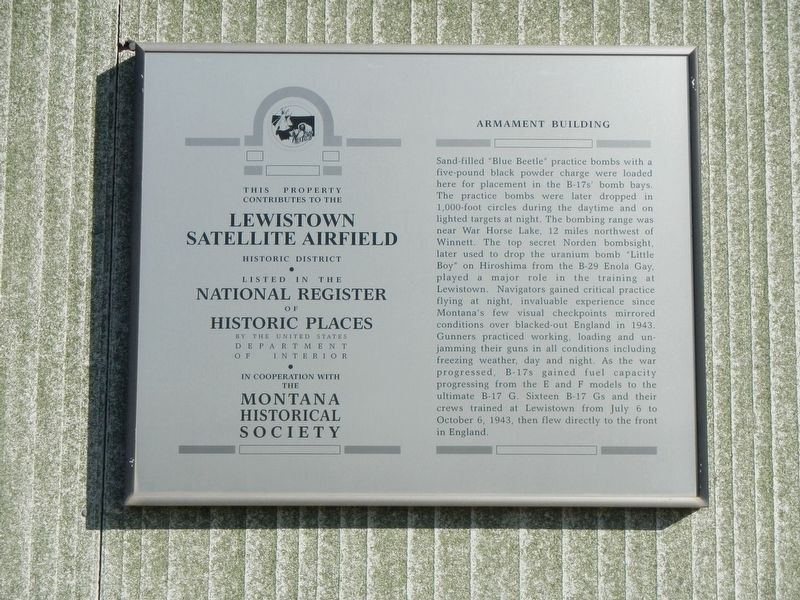
Photographed by Barry Swackhamer, August 18, 2019
1. Armament Building Marker
Inscription.
Armament Building. Lewistown Satellite Airfield Historic District. Sand-filled “Blue Beetle” practice bombs with a five-pound black powder charge were loaded here for placement in the B-17s bomb bays. The practice bombs were later dropped in 1,000-foot circles during the daytime and on lighted targets at night. The bombing range was near War Horse Lake, 12 miles northwest of Winnett. The top secret Norden bombsight, later used to drop the uranium bomb “Little Boy” on Hiroshima from the B-29 Enola Gay, played a major role in the training at Lewistown. Navigators gained critical practice flying at night, invaluable experience since Montanas few visual checkpoints mirrored conditions over blacked-out England in 1943. Gunners practiced working, loading, and un-jamming their guns in all conditions including freezing weather, day and night. As the war progressed, B-17s gained fuel capacity progressing from the E and F models to the ultimate B-17 G. Sixteen B-17 Gs and their crews trained at Lewistown from July 6 to October 6, 1943, then flew directly to the front in England.
Sand-filled “Blue Beetle” practice bombs with a five-pound black powder charge were loaded here for placement in the B-17s bomb bays. The practice bombs were later dropped in 1,000-foot circles during the daytime and on lighted targets at night. The bombing range was near War Horse Lake, 12 miles northwest of Winnett. The top secret Norden bombsight, later used to drop the uranium bomb “Little Boy” on Hiroshima from the B-29 Enola Gay, played a major role in the training at Lewistown. Navigators gained critical practice flying at night, invaluable experience since Montanas few visual checkpoints mirrored conditions over blacked-out England in 1943. Gunners practiced working, loading, and un-jamming their guns in all conditions including freezing weather, day and night. As the war progressed, B-17s gained fuel capacity progressing from the E and F models to the ultimate B-17 G. Sixteen B-17 Gs and their crews trained at Lewistown from July 6 to October 6, 1943, then flew directly to the front in England.
Erected by The Montana National Register Sign Program.
Location. 47° 2.853′ N, 109° 27.49′ W. Marker is near Lewistown, Montana, in Fergus County. It is at the intersection of West Aztec Drive and Gulf Stream Drive, on the right when traveling west on West Aztec Drive. Touch for map. Marker is at or near this postal address: 113 West Aztec Drive, Lewistown MT 59457, United States of America. Touch for directions.

Regionally, this marker is in andspecifically entral Montana in Russell Country. It is also in the American Mountain West and in the Lewis & Clark Corridor. Globally, it is in North America, the Western Hemisphere, the Western World, and the Anglosphere. Historically, it finds itself in what was once Ruperts Land and also the Louisiana Purchase.
Other nearby markers. At least 8 other markers are within walking distance of this marker: Crew Chief Building (within shouting distance of this marker); Recreation Building (within shouting distance of this marker); All Purpose Shop
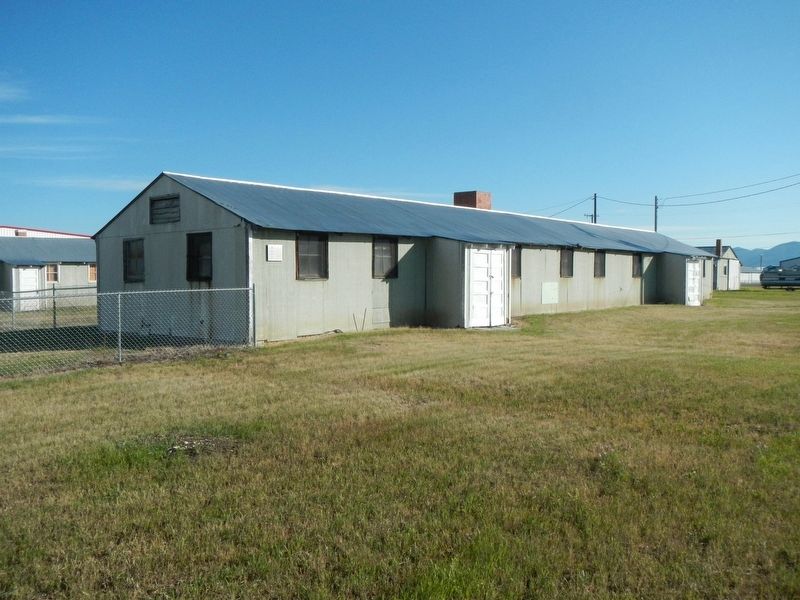
More about this marker. This marker is located at the former Lewistown Satellite Airfield, now the Lewiston Airport.
Credits. This page was last revised on December 22, 2019. It was originally submitted on December 15, 2019, by Barry Swackhamer of Brentwood, California. This page has been viewed 246 times since then and 9 times this year. Photos:1, 2. submitted on December 15, 2019, by Barry Swackhamer of Brentwood, California.
