Former Walter Reed Army Medical Center in Northwest Washington in Washington, District of Columbia — The American Northeast (Mid-Atlantic)
Borden's Dream
Former Walter Reed Army Medical Center
| — | Walking Tour | — |
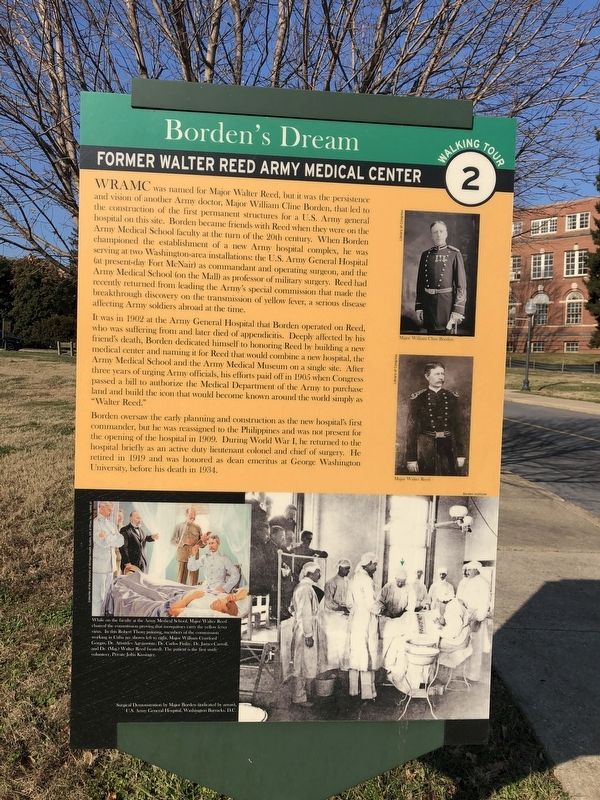
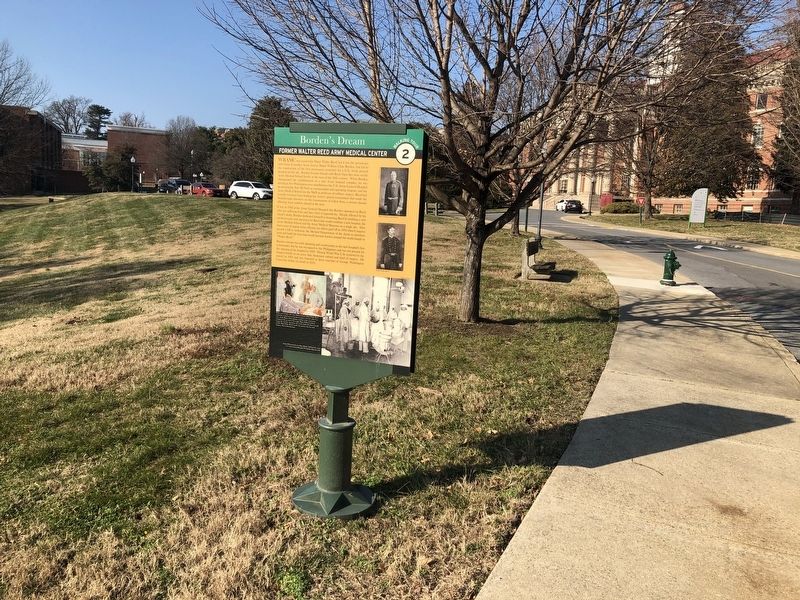
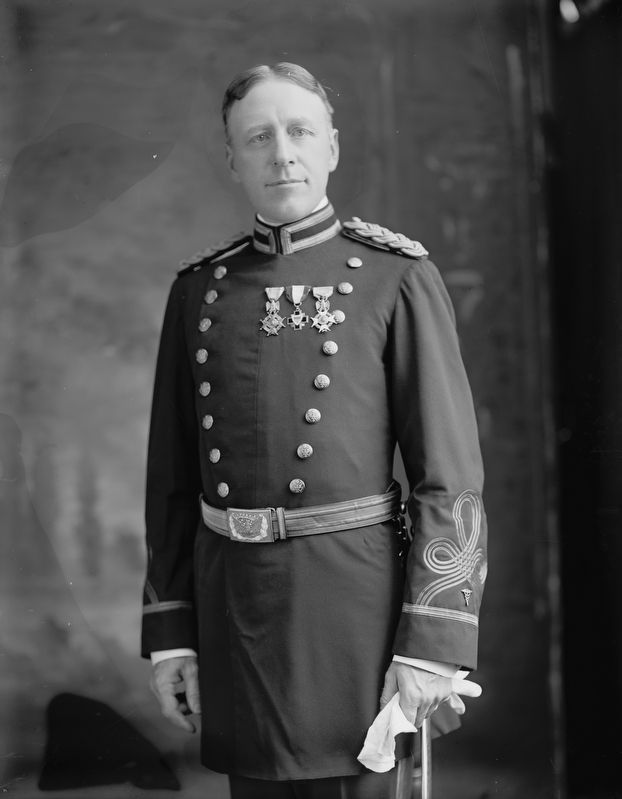
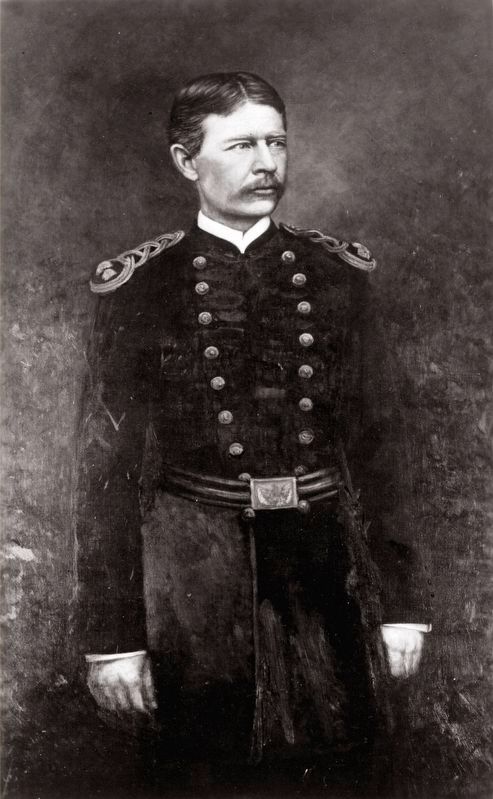
WRAMC was named for Major Walter Reed, but it was the persistence and vision of another Army doctor, Major William Cline Borden, that led to the construction of the first prominent structures for a U.S. Army general hospital on this site. Borden became friends with Reed when they were on the Army Medical School faculty at the turn of the 20th century. When Borden championed the establishment of a new Army hospital complex, he was serving at two Washington-area installations: the U.S. Army General Hospital (at present-day Fort McNair) as commandant and operating surgeon, and the Army Medical School (on the Mall) as professor of military surgery. Reed had the breakthrough discovery on the transmission of yellow fever, a serious disease affecting Army soldiers abroad at the time.
It was in 1902 at the Army General Hospital that Borden operated on Reed, who was suffering from and later died of appendicitis. Deeply affected by his friend's death, Borden dedicated himself to honoring Reed by building a new medical center and naming it for Reed that would combine a new hospital, the Army Medical School and the Army Medical
this page online
Borden oversaw the early planning and construction as the new hospital's first commander, but he was reassigned to the Philippines and was not present for the opening of the hospital in 1909. During World War I, he returned to the hospital briefly as an active duty lieutenant colonel and chief of surgery. He retired in 1919 and was honored as dean emeritus at George Washington University, before his death in 1934. (Marker Number 2.)
Topics. This historical marker is listed in these topic lists: Education • Science & Medicine • War, World I. A significant historical year for this entry is 1902.
Location. 38° 58.465′ N, 77° 1.729′ W. Marker is in Northwest Washington in Washington, District of Columbia. It is in Former Walter Reed Army Medical Center. It is on Main Drive Northwest just west of 12th Street Northwest, on the left when traveling west. Touch for map.
![Borden's Dream Marker [Reverse] image. Click for full size.](Photos5/505/Photo505664.jpg?1220201934200PM "Borden's Dream Marker [Reverse]. Click for full size.")

Regionally, this marker is in the Washington Metropolitan Area. It is also in the American Northeast, in the Upper South, in the Mid-Atlantic, in the Tidewater, and in the Chesapeake Bay Region. Globally, it is in North America, the Western Hemisphere, the Western World, and the Anglosphere.
Other nearby markers. At least 8 other markers are within walking distance of this marker: Walter Reed General Hospital (within shouting distance of this marker); Battle of Fort Stevens (within shouting distance of this marker); Walter Reed Army Medical Center (about 300 feet away, measured in a direct line); Borden's Dream Realized (about 300 feet away); a different marker also named Walter Reed Army Medical Center (about 300 feet away); WRAMC - Modern Era (about 300 feet away); Site of a Tulip Tree (about 400 feet away); Cameron's Creek and the Rose Garden (about 400 feet away). Touch for a list and map of all markers in Northwest Washington.
More about this marker.
[Caption:]
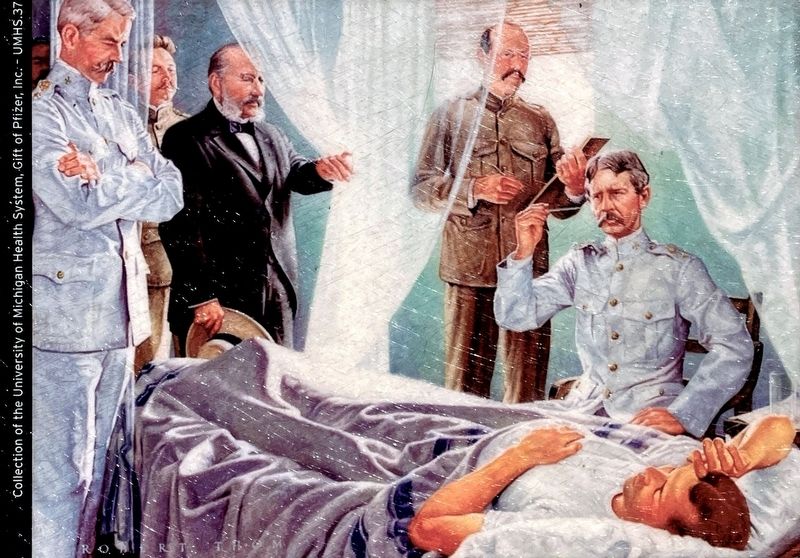
While on the faculty at the Army Medical School, Major Walter Reed chaired the commission proving that mosquitoes carry the yellow fever virus. In this Robert Thom painting, members of the commission working in Cuba are shown left to right, Major William Crawford Gorgas, Dr. Atistides Agramonte, Dr. Carlos Finlay, Dr. James Carroll, and Dr. (Maj.) Walter Reed (seated). The patients is the first study volunteer, Private John Kissinger.
[Captions on the back of the marker:]
The Army Medical School moved twice, once in 1910 (left) and again in 1916 (right) before being moved to the Army Medical Center at Walter Reed in 1923.
West and south facades of the Army Medical Museum & Library, Seventh Street & Independence Avenue Southwest, Washington, DC, where the Smithsonian's Hirshhorn Museum and Sculpture Garden building now stands.
Photographed by Wikipedia
4. Major William Cline Borden
Photographed by Borden Institute
5. Major Walter Reed
Photographed by Allen C. Browne, March 14, 2023
6. Yellow Fever Commission
While on the faculty at the Army Medical Center, Major Walter Reed chaired the commission proving that mosquitoes carry yellow fever virus. In this Robert Thom painting, members of the commission working in Cuba are shown left to right, Major William Crawford Gorgis, Dr. Aristides Agramonte, Dr. Carlos Finlay, Dr. James Carroll, and Dr. (Maj.) Walter Reed (seated). The patient is the first study volunteer, Private John Kissinger.
Close-up of photo on marker
Photographed by Devry Becker Jones (CC0), December 24, 2019
7. Signage on the perimeter of the former Walter Reed Army Medical Center
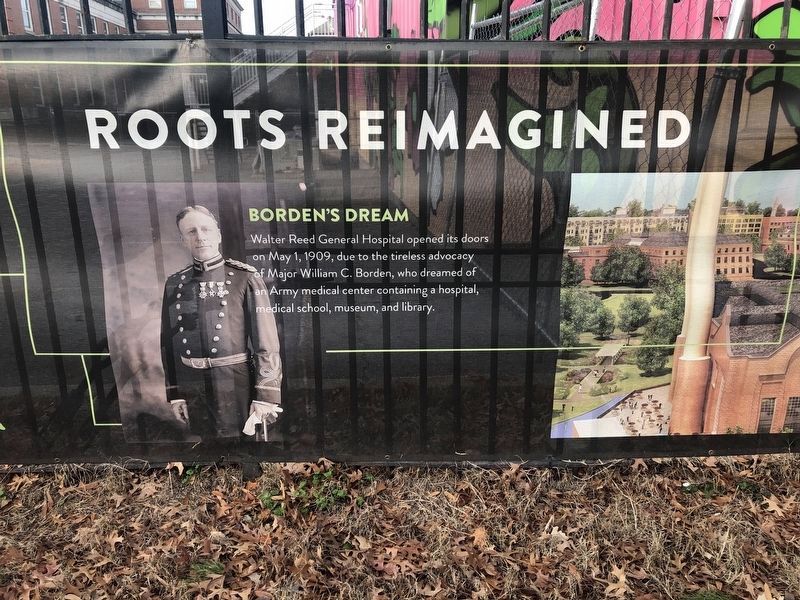
Borden's Dream
Walter Reed General Hospital opened its doors on May 1, 1909, due to the tireless advocacy of Major William C. Borden, who dreamed of an Army medical center containing a hospital medical school, museum, and library.
Walter Reed General Hospital opened its doors on May 1, 1909, due to the tireless advocacy of Major William C. Borden, who dreamed of an Army medical center containing a hospital medical school, museum, and library.
Credits. This page was last revised on April 3, 2023. It was originally submitted on December 20, 2019, by Devry Becker Jones of Washington, District of Columbia. This page has been viewed 531 times since then and 32 times this year. Photos: 1, 2, 3. submitted on December 20, 2019, by Devry Becker Jones of Washington, District of Columbia. 4, 5, 6. submitted on March 28, 2023, by Allen C. Browne of Silver Spring, Maryland. 7. submitted on December 24, 2019, by Devry Becker Jones of Washington, District of Columbia.
