
Former Walter Reed Army Medical Center in Northwest Washington in Washington, District of Columbia — The American Northeast (Mid-Atlantic)
WRAMC - Modern Era
Former Walter Reed Army Medical Center
| — | Walking Tour | — |
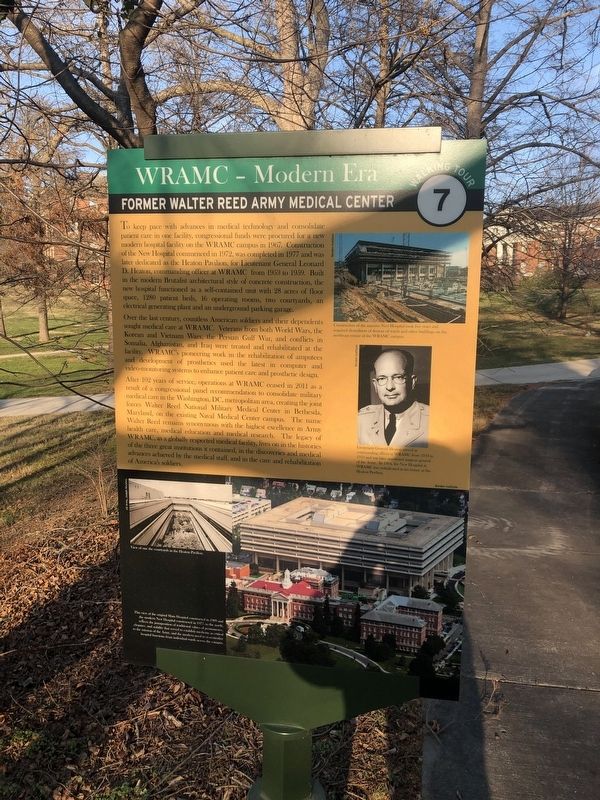
Over the last century, countless American soldiers and their dependents sought medical care at WRAMC. Veterans from both World Wars, the Korean and Vietnam Wars, the Persian Gulf War, and conflicts in Somalia, Afghanistan, and Iraq were treated and rehabilitate at the facility. WRAMC's pioneering work in the rehabilitation of amputees and development of prosthetics used the latest in computer and video-monitoring systems to enhance patient care
this page online
After 102 years of service, operations at WRAMC ceased in 2011 as a result of a congressional panel recommendation to consolidate military medical care in the Washington, DC, metropolitan area, creating the joint forces Walter Reed National Military Medical Center in Bethesda, Maryland, on the existing Naval Medical Center campus. The name Walter Reed remains synonymous with the highest excellence in Army health care, medical education and medical research. The legacy of WRAMC, as a globally respected medical facility, lives on in the histories of the three great institutions it contained, in the discoveries and medical advances achieved by the medical staff, and in the care and rehabilitation of America's soldiers. (Marker Number 7.)
Topics. This historical marker is listed in these topic lists: Architecture • Education • Military • Science & Medicine. A significant historical year for this entry is 1967.
Location. 38° 58.413′ N, 77° 1.76′ W. Marker is in Northwest Washington in Washington, District of Columbia. It is in Former Walter Reed Army Medical Center. It can be reached from Main Drive
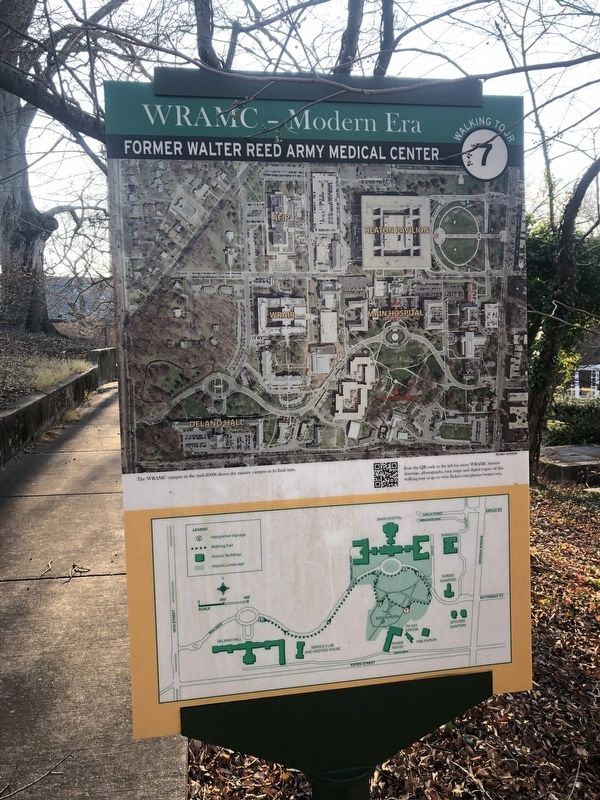

Regionally, this marker is in the Washington Metropolitan Area. It is also in the American Northeast, in the Upper South, in the Mid-Atlantic, in the Tidewater, and in the Chesapeake Bay Region. Globally, it is in North America, the Western Hemisphere, the Western World, and the Anglosphere.
Other nearby markers. At least 8 other markers are within walking distance of this marker: Cameron's Creek and the Rose Garden (within shouting distance of this marker); Battle of Fort Stevens (about 300 feet away, measured in a direct line); Borden's Dream (about 300 feet away); Borden's Dream Realized (about 400 feet away); Walter Reed General Hospital (about 400 feet away); Site of a Tulip Tree (about 400 feet away); Walter Reed Army Medical Center (about 500 feet away); a different marker also named Walter Reed Army Medical Center (about 500 feet away). Touch for a list and map of all markers in Northwest
More about this marker.
[Captions:]
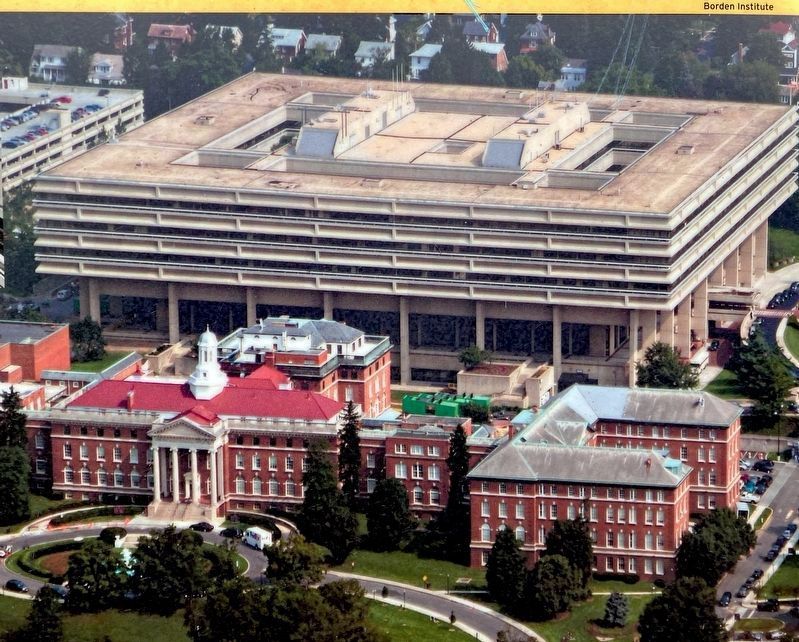
Construction of the massive New Hospital took five years and required demolition of dozens of wards and other buildings on the northeast corner of the WRAMC campus.
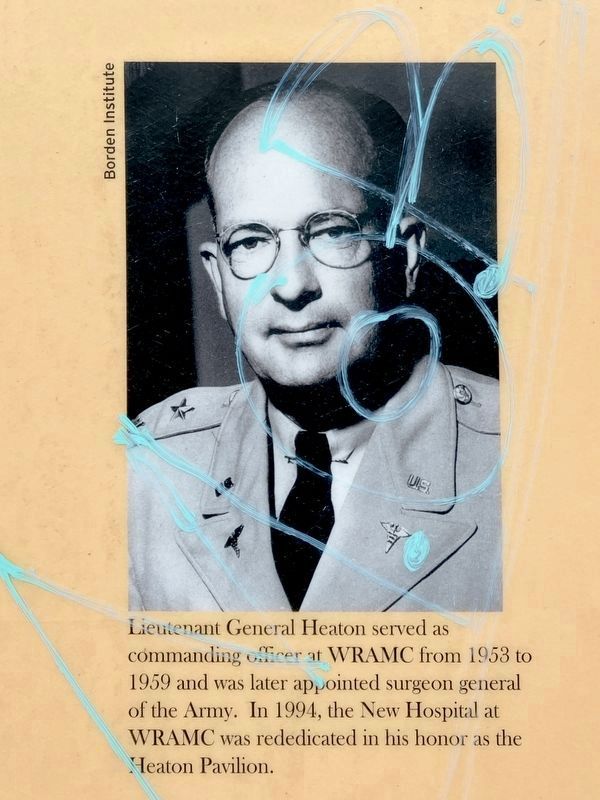
Lieutenant General Heaton served as commanding officer at WRAMC from 1953 to 1959 and was later appointed surgeon general of the Army. In 1994, the New Hospital at WRAMC was rededicated in his honor as the Heaton Pavilion.
This view of the original Main Hospital constructed in 1909 and the modern New Hospital constructed in 1977, to the north, reflects the juxtaposition of traditional values of permanence, elegance, and stability that served to establish medicine as critical to the mission of the Army, and the modern need to re-centralize hospital functions from individual wards across the campus.
Photographed by Allen C. Browne, March 18, 2023
4. General Heaton
Graffitied
Graffitied
Lieutenant General Heaton served as commanding officer at WRAMC form 1953 to 1959 and was later appointed surgeon general of the Army. In 1994, the New Hospital at WRAMC was rededicated in his honor as the Heaton Pavilion.
Close-up of photo on marker
Photographed by Allen C. Browne, March 18, 2023
5. The Heaton Pavilion behind the old Main Building.
This view of the original Main Hospital constructed in 1909 and the modern New Hospital constructed in 1977, to the north, reflects the juxtaposition of traditional values of permanence elegance, and stability that served to establish medicine as critical to the mission of the Army, and the modern need to re-centralize hospital functions from individual wards across campus.
Close-up of photo on marker
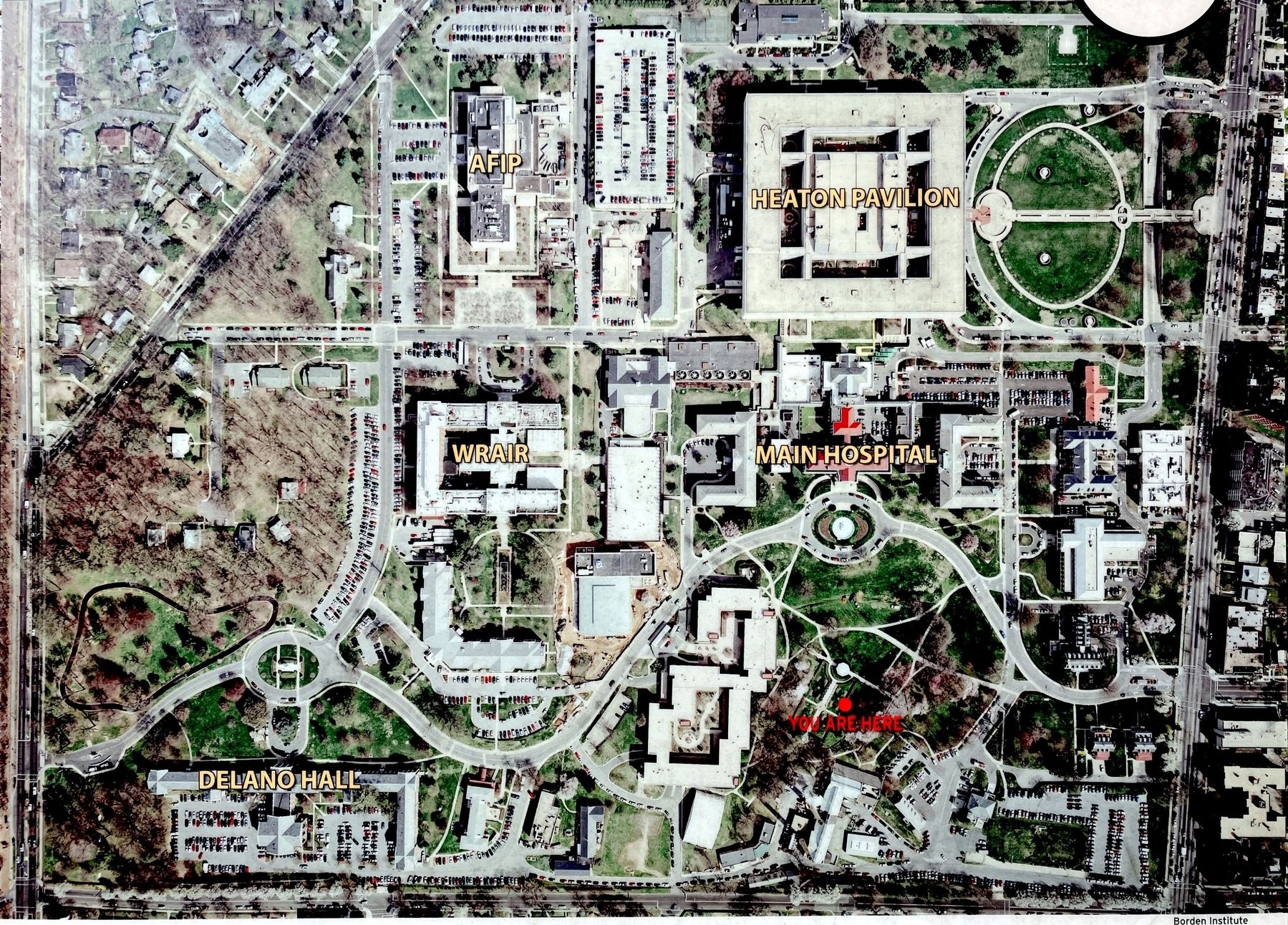
[In 2023, the brutalist Heaton Pavilion has been torn down, but the Georgian revival Main Hospital Building remains.]
[In 2023, the brutalist Heaton Pavilion has been torn down, but the Georgian revival Main Hospital Building remains.]
Photographed by Allen C. Browne, March 18, 2023
6. You Are Here
Photographed by Devry Becker Jones (CC0), December 24, 2019
7. Signage on the perimeter of the former Walter Reed Army Medical Center
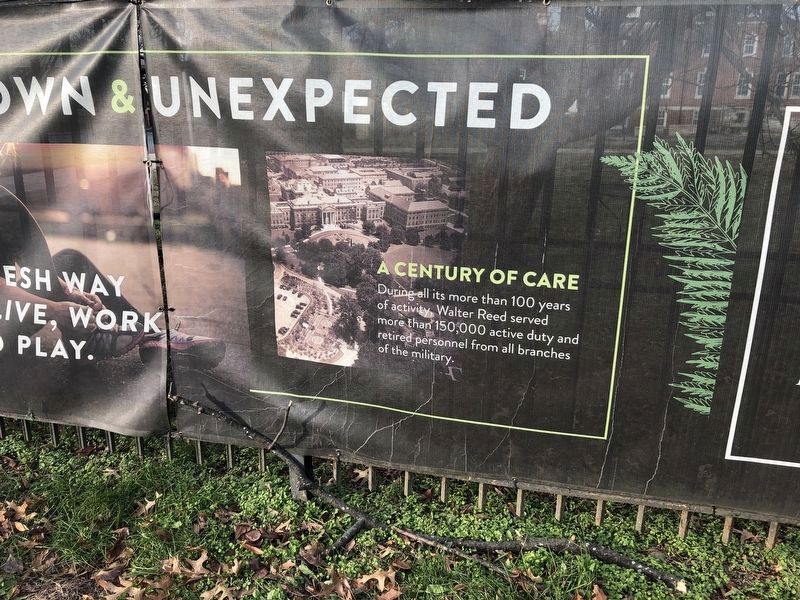
A Century of Care
During all its more than 100 years of activity, Walter Reed served more than 150,000 active duty and retired personnel from all branches of the military.
During all its more than 100 years of activity, Walter Reed served more than 150,000 active duty and retired personnel from all branches of the military.
Credits. This page was last revised on April 3, 2023. It was originally submitted on December 20, 2019, by Devry Becker Jones of Washington, District of Columbia. This page has been viewed 1,200 times since then and 89 times this year. Photos: 1, 2, 3. submitted on December 20, 2019, by Devry Becker Jones of Washington, District of Columbia. 4, 5, 6. submitted on March 29, 2023, by Allen C. Browne of Silver Spring, Maryland. 7. submitted on December 24, 2019, by Devry Becker Jones of Washington, District of Columbia.
