Fredericksburg, Virginia — The American South (Mid-Atlantic)
Ferries and Flats
Photographed by Craig Swain, December 13, 2008
1. Ferries and Flats Marker
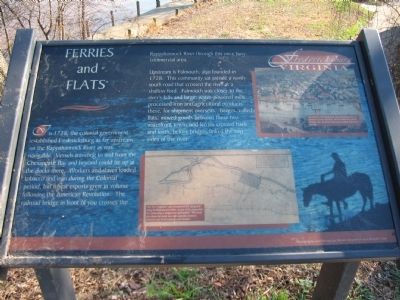
Upstream is Falmouth, also founded in 1728. This community sat astride a north-south road that crossed the river at a shallow ford. Falmouth was closer to the river's falls and large, water-powered mills processed iron and agricultural products there, for shipment overseas. Barges called flats, moved goods between these two waterfront towns and ferries crossed back and forth, before bridges linked the two sides of the river.
Topics. This historical marker is listed in these topic lists: Industry & Commerce • Waterways & Vessels. A significant historical year for this entry is 1728.
Location. Marker has been permanently removed. It was located near 38° 18.088′ N, 77° 27.362′ W.
this page online
We have been informed that this marker is no longer there and will not be replaced. This page is an archival view of what was.
Regionally, this marker was in the Washington Metropolitan Area and in Northern Virginia. It was also in the American South and specifically in the Upper South. Globally, it was in North America, the Western Hemisphere, the Western World, and the Anglosphere. Historically, it found itself in what was once the territory of the Mississippian Culture, one of the original Thirteen Colonies, one of the Confederate States of America, and the Antebellum South.

Other nearby markers. At least 8 other markers are within walking distance of this location: The sandstone blocks… (a few steps from this marker); This natural rise in the landscape… (within shouting distance of this marker); 1846-47 / Philip Y. Wyatt
Photographed by Craig Swain, December 13, 2008
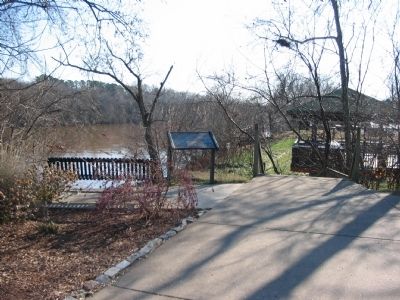
2. Ferries and Flats Marker
Other markers no longer nearby. Shiloh Baptist Church (Old Site) (was about 500 feet away but has been replaced with another marker now near it); African Baptist Church of Fredericksburg (was about 500 feet away but has been replaced with another marker now near it).
More about this marker. In the upper right is a painting of Fredericksburg around 1856. This detail from an 1856 lithograph depicts a busy Fredericksburg waterfront, just downstream of a wooden railroad bridge. Note the flat-bottomed ferry to the left. The barges or flats, that plied these waters to and from Falmouth would have been very similar.
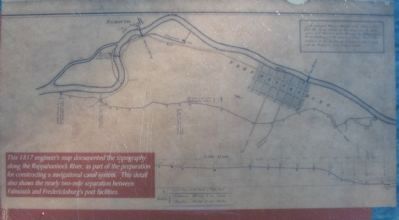
In the lower center is a map captioned: This 1817 engineer's map documented the topography along the Rappahannock River, as part of the preparation for constructing a navigational canal system. This detail also shows the nearly two-mile separation between Falmouth and Fredericksburg's port facilities.
Photographed by Craig Swain, December 13, 2008
3. Close up of the Map
Photographed by Craig Swain, December 13, 2008
4. Rappahannock River
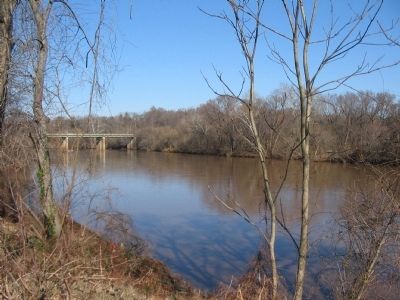
The King's Highway (Va. 3) Bridge crosses the river just upstream from the marker. Ultimately, the introduction of bridges, the first being wood and stone railroad bridges, meant the end of ferry and flat traffic on the river.
Credits. This page was last revised on May 16, 2025. It was originally submitted on December 14, 2008, by Craig Swain of Leesburg, Virginia. This page has been viewed 1,311 times since then and 31 times this year. Photos: 1, 2, 3, 4. submitted on December 14, 2008, by Craig Swain of Leesburg, Virginia.
