Missoula in Missoula County, Montana — The American West (Mountains)
Mrs. Lydia McCaffery's Furnished Rooms
Photographed by Barry Swackhamer, August 21, 2019
1. Mrs. Lydia McCaffery's Furnished Rooms Marker
Inscription.
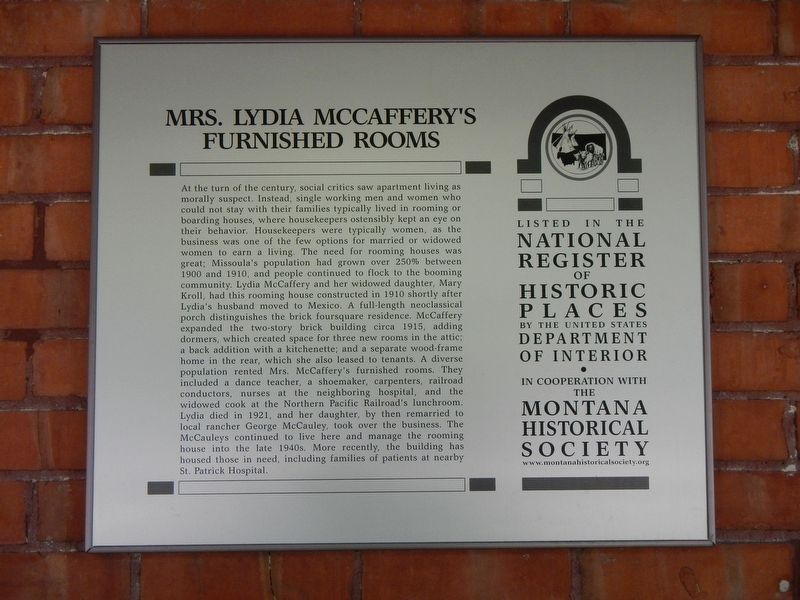
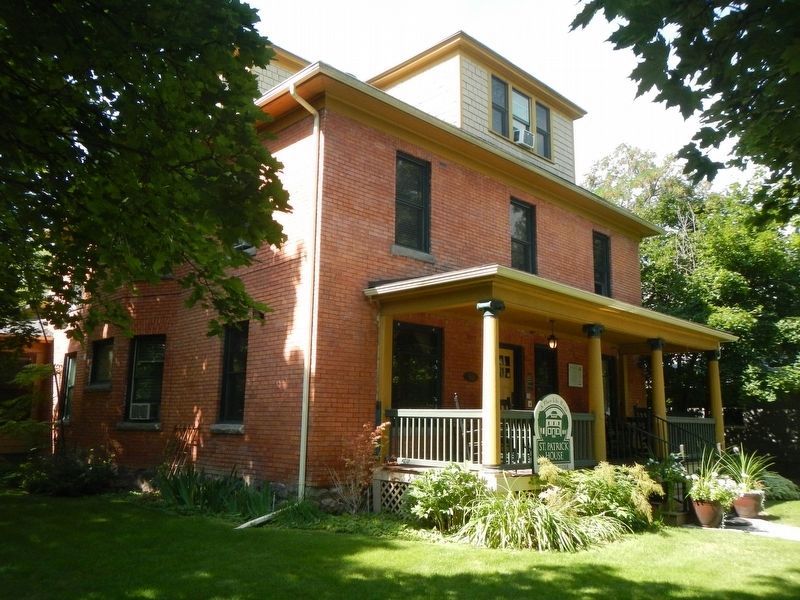
At the turn of the century, social critics saw apartment living as morally suspect. Instead, single working men and women who could not stay with their families typically lived in rooming or boardinghouses, where housekeepers ostensibly kept an eye on their behavior. Housekeepers were typically women, as the business was one of the few options for married or widowed women to earn a living. The need for rooming houses was great; Missoula’s population had grown over 250% between 1900 and 1910, and people continued to flock to the booming community. Lydia McCaffery and her widowed daughter, Mary Kroll, had this rooming house constructed in 1910 shortly after Lydia’s husband moved to Mexico. A full-length neoclassical porch distinguishes the brick foursquare residence. McCaffery expanded the two-story brick building circa 1915, adding dormers, which created space for three new rooms in the attic; a back addition with a kitchenette; and a separate wood-frame home in the rear, which she also leased to tenants. A diverse population rented Mrs. McCaffery’s furnished rooms. They included a dance teacher, a shoemaker, carpenters,
Click or scan to see this page online
railroad conductors, nurses at the neighboring hospital, and the widowed cook at the Northern Pacific Railroad’s lunchroom. Lydia died in 1921, and her daughter, by then remarried to local rancher George McCauley, took over the business. The McCauleys continued to live here and manage the rooming house into the late 1940s. More recently, the building has housed those in need, including families of patients at nearby St. Patrick Hospital.
Erected by Montana National Register Sign Program.
Location. 46° 52.603′ N, 113° 59.908′ W. Marker is in Missoula, Montana, in Missoula County. It is at the intersection of West Alder Street and Owen Street, on the left when traveling west on West Alder Street. Touch for map. Marker is at or near this postal address: 501 West Alder Street, Missoula MT 59802, United States of America. Touch for directions.
Regionally, this marker is in Western Montana and in Glacier
Photographed by Barry Swackhamer, August 21, 2019
2. Mrs. Lydia McCaffery's Furnished Rooms Marker and House
The marker is on the porch.
Country. It is also in the American Mountain West and in the Lewis & Clark Corridor. Globally, it is in North America, the Rocky Mountains, the Western Hemisphere, the Western World, and the Anglosphere. Historically, it finds itself in what was once Rupert’s Land and also the Louisiana Purchase.
Credits. This page was last revised on January 14, 2020. It was originally submitted on January 14, 2020, by Barry Swackhamer of Brentwood, California. This page has been viewed 234 times since then and 22 times this year. Photos:1, 2. submitted on January 14, 2020, by Barry Swackhamer of Brentwood, California.