Near West Liberty in Logan County, Ohio — The American Midwest (Great Lakes)
Industry on the Macacheek
They Lived Long on the Land
Photographed by Joel Seewald, October 12, 2019
1. Industry on the Macacheek Marker
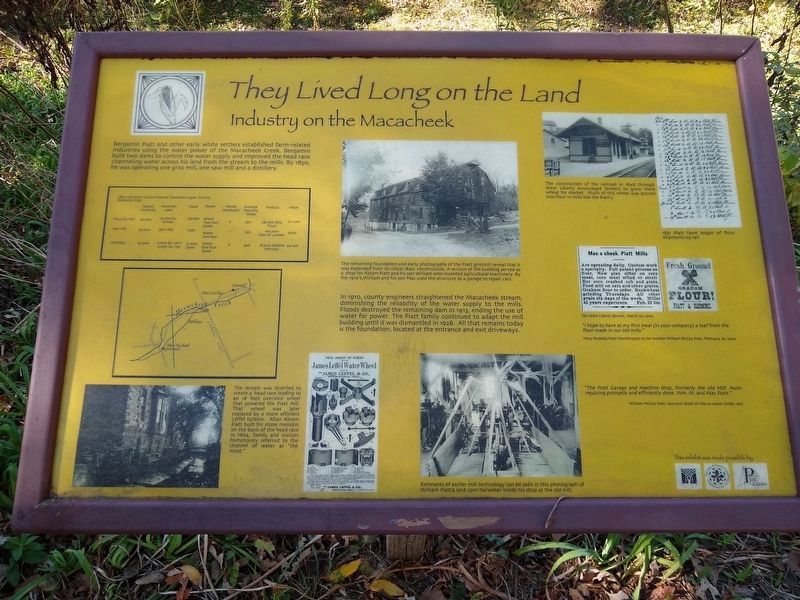
Benjamin Piatt and other early white settlers established farm-related industries using the water power of the Macacheek Creek. Benjamin built two dams to control the water supply and improved the head race channeling water across his land from the stream to the mills. By 1850, he was operating one grist mill, one saw mill and a distillery.
In 1910, county engineers straightened the Macacheek stream, diminishing the reliability of the water supply to the mills. Floods destroyed the remaining dam in 1913, ending the use of water for power. The Piatt family continued to adapt the mill building until it was dismantled in 1928. All that remains today is the foundation, located at the entrance and exit driveways.
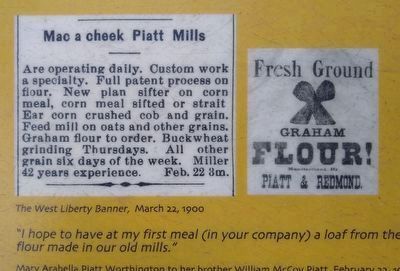
"I hope to have at my first meal (in your company) a loaf from the flour made in our mills."
Mary Arabella Piatt Worthington to her brother William McCoy Piatt, February 22, 1909
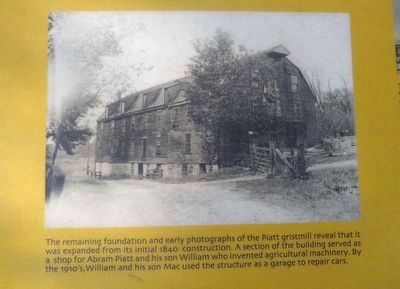
"The Piatt Garage and machine shop, formerly the old Mill. Auto repairing promptly and efficiently done. Wm. M. and Mac Piatt."
William McCoy Piatt, Souvenir Book of Mac-a-cheek Castle, 1917
Erected by Ohio Humanities
this page online
Topics. This historical marker is listed in these topic lists: Industry & Commerce • Settlements & Settlers. A significant historical date for this entry is February 22, 1909.
Location. 40° 15.064′ N, 83° 43.621′ W. Marker is near West Liberty, Ohio, in Logan County. It can be reached from Township Road 47 0.1 miles south of Ohio Route 245. Marker is behind the Mac-A-Cheek Castle, which is about 700 feet from Township Road 47. Touch for map. Marker is in this post office area: West Liberty OH 43357, United States of America. Touch for directions.

Regionally, this marker is in Ohio’s Till Plains. It is also in the American Midwest and in the Corn Belt. Globally, it is in North America, the Western Hemisphere, the Western World, and the Anglosphere. Historically, it finds itself in what was once the Viceroyalty of New France, the Haudenosaunee (Iroquois) Confederacy, the territory of the Mississippian Culture, and the Northwest Territory.
Other nearby markers. At least 8 other markers are within walking distance of this marker: Finding the Balance Between History & Legacy
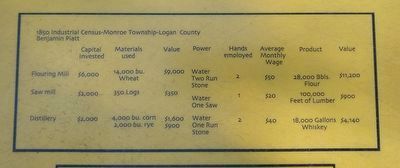
2. Industry on the Macacheek Marker — upper left image
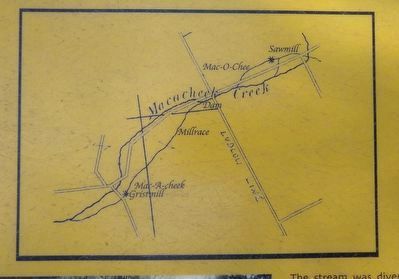
October 12, 2019
3. Industry on the Macacheek Marker — middle left image
October 12, 2019
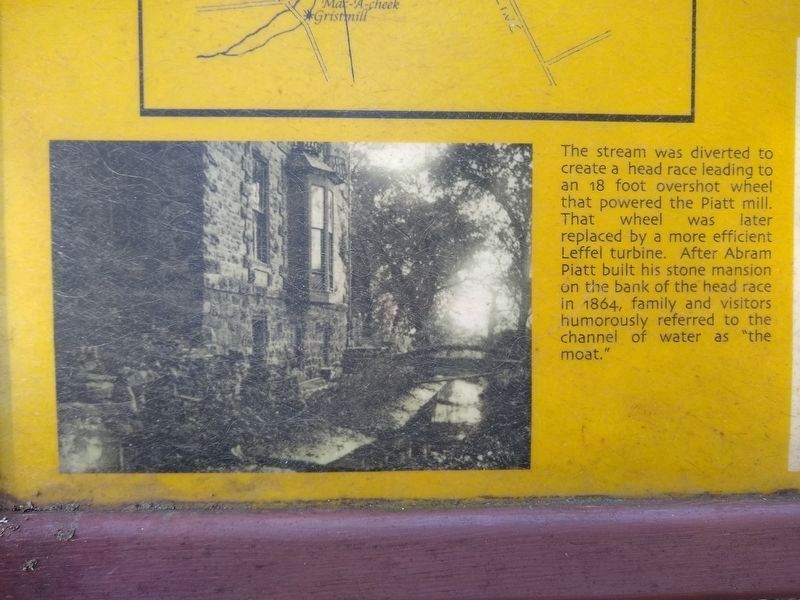
4. Industry on the Macacheek Marker — lower left image
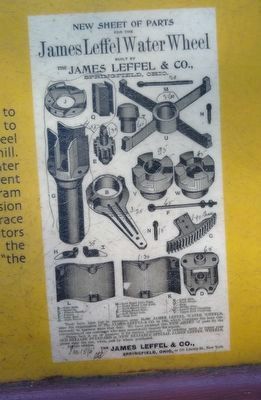
The stream was diverted to create a head race leading to an 18 foot overshot wheel that powered the Piatt mill. That wheel was later replaced by a more efficient Leffel turbine. After Abram Piatt built his stone mansion on the bank of the head race in 1864, family and visitors humorously referred to the channel of water as "the moat."
5. Industry on the Macacheek Marker — upper middle image
The remaining foundation and early photographs of the Piatt gristmill reveal that it was expanded from its initial 1840 construction. A section of the building served as a shop for Abram Piatt and his son William who invented agricultural machinery. By the 1910's, William and his son Mac used the structure as a garage to repair cars.
6. Industry on the Macacheek Marker — lower middle image
7. Industry on the Macacheek Marker — upper right images
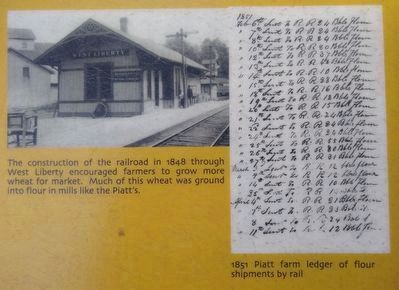
Left: The construction of the railroad in 1848 through West Liberty encouraged farmers to grow more wheat for market. Much of this wheat was ground into flour in mills like the Piatt's.
Right: 1851 Piatt farm ledger of flour shipments by rail
Right: 1851 Piatt farm ledger of flour shipments by rail
8. Industry on the Macacheek Marker — middle right images
The West Liberty Banner, March 22, 1900
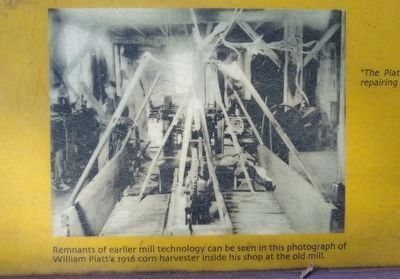
9. Industry on the Macacheek Marker — lower right image
Remnants of earlier mill technology can be seen in this photograph of William Piatt's 1916 corn harvester inside his shop at the old mill.
Credits. This page was last revised on January 23, 2020. It was originally submitted on January 17, 2020, by Joel Seewald of Madison Heights, Michigan. This page has been viewed 516 times since then and 27 times this year. Photos: 1, 2, 3, 4, 5, 6, 7, 8, 9. submitted on January 17, 2020, by Joel Seewald of Madison Heights, Michigan.
Editor’s want-list for this marker. Far view of the marker • Can you help?
