
Kahoka in Clark County, Missouri — The American Midwest (Upper Plains)
Clark County
Photographed by Michael E Sanchez, Jr., March 24, 2017
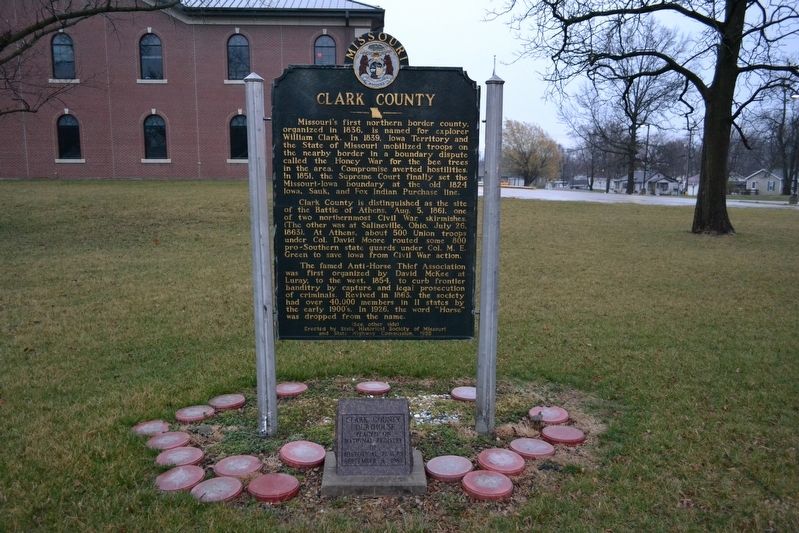
1. Clark County Marker front
Missouri's first northern border county, organized in 1836, is named for explorer William Clark. In 1839, Iowa Territory and the State of Missouri mobilized troops on the nearby border in a boundary dispute called the Honey War for the bee trees in the area. Compromise averted hostilities. In 1851, the Supreme Court finally set the Missouri-Iowa boundary at the old 1824 Iowa, Sauk [Sac] and Fox Indian Purchase Line.
Clark County is distinguished as the site of the Battle of Athens, Aug. 5, 1861, one of two northernmost Civil War Skirmishes, (The other was at Salineville, Ohio, July 26, 1863). At Athens, about 500 Union troops under Col. David Moore routed some 800 pro-Southern guards under Col. M.E. Green to save Iowa from Civil War action.
The famed Anti-Horse Thief Association was first organized by David McKee at Luray, to the west, 1854, to curb frontier banditry by capture and legal prosecution of criminals. Revived in 1863, the society had over 40,000 members in 11 states by the early 1900's. In 1926, the word "Horse" was dropped from the name.
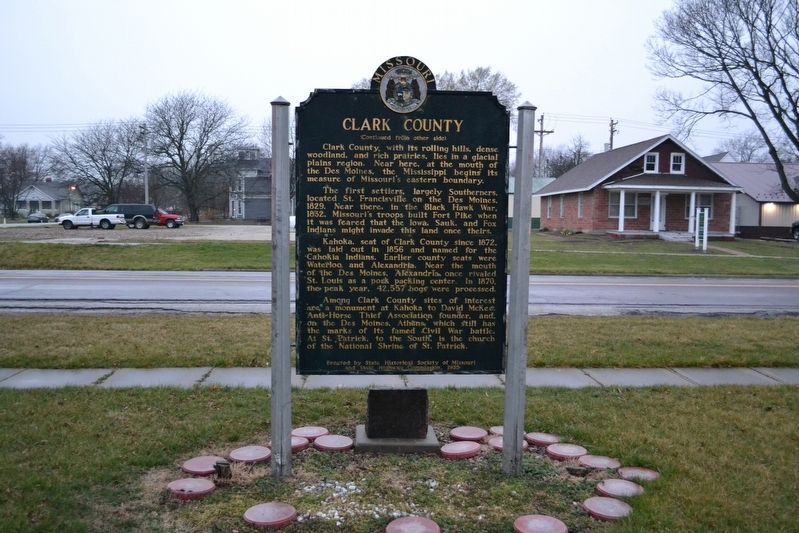
Clark County, with its rolling hills, dense woodland, and rich prairies, lies in a glacial plains region. Near here, at the mouth of the Des Moines, the Mississippi begins its measure of Missouri's eastern boundary.
The first settlers, largely
this page online
Kahoka, seat of Clark County since 1872, was laid out in 1856 and named for the Cahokia Indians. Earlier county seats were Waterloo and Alexandria. Near the mouth of the Des Moines, Alexandria once rivaled St. Louis as a pork packing center. In 1870, the peak year, 42,557 hogs were processed.
Among Clark County sites of interest are a monument at Kahoka to David McKee, Anti-Horse Thief Association founder, and, on the Des Moines, Athens, which still has the marks of its famed Civil War battle. At St. Patrick, to the south, is the church of the National Shrine of St. Patrick.
Erected 1955 by State Historical Society of Missouri and State Highway Commission.
Topics and series. This historical marker is listed in these topic lists: Industry & Commerce • Settlements & Settlers • War, US Civil. In addition, it is included in the Missouri, The State Historical Society of series list. A significant historical date for this entry is July 26, 1836.
Location. 40° 25.481′ N, 91° 43.158′ W. Marker is in Kahoka, Missouri, in Clark County. It is on North
Photographed by Michael E Sanchez, Jr., March 24, 2017
2. Clark County Marker back

Regionally, this marker is in North Missouri. It is also in the American Lewis & Clark Corridor, in the Corn Belt, and in the Great River Road Region. Globally, it is in North America, the Western Hemisphere, the Western World, and the Anglosphere. Historically, it finds itself in what was once the territory of the Mississippian Culture, the Louisiana Purchase, and the Antebellum South.
Other nearby markers. At least 8 other markers are within 11 miles of this marker, measured as the crow flies: Iliniwek Village State Historic Site (approx. 8½ miles away); Archeology (approx. 8½ miles away); Origins, Groups, and Encounters (approx. 8½ miles away); Daily Village Life (approx. 8½ miles away); The Illinois in History (approx. 8½ miles away); Marquette and Joliet (approx. 8½ miles away); The Longhouse (approx. 8.7 miles away); Jane Gray House Foundation (approx. 11.1 miles away).
Credits. This page was last revised on November 22, 2024. It was originally submitted on January 17, 2020, by Michael E Sanchez, Jr. of Kansas City, Missouri. This page has been viewed 744 times since then and 40 times this year. Photos: 1, 2. submitted on January 19, 2020, by Michael E Sanchez, Jr. of Kansas City, Missouri. • Bernard Fisher was the editor who published this page.
