Ellicott City in Howard County, Maryland — The American Northeast (Mid-Atlantic)
B&O Railroad Station
Keep Supplies Moving
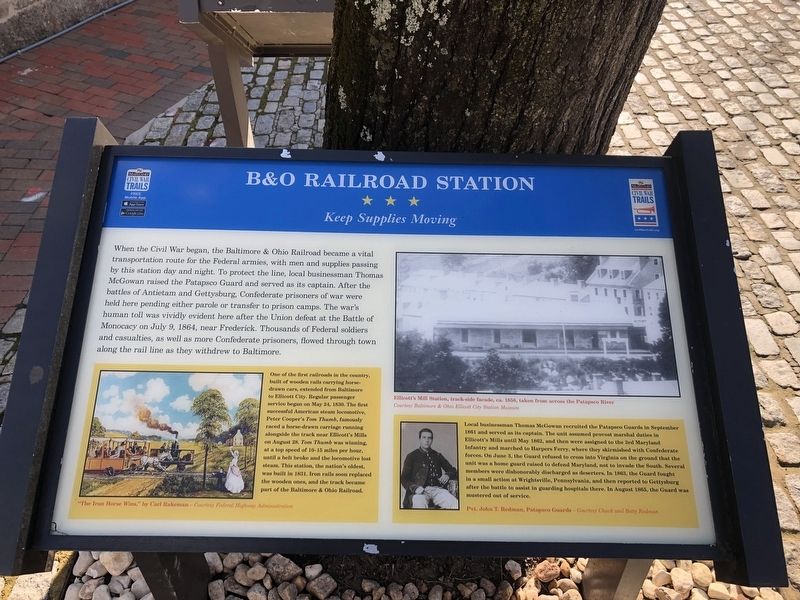
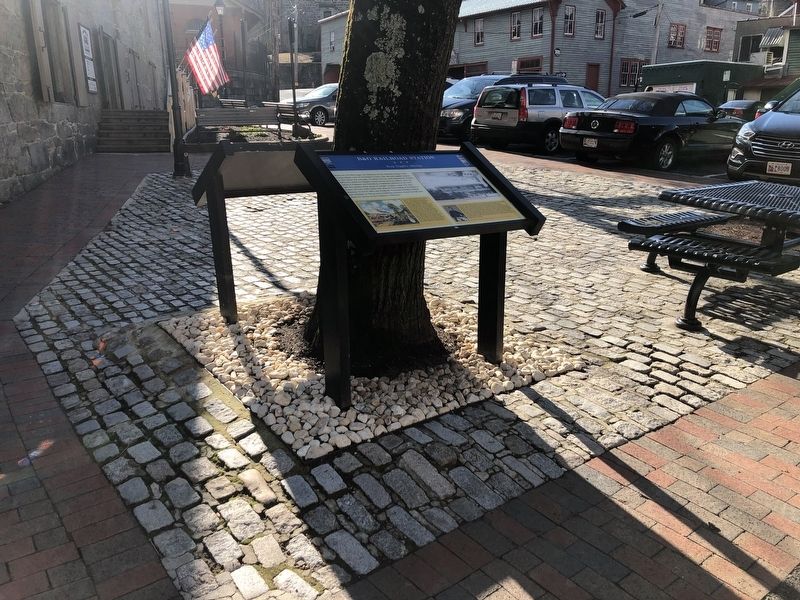
When the Civil War began, the Baltimore & Ohio Railroad became a vital transportation route for the Federal armies, with men and supplies passing by this station day and night. To protect the line, local businessman Thomas McGowan raised the Patapsco Guard and served as its captain. After the battles of Antietam and Gettysburg, Confederate prisoners of war were held here pending either parole or transfer to prison camps. The war's human toll was vividly evident here after the Union defeat at the Battle of Monocacy on July 9, 1864, near Frederick. Thousands of Federal soldiers and casualties, as well as more Confederate prisoners, flowed through town along the rail line as they withdrew to Baltimore.
[Sidebars:]
One of the first railroads in the country, built of wooden rails carrying horse-drawn carts, extended from Baltimore to Ellicott City. Regular passenger service began on May 24, 1830. The first successful American steam locomotive, Peter Cooper's Tom Thumb, famously raced a horse-drawn carriage running alongside the track near Ellicott's Mills on August 28. Tom Thumb was winning at a top speed of 10-15 miles per hour, until a belt broke and the locomotive lost steam. This station, the nation's oldest, was built in 1831. Iron rails soon replaced the wooden ones, and the track became part of the Baltimore & Ohio Railroad.
Local businessman Thomas McGowan recruited the Patapsco Guards in September 1861 and served as its captain. The unit assumed provost marshal duties in Ellicott's Mills until 1862, and then were assigned to the 3rd Maryland Infantry and marched to Harpers Ferry, where they skirmished with Confederate forces. On June 3, the Guard refused to cross into Virginia on the ground that the unit was a home guard raised to defend Maryland, not to invade the South. Several members were dishonorably discharged as deserters. In 1863, the Guard fought in a small action at Wrightsville, Pennsylvania, and then reported to Gettysburg after the battle to assist in guarding hospitals there. In August 1865, the guard was mustered out of service.
Erected by Maryland
this page online
Topics and series. This historical marker is listed in these topic lists: Animals • Railroads & Streetcars • War, US Civil. In addition, it is included in the Baltimore and Ohio Railroad (B&O), the Maryland Civil War Trails, and the National Historic Landmarks series lists. A significant historical date for this entry is May 24, 1830.
Location. 39° 16.057′ N, 76° 47.705′ W. Marker is in Ellicott City, Maryland, in Howard County. It is at the intersection of Main Street (Maryland Route 144) and Maryland Avenue, on the right when traveling east on Main Street. Touch for map. Marker is at or near this postal address: 8030 Main Street, Ellicott City MD 21043, United States of America. Touch for directions.

Regionally, this marker is in the Baltimore Metro Region and in Central Maryland. It is also in the American Mid-Atlantic and on the Eastern Seaboard. Globally, it is in the North Atlantic Region, North America, the Western Hemisphere, the Western World, and the Anglosphere. Historically, it finds itself in what was once one of the original Thirteen Colonies and also the Antebellum South.
Other nearby markers. At
Other markers no longer nearby. Roads versus Rails (was here, next to this marker but has been permanently removed); Road Versus Rails (was a few steps from this marker but has been replaced with another marker now near it); a different marker also named B&O Railroad Station (was a few steps from this marker but has been replaced with another marker now near it); The Phoenix Emporium (was within shouting distance of this marker but has been permanently removed); a different marker also named
Photographed by Tom Fuchs, January 13, 2007
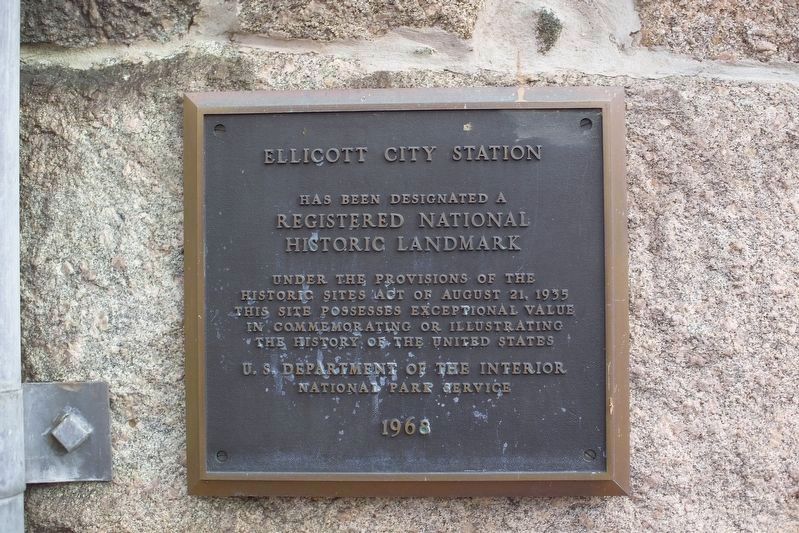
3. Ellicott City Station is a Landmark
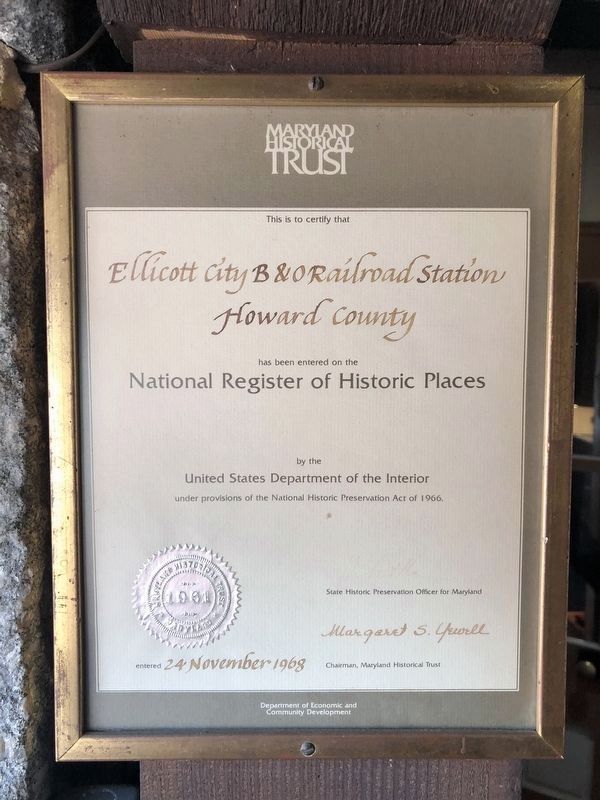
Ellicott City Station has been designated a Registered National Historic Landmark under the provisions of the Historic Sites Act of August 21, 1935. This site possesses exceptional value in commemorating or illustrating the history of the United States. U.S. Department of the Interior, National Park Service. 1968.
Related marker. Click here for another marker that is related to this marker. This marker replaces the linked marker.
Credits. This page was last revised on December 26, 2023. It was originally submitted on January 19, 2020, by Devry Becker Jones of Washington, District of Columbia. This page has been viewed 698 times since then and 48 times this year. Photos: 1, 2. submitted on January 19, 2020, by Devry Becker Jones of Washington, District of Columbia. 3. submitted on February 6, 2007, by Tom Fuchs of Greenbelt, Maryland. 4. submitted on January 19, 2020, by Devry Becker Jones of Washington, District of Columbia.
