
Oakmore in Piedmont in Alameda County, California — The American West (Pacific Coastal)
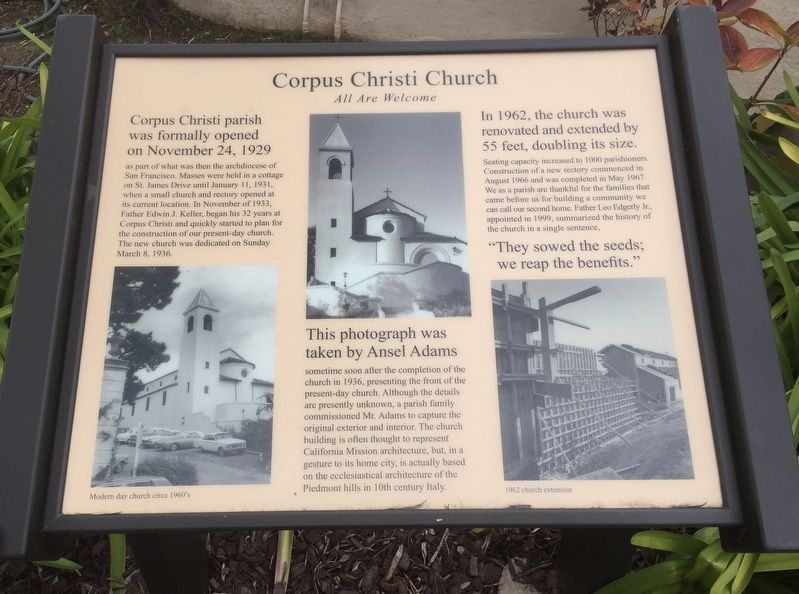
Corpus Christi Church
All Are Welcome
Photographed by Andrew Ruppenstein, January 19, 2020
1. Corpus Christi Church Marker
In 1962, the church was renovated and extended by
55 feet, doubling its size.
Seating capacity increased to 1000 parishioners.
Construction of a new rectory commenced in
August 1966 and was completed in May 1967.
We as a parish are thankful for the families that
came before us for building a community we
can call our second home. Father Leo Edgerly Jr.,
appointed in 1999, summarized the history of
the church in a single sentence, "They sowed the seeds;
we reap the benefits."
Topics. This historical marker is listed in this topic list: Religion & Religious Structures. A significant historical date for this entry is January 11, 1931.
Location. 37° 48.779′ N, 122° 12.892′ W.
this page online

Regionally, this marker is in California’s San Francisco Bay Area and on the Coast Ranges. It is also on the American Pacific Coast. Globally, it is in North America, on the Ring of Fire, in the Pacific Rim, in the Western Hemisphere, in the Western World, and in the Anglosphere. Historically, it finds itself in what was once New Spain and also Mexico’s Alta California.
Other nearby markers. At least 8 other markers are within 2 miles of this marker, measured as the crow flies: Leimert Bridge (about 300 feet away, measured in a direct line); a different marker also named Leimert Bridge (about 700 feet away); Voyage of the Brooklyn (approx. 0.9 miles away); Shepherd Canyon Highway That Almost Was (approx. one mile away); The Railroad History of Shepherd Canyon (approx. one mile away); The Japanese Teahouse (approx. 1.1 miles away); Piedmont
Photographed by Andrew Ruppenstein, January 19, 2020
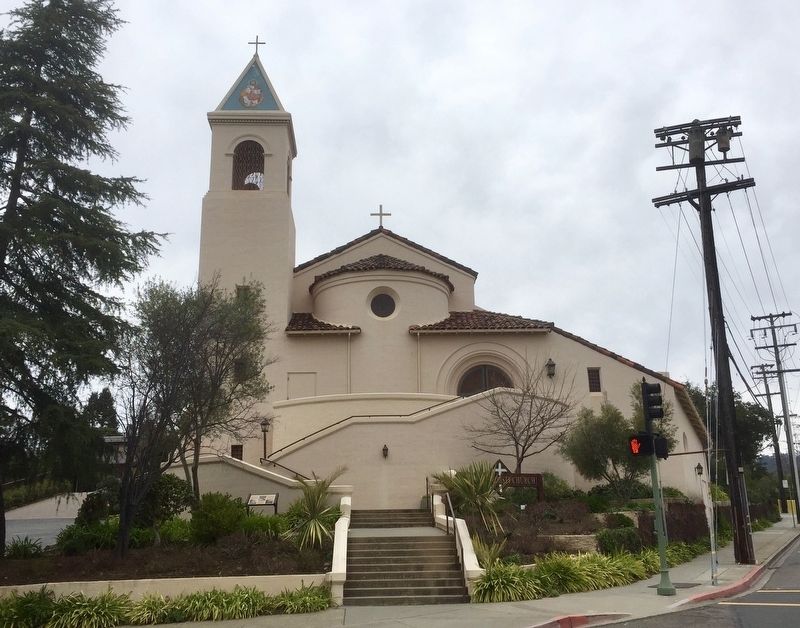
2. Corpus Christi Church Marker - wide view
The marker is visible here to the left of the staircase, after the first flight of steps.
Photographed by Ansel Adams, circa 1936
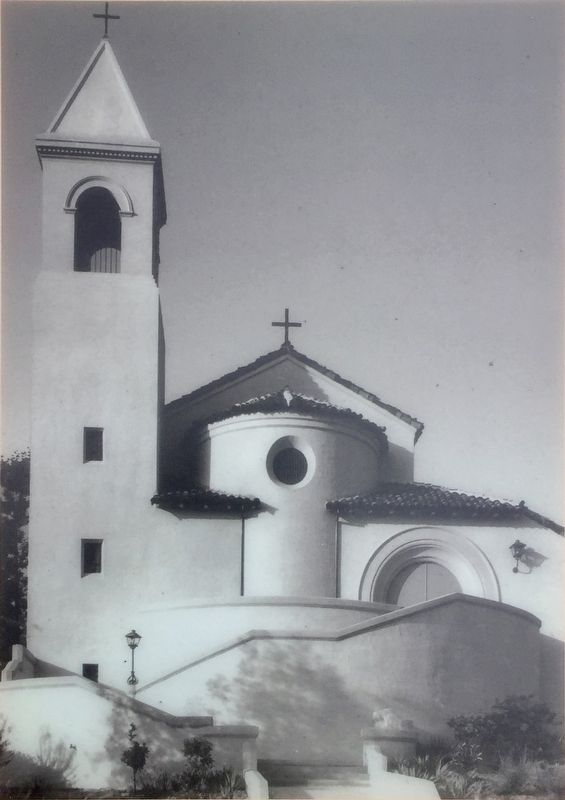
3. Marker photo of Corpus Christi Church
"This photograph was taken by Ansel Adams sometime soon after the completion of the church in 1936, presenting the front of the present-day church. Although the details are presently unknown, a parish family commissioned Mr. Adams to capture the original exterior and interior. The church building is often thought to represent California Mission architecture, but, in a gesture to its home city, is actually based on the ecclesiastical architecture of the Piedmont hills in 10th century Italy."

1962
4. Marker photo: church extension
Credits. This page was last revised on February 7, 2023. It was originally submitted on January 19, 2020, by Andrew Ruppenstein of Lamorinda, California. This page has been viewed 600 times since then and 79 times this year. Photos: 1, 2, 3, 4. submitted on January 19, 2020, by Andrew Ruppenstein of Lamorinda, California.
