New Delhi in Central Delhi District, National Capital Territory of Delhi, India — भारत (South Asia)
Diwan-i-Khas
Photographed by Shaw Zavoshy, January 17, 2020
1. Diwan-i-Khas Marker
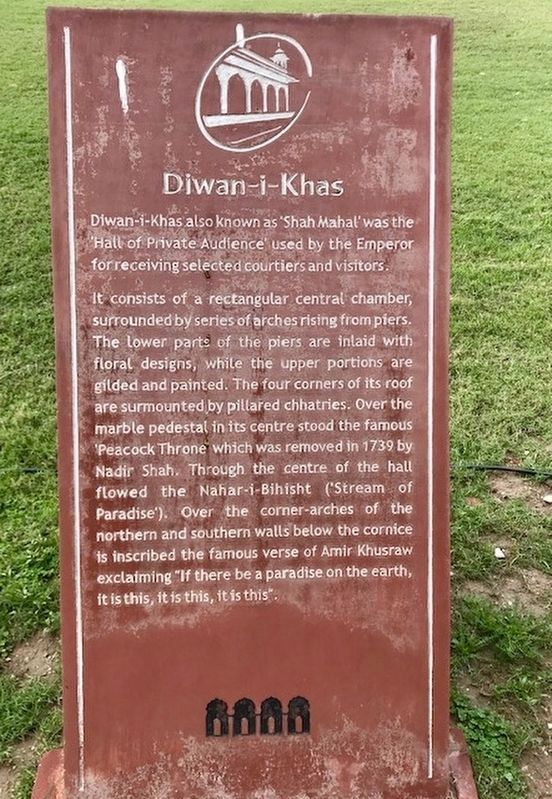
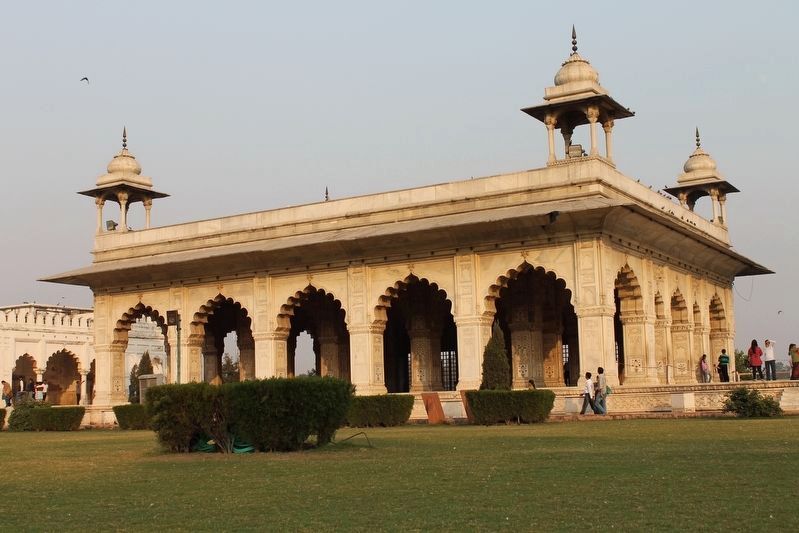
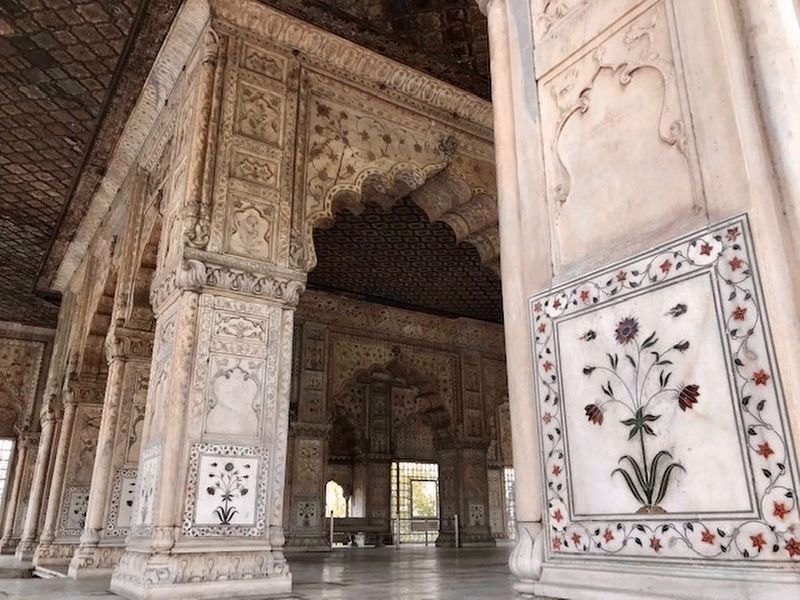
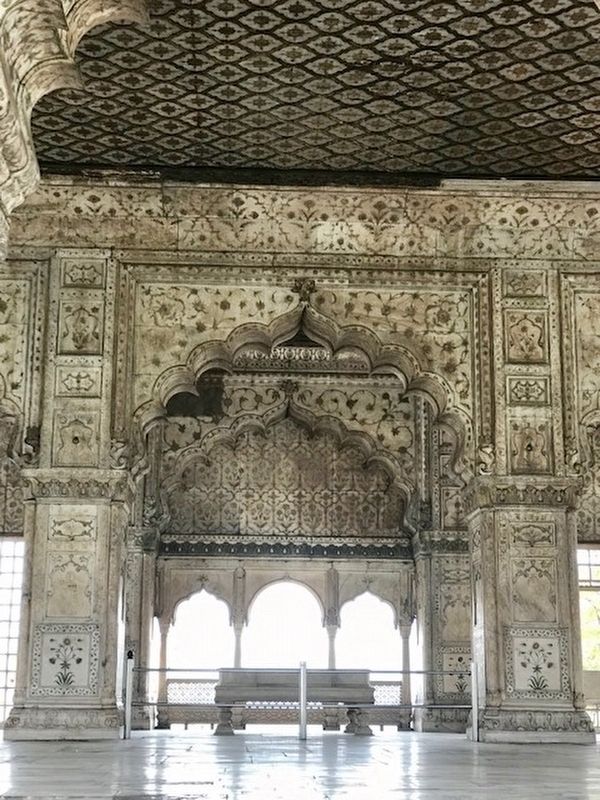
It consists of a rectangular central chamber, surrounded by series of arches rising from piers. The lower parts of the piers are inlaid with floral designs, while the upper portions are gilded and painted. The four corners of its roof are surmounted by pillared chhatries. Over the marble pedestal in its centre stood the famous 'Peacock Throne which was removed in 1739 by Nadir Shah. Through the centre of the hall flowed the Nahar-i-Bihisht ('Stream of Paradise'). Over the corner-arches of the northern and southern walls below the cornice is inscribed the famous verse of Amir Khusraw exclaiming "If there be a paradise on the earth, it is this, it is this, it is this".
Topics and series. This historical marker is listed in this topic list: Notable Buildings. In addition, it is included in the UNESCO World Heritage Sites series list. A significant historical year for this entry is 1739.
Location. 28° 39.386′ N, 77° 14.606′ E. Marker is in New Delhi, National Capital Territory
this page online

Regionally, it is in Asia, specifically in South Asia, in the Indian Subcontinent, on the Arabian Sea, on the Bay of Bengal, and in the Anglosphere. Historically, it finds itself in what was once the Mughal Empire, Portuguese colonies, and a British colony.
Other nearby markers. At least 2 other markers are within 16 kilometers of this marker, measured as the crow flies: Naubat Khana (approx. 0.2 kilometers away); Iron Pillar (approx. 15.7 kilometers away).
More about this marker. The marker is located in the Red Fort complex, in front of the Diwan-i-Khas building.
Also see . . . Diwan-i-Khas (Red Fort) (Wikipedia). "The Diwan-i-Khas (Persian: ديوان خاص), or Hall of Private Audiences, was a chamber in the Red Fort of Delhi built in 1571 as a location for receptions. It was the location where the Mughal Emperor Akbar received
Photographed by Kedar Kulkarni (via Wikimedia Commons under CC 3.0 license), December 6, 2011
2. Diwan-i-Khas and Marker
The backs of the English and Hindi versions of the marker are visible here in the gap between the hedges in front of the Diwan-i-Khas.
Photographed by Shaw Zavoshy, January 17, 2020
3. Diwan-i-Khas interior
Photographed by Shaw Zavoshy, January 17, 2020
4. Diwan-i-Khas interior
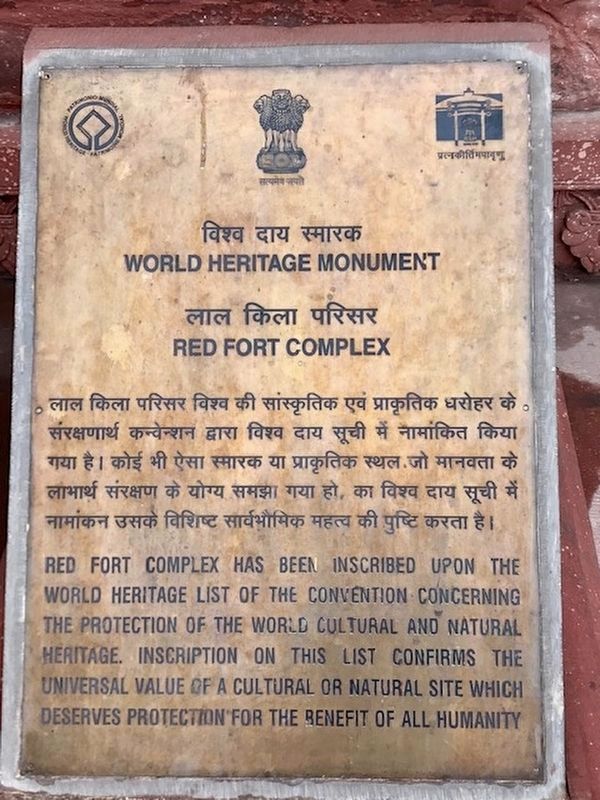
Photographed by Shaw Zavoshy, January 17, 2020
5. Nearby World Heritage plaque for the Red Fort
Credits. This page was last revised on May 22, 2026. It was originally submitted on January 23, 2020, by Andrew Ruppenstein of Lamorinda, California. This page has been viewed 2,189 times since then and 832 times this year. Photos: 1, 2, 3, 4. submitted on January 23, 2020, by Andrew Ruppenstein of Lamorinda, California. 5. submitted on January 23, 2020.
