Stille Wasser gründen tief...
⎯⎯⎯
Still Waters Run Deep
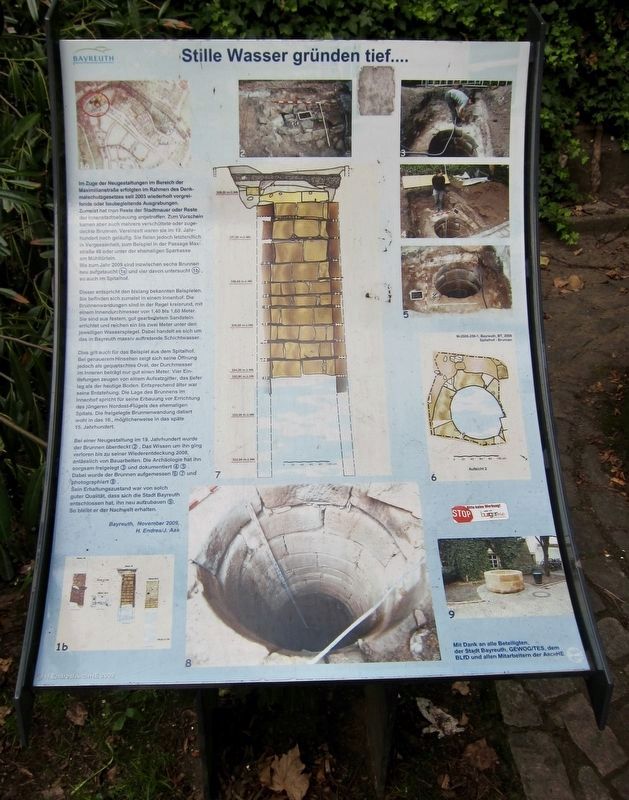

Bis zum Jahr 2009 sind inzwischen sechs Brunnen neu aufgetaucht (1a) und vier davon untersucht (1b) so auch im Spitalhof.
Dieser entspricht den bislang bekannten Beispielen. Sie befinden sich zumeist in einem Innenhof. Die Brunnenwandungen sind in der Regel kreisrund, mit einem Innendurchmesser von 1,40 bis 1,60 Meter. Sie sind aus festem, gut gearbeitetem Sandstein errichtet und reichen ein bis zwei Meter unter den jeweiligen Wasserspiegel. Dabei handelt es sich um das in Bayreuth massiv auftretende Schichtwasser.
Dies gilt auch für das Beispiel aus dem Spitalhof. Bei
this page online
Bei einer Neugestaltung im 19. Jahrhundert wurde der Brunnen überdeckt (2), Das Wissen um ihn ging verloren bis zu seiner Wiederentdeckung 2008, anlässlich von Bauarbeiten. Die Archäologie hat ihn sorgsam freigelegt (3) und dokumentiert (4)(5). Dabei wurde der Brünnen aufgemessen (6)(7) und photographiert (8), Sein Erhaltungszustand war von solch guter Qualität, dass sich die Stadt Bayreuth entschlossen hat, ihn neu aufzubauen (9). So bleibt er der Nachwelt erhalten.
Bayreuth, November 2009,
H. Endres/J. Aas
-
As of 2009, six wells have been discovered (1a), and of those, four were investigated (1b), including this one here in the Spital courtyard.
This well is similar to previously known examples.
Usually they are situated within a courtyard. The
well walls are usually circular, with
an inner diameter of 1.40 to 1.60 meters, made of solid, well-worked sandstone, and reach downwards from one to two meters below the
ground water level.
The above also applies to this example in the Spital courtyard.
A closer look reveals its opening,
however, as a compressed oval, and the inner diameter is just over a meter. Four indentations point to there having been a grille, located
During a redesign in the 19th century
the well was covered (2), and the knowledge of it was
lost until its rediscovery in 2008,
on the occasion of construction work. Archaeological investigation has
carefully exposed (3) and documented (4)(5) the well.
The well was measured (6)(7) and photographed (8),
and its state of preservation was of such
good quality that the city of Bayreuth
decided to rebuild it (9).
And so it is preserved for posterity.
Bayreuth, November 2009,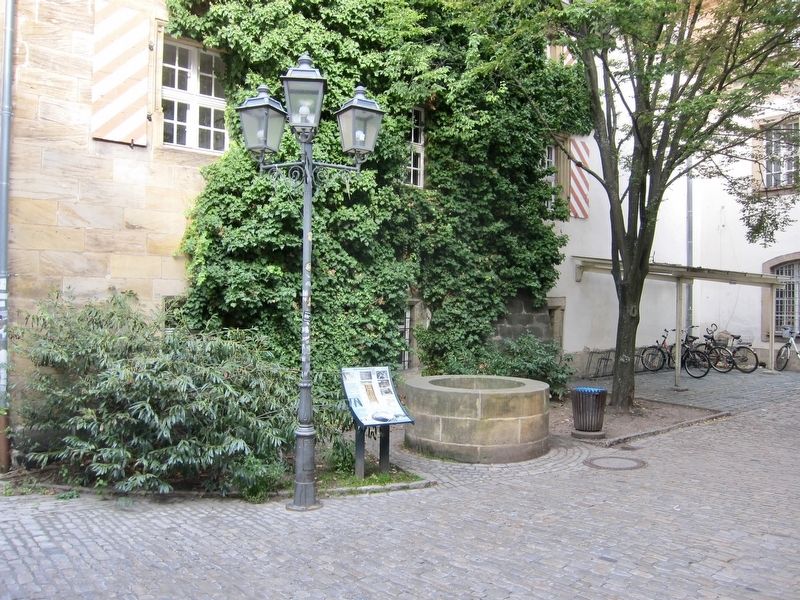
H. Endres/J. Aas
Erected 2009 by Stadt Bayreuth.
Topics. This historical marker is listed in this topic list: Man-Made Features. A significant historical month for this entry is November 2009.
Location. 49° 56.707′ N, 11° 34.293′ E. Marker is in Bayreuth, Bayern (Bavaria). It is on Maximilianstraße. Touch for map.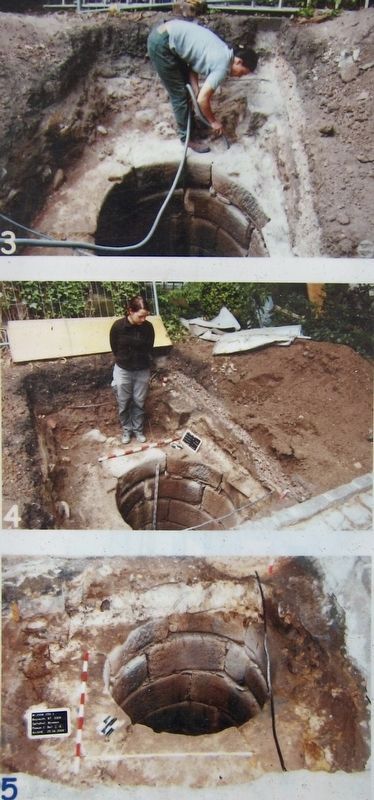

Regionally, this marker is in German Franconia. Globally, it is in Europe, the European Union, Atlantic Europe, Central Europe, the Schengen Area, Western Europe, and the Western World. Historically, it finds itself in what was once the Holy Roman Empire and also the former West Germany.
Other nearby markers. At least 8 other markers are within walking distance of this marker: Spitalkirche / "Spital" Church (within shouting distance of this marker); Dr. Jakob Herz (about 180 meters away, measured in a direct line); Michael Mebart (about 210 meters away); The Hotel Reichsadler (about 210 meters away); Die ersten drei Monate: Zürich I / The first three months: Zurich I (approx. 0.2 kilometers away); Max Stirner (approx. 0.3 kilometers away); Altes Rathaus / Old Town Hall (approx. 0.3 kilometers away); a different marker also named Max Stirner (approx. 0.3 kilometers away). Touch for a list and map of all markers in Bayreuth.
Another marker is no longer nearby. Ein grösserer Meister: Joseph Haydn / A Greater Master: Joseph Haydn (was approx. 0.2 kilometers away but has been permanently removed).
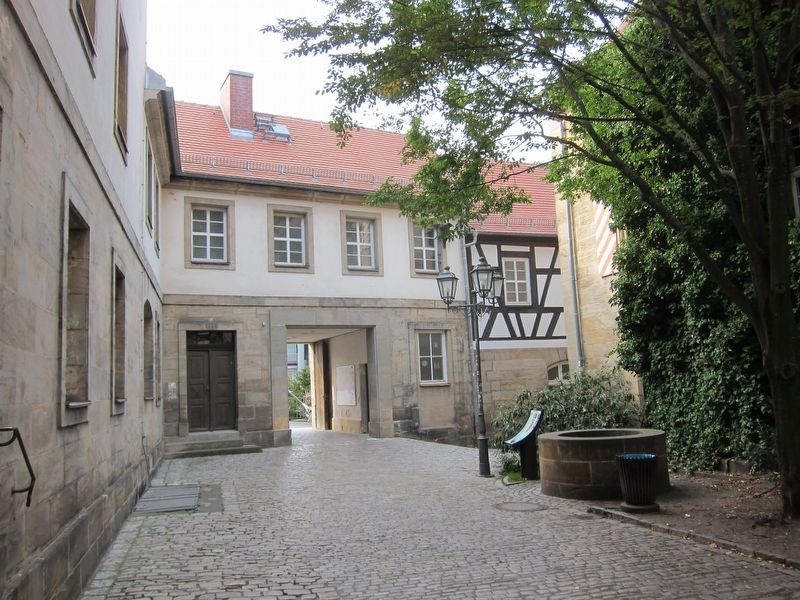
More about this marker. The marker is located in the inner courtyard of the Spital, and is accessible from the street.
Credits. This page was last revised on January 28, 2022. It was originally submitted on February 7, 2020, by Andrew Ruppenstein of Lamorinda, California. This page has been viewed 177 times since then and 5 times this year. Photos: 1, 2, 3, 4. submitted on February 7, 2020, by Andrew Ruppenstein of Lamorinda, California.
