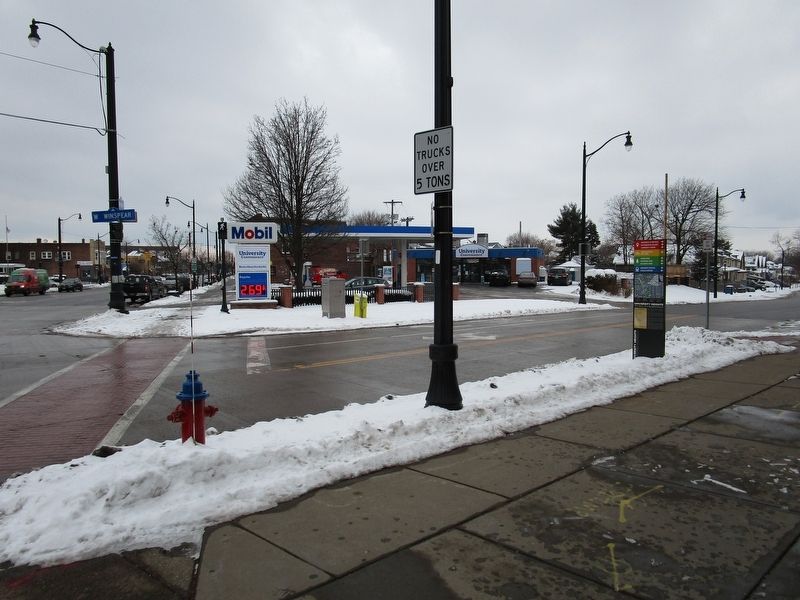
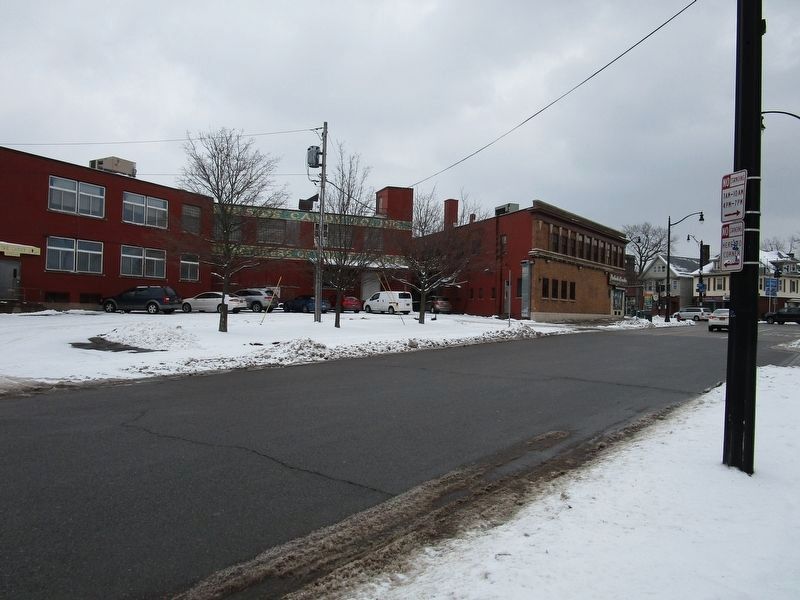
University Heights in Buffalo in Erie County, New York — The American Northeast (Mid-Atlantic)
Parkside Candy
A Neighborhood Landmark
⎯⎯⎯ University Heights
The Story of a Neighborhood
Photographed by Anton Schwarzmueller, February 9, 2020
1. Parkside Candy
Inscription.
Parkside Candy, also, University Heights. A Neighborhood Landmark, also, The Story of a Neighborhood.
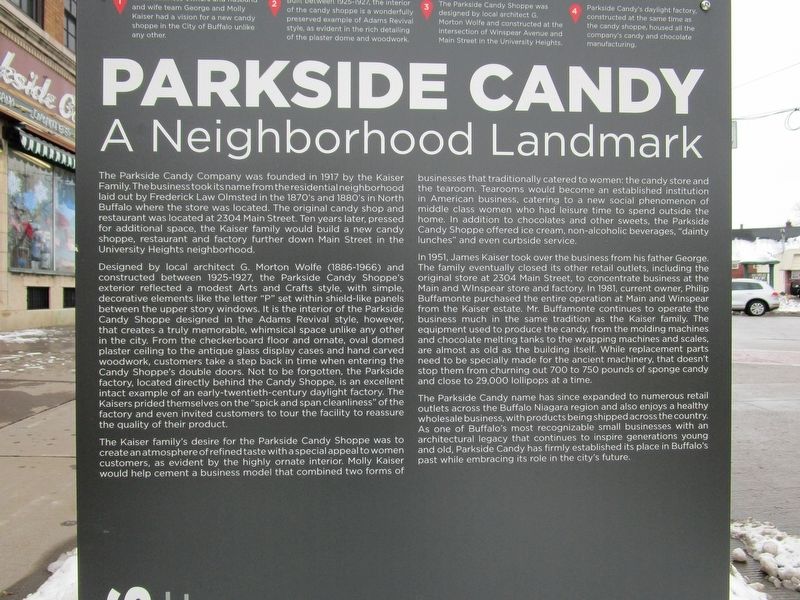
Parkside Candy A Neighborhood Landmark. The Parkside Candy Company was founded in 1917 by the Kaiser Family. The business took its name from the residential neighborhood laid out by Frederick Law Olmsted in the 1870's and 1880's in North Buffalo where the store was located. The original candy shop and restaurant was located at 2304 Main Street. Ten years later, pressed for additional space, the Kaiser family would build a new candy shoppe, restaurant and factory further down Main Street in the University Heights neighborhood. , Designed by local architect G. Morton Wolfe (1886-1966) and constructed between 1925-1927, the Parkside Candy Shoppe's exterior reflected a modest Arts and Crafts style, with simple, decorative elements like the letter "P" set within shield-like panels between the upper story windows. It is the interior of the Parkside Candy Shoppe designed in the Adams Revival style, however, that creates a truly memorable, whimsical space unlike any other in the city. From the checkerboard floor and ornate, oval domed plaster ceiling to the antique brass glass display cases and hand carved woodwork, customers take a step back in time when entering the Candy Shoppe's double doors. Not to be forgotten, the Parkside factory, located directly behind the Candy Shoppe, is an excellent example of an early twentieth-century daylight factory. The Kaisers prided themselves on the "spick and span cleanliness" of the factory and even invited customers to tour the facility to reassure the quality of their product. , The Kaiser family's desire for the Parkside Candy Shoppe was to create an atmosphere of refined taste with a special appeal to women customers, as evident by the highly ornate interior. Molly Kaiser would help cement a business model that combined the two forms of businesses that traditionally catered to women: the candy store and the tearoom. Tearooms would become an established institution in American business, catering to a new social phenomenon of middle class women who had leisure time to spend outside the home. In addition to chocolates and other sweets, the Parkside Candy Shoppe offered ice cream, non-alcoholic beverages, "dainty lunches" and even curbside service. , In 1951, James Kaiser took over the business from his father George. The family eventually closed its other retail outlets, including the original store at 2304 Main Street, to concentrate business at the Main and Winspear store and factory. In 1981, current owner Philip Buffamonte purchased the entire operation at Main and Winspear from the Kaiser estate. Mr. Buffamonte continues to operate the business much in the same tradition as the Kaiser family. The equipment used to produce the candy, from the molding machines and scales, are almost as old as the building itself. While replacement parts need to be specially made for the ancient machinery, that doesn't stop them from churning out 700 to 750 pounds of sponge candy and close to 29,000 lollipops at a time. , The Parkside Candy name has since expanded to numerous retail outlets across the Buffalo Niagara region and also enjoys a healthy wholesale business, with products being shipped across the country. As one of Buffalo's most recognizable small businesses with an architectural legacy that continues to inspire generations young and old, Parkside Candy has firmly established its place in Buffalo's past while embracing its role in the city's future. , 1. Local business owners and husband and wife team George and Molly Kaiser had a vision for a new candy shoppe in the City of Buffalo unlike any other. 2. Built between 1925-1927, the interior of the candy shoppe is a wonderfully preserved example of Adams revival style, as evident in the rich detailing of the plaster dome and woodwork. 3. The Parkside Candy Shoppe was designed by architect G. Morton Wolfe and constructed at the intersection of Winspear Avenue and Main Street in the University Heights. 4. Parkside Candy's daylight factory, constructed at the same time as the candy shoppe, housed all the company's candy and chocolate manufacturing. ,
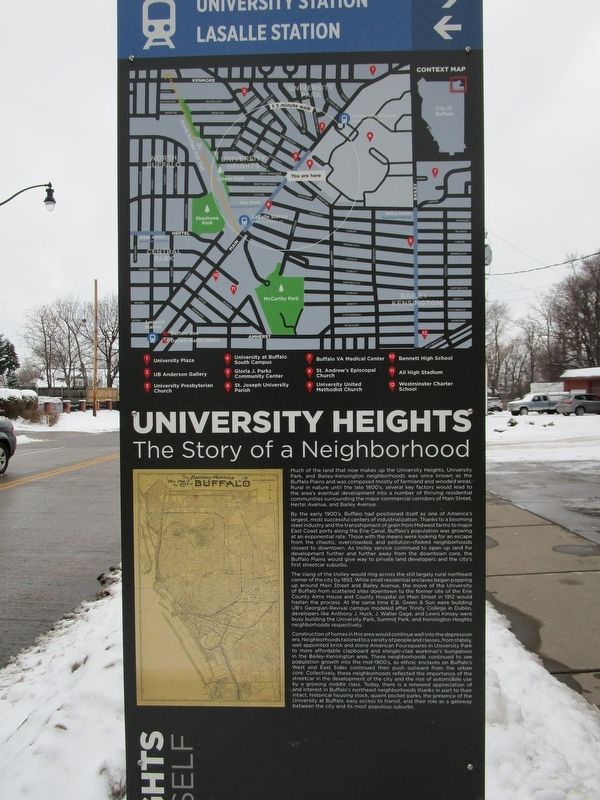
University Heights The Story of a Neighborhood . Much of the land that now makes up the University Heights, University Park, and Baily-Kensington neighborhoods was once known as the Buffalo Plains and was composed mainly of farmland and wooded areas. Rural in nature until the late 1880's, several key factors would lead to the area's eventual development into a number of thriving residential communities surrounding the major commercial corridors of Main Street, Hertel Avenue, and Baily Avenue. , By the early 1900's, Buffalo had positioned itself as one of America's largest, most successful centers of industrialization. Thanks to a booming steel industry and the transshipment of grain from Midwest farms to major East Coast ports along the Erie Canal, Buffalo's population was growing at an exponential rate. Those with the means were looking for an escape closest to downtown. As trolley service continued to open up land for development further and further away from the downtown core, the Buffalo Plains would give way to private land developers and the city's first streetcar suburbs. , The clang of the trolley would ring across the still largely rural northeast corner of the city by 1893. While small residential enclaves began popping up around Main Street and Baily Avenue, the move of the University of Buffalo from scattered sites downtown to the former site of the Erie County Alms House and County Hospital on Main Street in 1912 would hasten the process. At the same time E.B. Green and Son were building UB's Georgian-Revival campus modeled after Trinity College in Dublin, developers like Anthony J. Huck, J. Walter Gage, and Lewis Kinsey were busy building the University Park, Summit Park, and Kensington Heights neighborhoods respectively. , Construction of homes in this area would continue well into the depression era. Neighborhoods tailored to a variety of people and classes, from stately, well appointed brick and stone American Foursquares in University Park to more affordable clapboard and shingle-clad workman's bungalows in the Kensington-Bailey area. These neighborhoods continued to see population growth into the mid 1900's as ethnic enclaves on Buffalo's West and East sides continued their push outward from the urban core. Collectively, these neighborhoods reflected the importance of the streetcar in the development of the city and the rise of automobile use by a growing middle class. Today, there is a renewed appreciation and interest in Buffalo's northeast neighborhoods thanks in part to their intact, historical housing stock, quaint pocket parks, the presence of the University at Buffalo, easy access to transit, and their role as a gateway between the city and its most populous suburbs. , 1. University Plaza 2. UB Anderson Gallery 3. University Presbyterian Church 4. University at Buffalo South Campus 5. Gloria J. Parks Community Center 6. St Joseph University Parish 7. Buffalo VA Medical Center 8. St. Andrew's Episcopal Church 9. University United Methodist Church 10. Bennett High School 11. All High Stadium 12. Westminster Charter School
Parkside Candy A Neighborhood Landmark
The Parkside Candy Company was founded in 1917 by the Kaiser Family. The business took its name from the residential neighborhood laid out by Frederick Law Olmsted in the 1870's and 1880's in North Buffalo where the store was located. The original candy shop and restaurant was located at 2304 Main Street. Ten years later, pressed for additional space, the Kaiser family would build a new candy shoppe, restaurant and factory further down Main Street in the University Heights neighborhood.
Designed by local architect G. Morton Wolfe (1886-1966) and constructed between 1925-1927, the Parkside Candy Shoppe's exterior reflected a modest Arts and Crafts style, with simple, decorative elements like the letter "P" set within shield-like panels between the upper story windows. It is the interior of the Parkside Candy Shoppe designed in the Adams Revival style, however, that creates a truly memorable, whimsical space unlike any other in the city. From the checkerboard floor and ornate, oval domed plaster ceiling to the antique brass glass display cases and hand carved woodwork, customers take a step back in time when entering the Candy Shoppe's double doors. Not to be forgotten, the Parkside factory, located directly behind the Candy Shoppe, is an excellent example
Click or scan to see this page online
of an early twentieth-century daylight factory. The Kaisers prided themselves on the "spick and span cleanliness" of the factory and even invited customers to tour the facility to reassure the quality of their product.
The Kaiser family's desire for the Parkside Candy Shoppe was to create an atmosphere of refined taste with a special appeal to women customers, as evident by the highly ornate interior. Molly Kaiser would help cement a business model that combined the two forms of businesses that traditionally catered to women: the candy store and the tearoom. Tearooms would become an established institution in American business, catering to a new social phenomenon of middle class women who had leisure time to spend outside the home. In addition to chocolates and other sweets, the Parkside Candy Shoppe offered ice cream, non-alcoholic beverages, "dainty lunches" and even curbside service.
In 1951, James Kaiser took over the business from his father George. The family eventually closed its other retail outlets, including the original store at 2304 Main Street, to concentrate business at the Main and Winspear store and factory. In 1981, current owner Philip Buffamonte purchased the entire operation at Main and Winspear from the Kaiser estate. Mr. Buffamonte continues to operate the business much in the same tradition as the Kaiser family. The equipment used
Photographed by Anton Schwarzmueller, February 9, 2020
2. Parkside Candy Images
to produce the candy, from the molding machines and scales, are almost as old as the building itself. While replacement parts need to be specially made for the ancient machinery, that doesn't stop them from churning out 700 to 750 pounds of sponge candy and close to 29,000 lollipops at a time.
The Parkside Candy name has since expanded to numerous retail outlets across the Buffalo Niagara region and also enjoys a healthy wholesale business, with products being shipped across the country. As one of Buffalo's most recognizable small businesses with an architectural legacy that continues to inspire generations young and old, Parkside Candy has firmly established its place in Buffalo's past while embracing its role in the city's future.
1. Local business owners and husband and wife team George and Molly Kaiser had a vision for a new candy shoppe in the City of Buffalo unlike any other.
2. Built between 1925-1927, the interior of the candy shoppe is a wonderfully preserved example of Adams revival style, as evident in the rich detailing of the plaster dome and woodwork.
3. The Parkside Candy Shoppe was designed by architect G. Morton Wolfe and constructed at the intersection of Winspear Avenue and Main Street in the University Heights.
4. Parkside Candy's daylight factory, constructed at the same time as the candy shoppe, housed all the company's
Photographed by Anton Schwarzmueller, February 9, 2020
3. University Heights
candy and chocolate manufacturing.
University Heights The Story of a Neighborhood
Much of the land that now makes up the University Heights, University Park, and Baily-Kensington neighborhoods was once known as the Buffalo Plains and was composed mainly of farmland and wooded areas. Rural in nature until the late 1880's, several key factors would lead to the area's eventual development into a number of thriving residential communities surrounding the major commercial corridors of Main Street, Hertel Avenue, and Baily Avenue.
By the early 1900's, Buffalo had positioned itself as one of America's largest, most successful centers of industrialization. Thanks to a booming steel industry and the transshipment of grain from Midwest farms to major East Coast ports along the Erie Canal, Buffalo's population was growing at an exponential rate. Those with the means were looking for an escape closest to downtown. As trolley service continued to open up land for development further and further away from the downtown core, the Buffalo Plains would give way to private land developers and the city's first streetcar suburbs.
The clang of the trolley would ring across the still largely rural northeast corner of the city by 1893. While small residential enclaves began popping up around Main Street and Baily Avenue, the move of the
Photographed by Anton Schwarzmueller, February 9, 2020
4. Parkside Candy / University Heights Marker
View is Main Street southward (NY route 5 west) at West Winspear Avenue. This is the University Heights side of the marker.
University of Buffalo from scattered sites downtown to the former site of the Erie County Alms House and County Hospital on Main Street in 1912 would hasten the process. At the same time E.B. Green & Son were building UB's Georgian-Revival campus modeled after Trinity College in Dublin, developers like Anthony J. Huck, J. Walter Gage, and Lewis Kinsey were busy building the University Park, Summit Park, and Kensington Heights neighborhoods respectively.
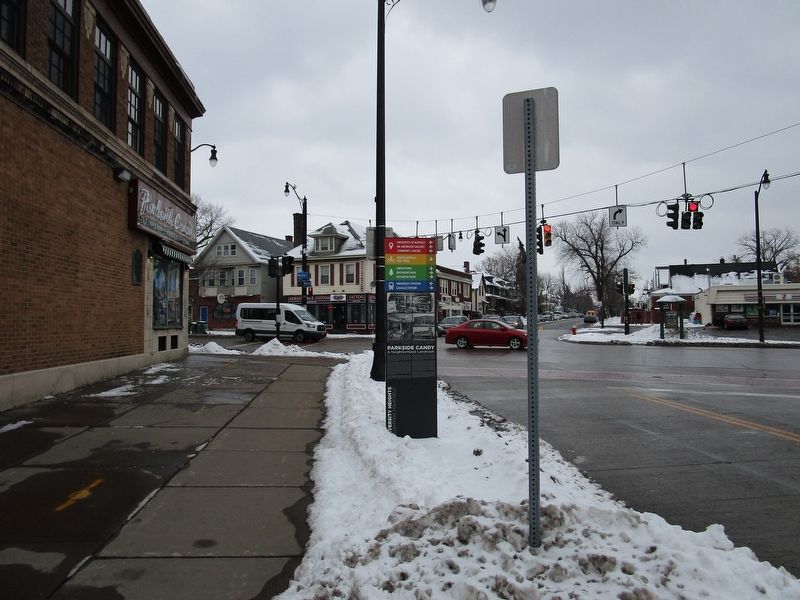
Construction of homes in this area would continue well into the depression era. Neighborhoods tailored to a variety of people and classes, from stately, well appointed brick and stone American Foursquares in University Park to more affordable clapboard and shingle-clad workman's bungalows in the Kensington-Bailey area. These neighborhoods continued to see population growth into the mid 1900's as ethnic enclaves on Buffalo's West and East sides continued their push outward from the urban core. Collectively, these neighborhoods reflected the importance of the streetcar in the development of the city and the rise of automobile use by a growing middle class. Today, there is a renewed appreciation and interest in Buffalo's northeast neighborhoods thanks in part to their intact, historical housing stock, quaint pocket parks, the presence of the University at Buffalo, easy access to transit, and their role as a gateway between
Photographed by Anton Schwarzmueller, February 9, 2020
5. Parkside Candy / University Heights Marker
This is the Parkside Candy side of the marker. View is eastward.
the city and its most populous suburbs.
1. University Plaza
2. UB Anderson Gallery
3. University Presbyterian Church
4. University at Buffalo South Campus
5. Gloria J. Parks Community Center
6. St Joseph University Parish
7. Buffalo VA Medical Center
8. St. Andrew's Episcopal Church
9. University United Methodist Church
10. Bennett High School
11. All High Stadium
12. Westminster Charter School
Topics. This historical marker is listed in these topic lists: Architecture • Industry & Commerce. A significant historical year for this entry is 1917.
Location. 42° 57.093′ N, 78° 49.549′ W. Marker is in Buffalo, New York, in Erie County. It is in University Heights. It is at the intersection of West Winspear Avenue and Main Street (New York State Route 5) on West Winspear Avenue. Touch for map. Marker is at or near this postal address: 3208 Main Street, Buffalo NY 14214, United States of America. Touch for directions.

Regionally, this marker is in Upstate New York and specifically in Western New York. It is also in the American Northeast, on the Great Lakes, and in the Mid-Atlantic. Globally, it is in the North Atlantic Region, North America, the Western Hemisphere, the Western World, and the Anglosphere. Historically, it finds itself in what was once the Viceroyalty of New France, the Haudenosaunee (Iroquois) Confederacy, New Netherland, and one of the original Thirteen Colonies.
Photographed by Anton Schwarzmueller, February 9, 2020
7. Parkside Candy Factory
Behind the shoppe.
Photographed by Anton Schwarzmueller, February 9, 2020
8. Parkside Candies
The storefront and interior featured in the 1984 movie "The Natural" starring Robert Redford. Attending a showing locally at the time, the audience broke out laughing when "Chicago" splashed across the screen with this storefront as a backdrop, including fake steel piers for the Chicago elevated train structure.
Credits. This page was last revised on January 28, 2026. It was originally submitted on February 9, 2020, by Anton Schwarzmueller of Wilson, New York. This page has been viewed 768 times since then and 38 times this year. Photos:1, 2, 3, 4, 5, 6, 7, 8. submitted on February 9, 2020, by Anton Schwarzmueller of Wilson, New York.