Memorial Plaque of the Archdiocese Vienna at Judenplatz
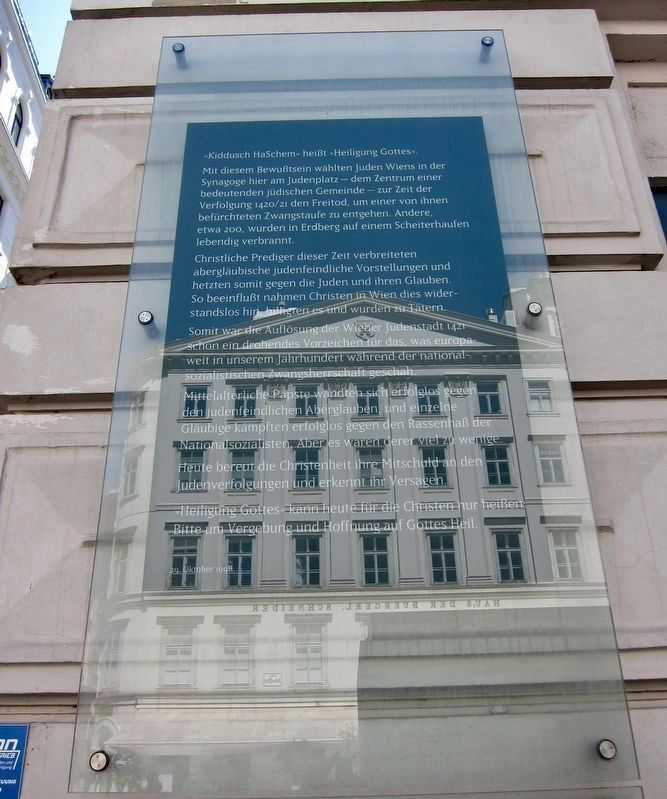

Mit diesem Bewußtsein wählten Juden Wiens in der Synagoge hier am Judenplatz — dem Zentrum einer bedeutenden jüdischen Gemeinde — zur Zeit der Verfolgung 1420/21 den Freitod, um einer von ihnen befürchteten Zwangstaufe zu entgehen. Andere, etwa 200, wurden in Erdberg auf dem Scheiterhaufen lebendig verbrannt.
Christliche Prediger dieser Zeit verbreiteten abergläubische judenfeindliche Vorstellungen und hetzten somit gegen die Juden und ihren Glauben. So beeinflußt nahmen Christen in Wien dies widerstandslos hin, billigten es und wurden zu Tätern.
Somit war die Auflösung der Wiener Judenstadt 1421 schon ein drohendes Vorzeichen für das, was europa- weit in unserem Jahrhundert während der national- sozialistischen Zwangsherrschaft geschah.
Mittelalterliche Päpste wandten sich erfolglos gegen den judenfeindlichen Aberglauben, und einzelne Gläubige kämpften erfolglos gegen den Rassenhaß der Nationalsozialisten. Aber es waren derer zu wenige.
Heute bereut die Christenheit ihre Mitschuld an den Judenverfolgungen und
this page online
„Heiligung Gottes“ kann heute für die Christen nur heißen: Bitte um Vergebung und Hoffnung auf Gottes Heil.
29. Oktober 1998
Christian preachers of that time spread
superstitious anti-Jewish ideas and
incited against the Jews and their faith.
Under this influence, Christians in Vienna accepted the crime without resistance, they approved it and became perpetrators. In this way, the destruction of the Viennese
"Jewish City” in 1421 was already a threatening omen for the events that
took place in all of Europe at the time of the National Socialist tyranny.
Medieval popes turned without success against this anti-Jewish
superstition, and individual believers fought in vain against the racial
hatred of the
Today, Christianity regrets its share in responsibility for the persecution
of Jews and realizes its failure. For Christians today, "Sanctification of God"
can only mean asking for forgiveness and hoping in God's saving action.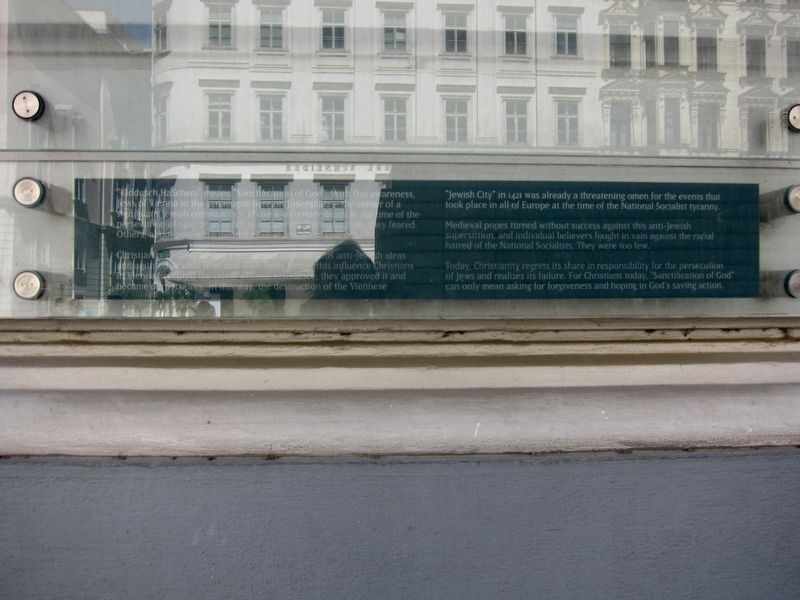
Erected 1998 by Erzdiözese Wien.
Topics. This historical marker is listed in this topic list: Religion & Religious Structures. A significant historical year for this entry is 1421.
Location. 48° 12.694′ N, 16° 22.165′ E. Marker is in Wien. It is in Stephansdom. It is at the intersection of Judenplatz and Parisergasse, on the left when traveling east on Judenplatz. Touch for map. Marker is at or near this postal address: Judenplatz 6, Wien 1010, Austria. Touch for directions.
Regionally, it is in Europe, the European Union, Central Europe, the Schengen Area, Western Europe, and the Western World. Historically, it finds itself in what was once the Roman Empire and specifically also the Holy Roman Empire.
Other nearby markers. At least 8 other markers are within walking distance of this marker: Mahnmal für die österreichischen jüdischen Opfer der Schoah / Judenplatz Holocaust Memorial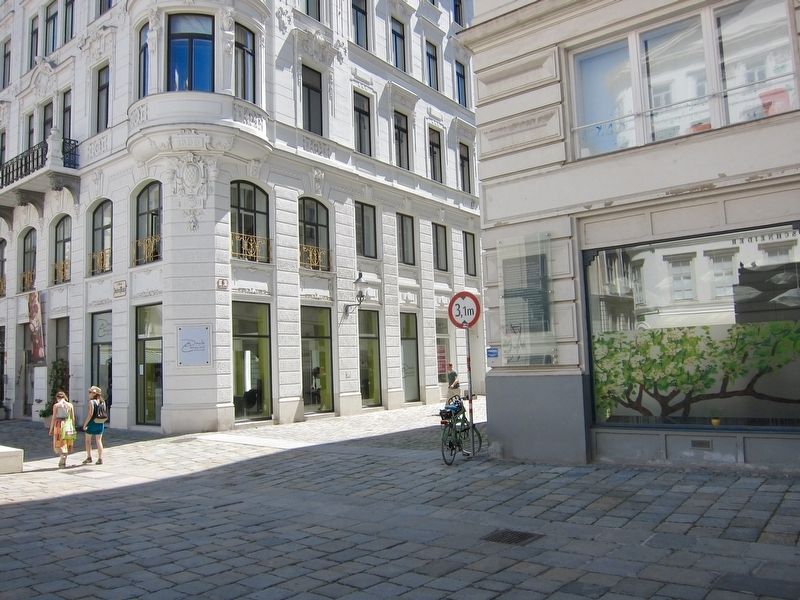
Another marker is no longer nearby. Emile Jacques-Dalcroze (was about 120 meters away but has been confirmed missing).
Credits. This page was last revised on February 1, 2022. It was originally submitted on February 13, 2020, by Andrew Ruppenstein of Lamorinda, California. This page has been viewed 582 times since then and 34 times this year. Photos: 1, 2, 3. submitted on February 13, 2020, by Andrew Ruppenstein of Lamorinda, California.
