Little Italy in Wilmington in New Castle County, Delaware — The American Northeast (Mid-Atlantic)
St. Anthony of Padua
Roman Catholic Church
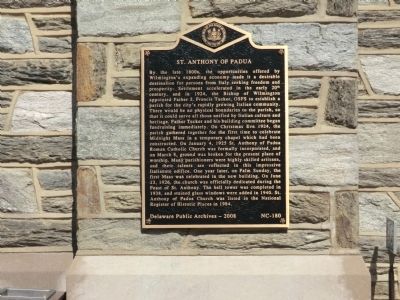
Photographed by Don Morfe, April 7, 2013
1. St. Anthony of Padua Marker
this page online
Erected 2008 by Delaware Public Archives. (Marker Number NC-180.)
Topics and series. This historical marker is listed in this topic list: Religion & Religious Structures. In addition, it is included in the Delaware Public Archives, and the National Register of Historic Places (NRHP) series lists. A significant historical date for this entry is December 24, 1924.
Location. 39° 45.145′ N, 75° 33.996′ W. Marker is in Wilmington, Delaware, in New Castle County. It is in Little Italy. It is at the intersection of West 9th Street and North Dupont Street, on the left when traveling east on West 9th Street. The marker is affixed to the front of the church on the right side of the entrance as you face the church. Touch for map. Marker is in this post office area: Wilmington DE 19805, United States of America. Touch for directions.

Regionally, this marker is in Greater Philadelphia. It is also in the American Mid-Atlantic, on the Delmarva Peninsula, and
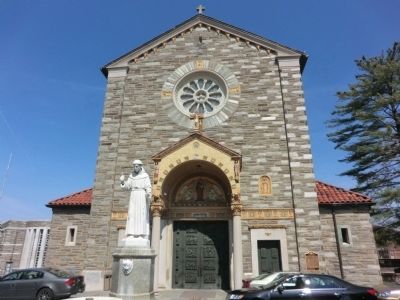
Photographed by Don Morfe, April 7, 2013
2. St. Anthony of Padua Marker
Other nearby markers. At least 8 other markers are within walking distance of this marker: Rededication of Rodney Street Reservoir (about 800 feet away, measured in a direct line); The Tilton Mansion (approx. ¼ mile away); Tilton Park (approx. 0.3 miles away); 718 North Franklin Street (approx. 0.4 miles away); 716 North Franklin Street (approx. 0.4 miles away); A City’s Growing Demand for Water (approx. 0.4 miles away); Science in Action (approx. 0.4 miles away); Evolution of Safe Drinking Water (approx. 0.4 miles away). Touch for a list and map of all markers in Wilmington.
Also see . . . St. Anthony's Roman Catholic Church - National Register of Historic Places Nomination Form.
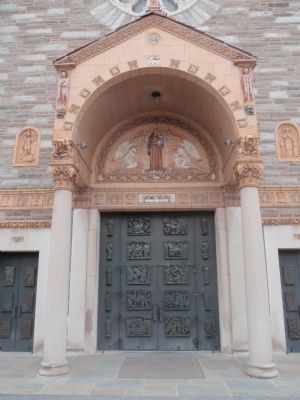
This church is being nominated under criteria A for having fostered the cultural pride of the Italian community in Wilmington through the programs and festivals it has sponsored.(Submitted on April 23, 2025, by Pete Skillman of Wilmington, Delaware.)It is being nominated under Criteria C because it is an excellent example of an American interpretation of the Italian Romanesque style and because its interior is decorated with murals, mosaics, shrine sculptures and other works of art by both Italian and Italian-American craftsmen and artists. Its architecture reflects the traditions and culture of the Italians of the community it serves.Photographed by Stephen J Duncan, May 13, 20133. The Main Entrance to the Church
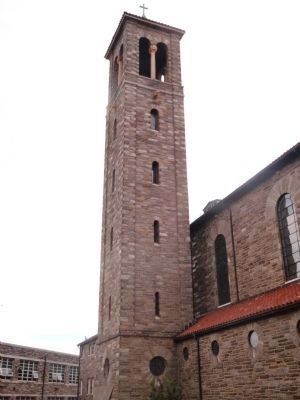
Photographed by Stephen J Duncan, May 13, 2013
4. The Church Bell Tower
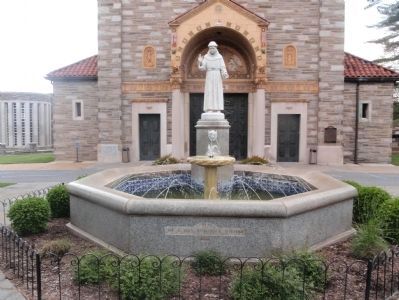
Photographed by Stephen J Duncan, May 13, 2013
5. St. Anthony of Padua Fountain
The fountain sits directly in front of the church.
Credits. This page was last revised on April 23, 2025. It was originally submitted on April 21, 2013, by Don Morfe of Baltimore, Maryland. This page has been viewed 1,177 times since then and 58 times this year. Last updated on February 23, 2020, by Carl Gordon Moore Jr. of North East, Maryland. Photos: 1, 2. submitted on April 21, 2013, by Don Morfe of Baltimore, Maryland. 3, 4, 5. submitted on May 13, 2013, by Stephen J Duncan of Wilmington, Delaware. • Bill Pfingsten was the editor who published this page.
