The Las Vegas Hard Rock Café Guitar Sign
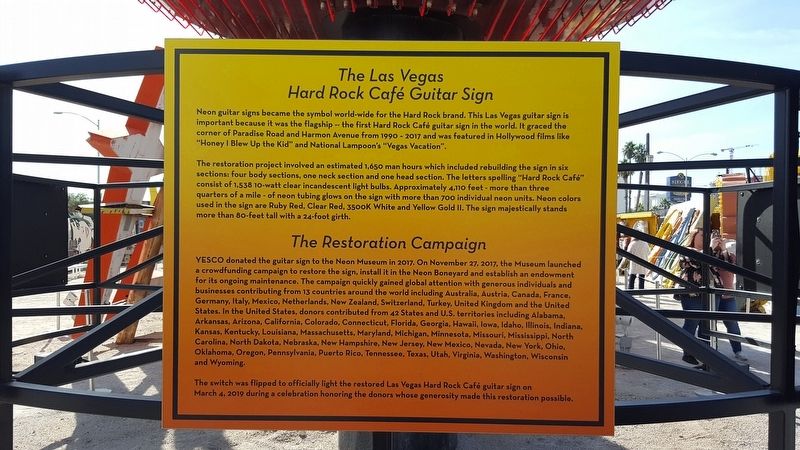
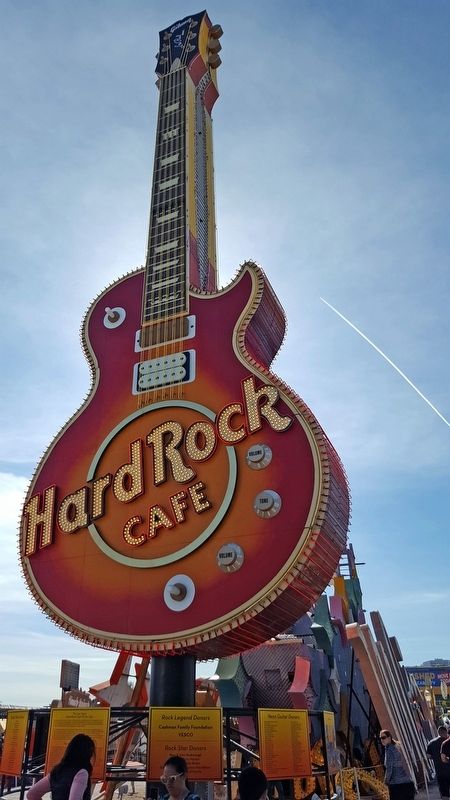
Neon guitar signs became the symbol world-wide for the Hard Rock brand. This Las Vegas guitar sign is important because it was the flagship -- the first Hard Rock Café guitar in the world. It graced the corner of Paradise Road and Harmon Avenue from 1990 - 2017 and was featured in Hollywood films like "Honey I Blew Up the Kid" and National Lampoon's "Vegas Vacation".
The restoration project involved an estimated 1,650 man hours which included rebuilding the sign in sections: four body sections, one neck section and one head section. The letters spelling "Hard Rock Café" consist of 1,538 10-watt clear incandescent light bulbs, Approximately 4,110 feet - more than three quarters of a mile - of neon tubing glows on the sign with more than 700 individual neon units. Neon colors used in the sign are Ruby Red, Clear Red, 3500K White and Yellow Gold II. The sign majestically stands more than 80-feet tall with a 24-foot girth.
this page online
The switch was flipped to officially light the restored Las Vegas Hard Rock Café guitar sign on March 4, 2019 during a celebration honoring the donors whose generosity made this restoration possible.
Erected by The Neon Museum.
Topics. This historical marker is listed
Location. 36° 10.613′ N, 115° 8.1′ W. Marker is in Las Vegas, Nevada, in Clark County. It is in Cultural Corridor Coalition. It can be reached from the intersection of Las Vegas Boulevard North and East McWilliams Avenue, on the right when traveling north. Touch for map. Marker is at or near this postal address: 770 Las Vegas Blvd N, Las Vegas NV 89101, United States of America. Touch for directions.

Regionally, this marker is in the Mojave Desert. It is also in the American Southwest and in the Mountain West. Globally, it is in North America, the Western Hemisphere, the Western World, and the Anglosphere. Historically, it finds itself in what was once New Spain and also Mexico’s Alta California.
Other nearby markers. At least 8 other markers are within walking distance of this marker: Jerry's Nugget (a few steps from this marker); The "H" Wall (within shouting distance of this marker); The Neon Boneyard Park Sign (within shouting distance of this marker); Silver Slipper Gambling Hall (within shouting distance of this marker); Bow & Arrow Motel (about 400 feet away); Las Vegas Fort (approx. ¼ mile away); Las Vegas Old Mormon Fort (approx. ¼ mile away); Helen Jane Wiser Stewart (approx. ¼ mile away). Touch for a list and map of all markers in Las Vegas.
Another marker is no longer nearby. Biltmore Village (was about 300 feet away, measured in a direct line but has been confirmed missing).
More about this marker. Marker is located in the Neon Museum 'Boneyard'. Admission fees apply.
Credits. This page was last revised on February 7, 2023. It was originally submitted on February 16, 2020, by Douglass Halvorsen of Klamath Falls, Oregon. This page has been viewed 1,494 times since then and 141 times this year. Last updated on February 24, 2020, by Craig Baker of Sylmar, California. Photos: 1, 2. submitted on February 16, 2020, by Douglass Halvorsen of Klamath Falls, Oregon. • Syd Whittle was the editor who published this page.
