Hopewell, Virginia — The American South (Mid-Atlantic)
Depot Field Hospital
Union Medical Care at its Best
Photographed by Bill Coughlin, April 25, 2007
1. Depot Field Hospital Marker
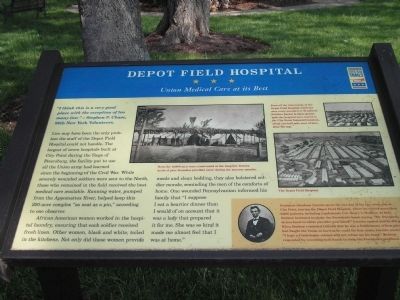
“I think this is a very good place with the exception of too many lice.” - Stephen P. Chase, 86th New York Volunteers.
Lice may have been the only problem the staff of the Depot Field Hospital could not handle. The largest of seven hospitals built at City Point during the Siege of Petersburg, the facility put to use all the Union army had learned since the beginning of the Civil War. While severely wounded soldiers were sent to the North, those who remained in the field received the best medical care available. Running water, pumped from the Appomattox River, helped keep this 200-acre complex “as neat as a pin,” according to one observer.
African American women worked in the hospital laundry, ensuring that each soldier received fresh linen. Other women, black and white, toiled in the kitchens. Not only did these women provide meals and clean bedding, they also bolstered soldier morale, reminding the men of the comforts of home. One wounded Pennsylvanian informed his family that “I suppose I eat a heartier dinner than I would of on account that it was a lady that prepared it for me. She was so
this page online
Sidebar: President Abraham Lincoln spent the last day of his two week stay at City Point touring the Depot Field Hospital, where he visited more than 6,000 patients, including Confederate Col. Henry L. Benbow. At first, Benbow hesitated to shake the President’s hand, saying, “Mr. President, do you know to whom you offer your hand?” Lincoln replied that he did not. When Benbow reminded Lincoln that he was a Confederate officer who had fought the Union as hard as he could for four years, Lincoln answered, “I hope a Confederate colonel will not refuse me his hand.” Benbow responded by extending both hands to clasp the President’s proffered arms.
Erected by Virginia Civil War Trails.
Topics and series. This historical marker is listed in these topic lists: Notable Places • War, US Civil. In addition, it is included in the Virginia Civil War Trails series list.
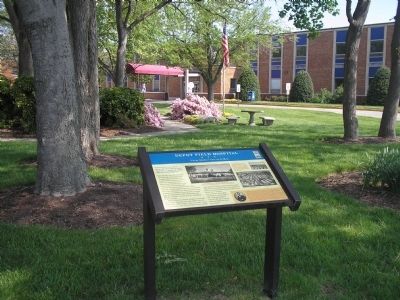
Location. 37° 18.433′ N, 77° 17.416′ W. Marker is in Hopewell, Virginia. It is on Eppes Street, on the right when traveling west. Marker is
Photographed by Bill Coughlin, April 25, 2007
2. Marker at John Randolph Medical Center

Regionally, this marker is in Central Virginia. It is also in the American South, specifically in the Upper South, and on the Eastern Seaboard. Globally, it is in the North Atlantic Region, North America, the Western Hemisphere, the Western World, and the Anglosphere. Historically, it finds itself in what was once the territory of the Mississippian Culture, one of the original Thirteen Colonies, one of the Confederate States of America, and the Antebellum South.
Other nearby markers. At least 8 other markers are within walking distance of this marker: John Randolph (about 300 feet away, measured in a direct line); Welcome to the Hopewell Riverwalk (approx. 0.2 miles away); Confederate Memorial (approx. 0.2 miles away); Appomattox River (approx. 0.2 miles away); Peter Francisco (approx. ¼ mile away); Dr. M. L. King, Jr. (approx. 0.3 miles away); "Captain Francis Eppes Making Friends with the Appomattox Indians" (approx. 0.3 miles away); In Honor of Those Who Gave the Ultimate Sacrifice (approx. 0.4 miles away). Touch for a list and map of all markers in Hopewell.
More about this marker. The top center of the marker contains a wartime photograph of the hospital site with the caption “Tents for 10,000 men were constructed at the hospital. Bowers made of pine branches provided cover during the summer months.” Two other photographs of The Depot Field Hospital are on the right side of the marker. They have the caption “Even all the innovations of the Depot Field Hospital could not save every wounded or ill patient. Soldiers buried in these graves near the hospital were moved to the City Point National Cemetery, about one-half mile west of here, after the war.”
Credits. This page was last revised on June 16, 2016. It was originally submitted on December 21, 2008, by Bill Coughlin of Woodland Park, New Jersey. This page has been viewed 2,147 times since then and 69 times this year. Photos: 1, 2. submitted on December 21, 2008, by Bill Coughlin of Woodland Park, New Jersey.
