Sarasota in Sarasota County, Florida — The American South (South Atlantic)
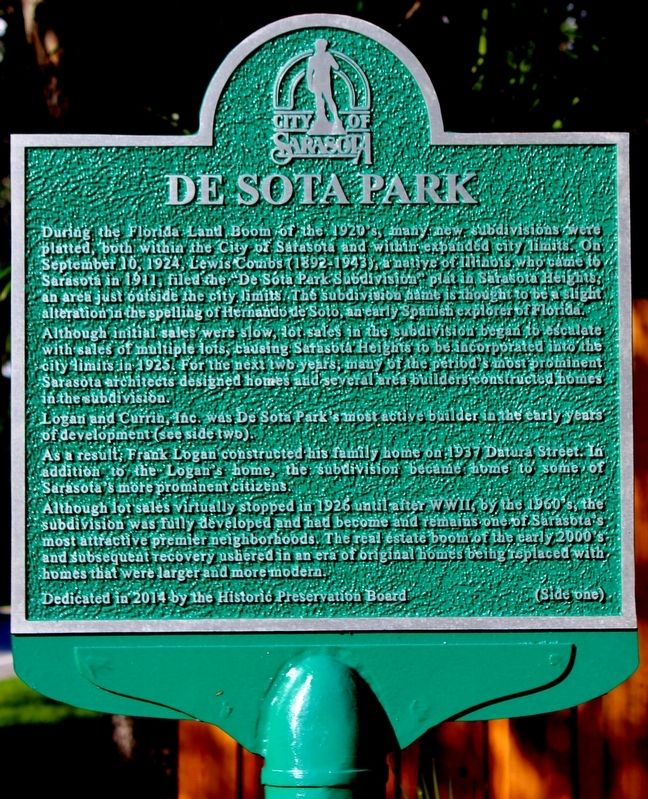
De Sota Park
⎯⎯⎯
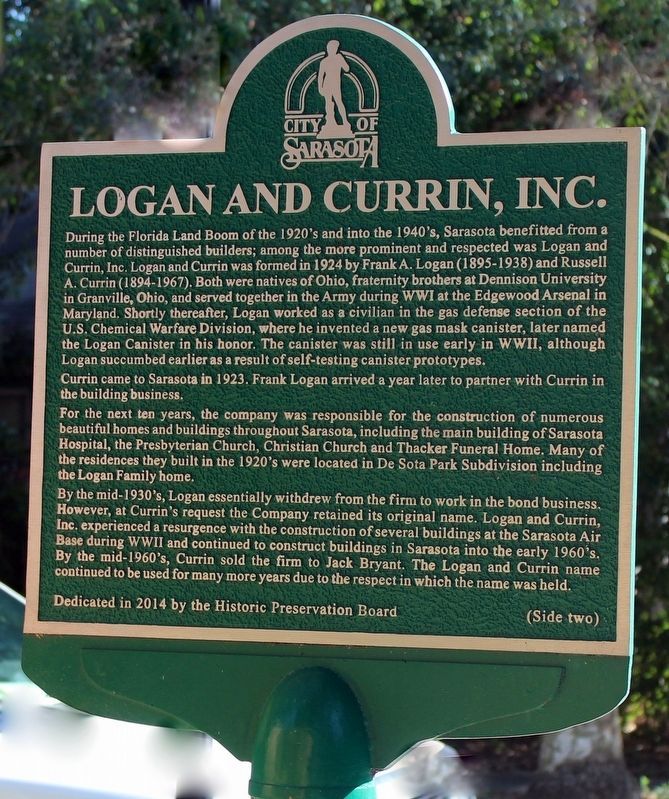
Logan and Currin, Inc.
Photographed by Tim Fillmon, October 29, 2019
1. De Sota Park Marker
Although initial sales were slow, lot sales in the subdivision began to escalate with sales of multiple lots, causing Sarasota Heights to be incorporated into the city limits in 1925. For the next two years, many of the period's most prominent Sarasota architects designed homes and several area builders constructed homes in the subdivision.
Logan and Currin, Inc. was DeSota Park's most active builder in the early years of development (see side two).
As a result, Frank Logan constructed his family home on 1937 Datura Street. In addition to the Logan's home, the subdivision became home to some of Sarasota's more prominent citizens.
Although
this page online
Photographed by Tim Fillmon, October 29, 2019
2. Logan and Currin, Inc. Marker
Currin came to Sarasota in 1923. Frank Logan arrived a year later to partner with Currin in the building business.
For the next ten years, the company was responsible for the construction of numerous beautiful homes and buildings throughout Sarasota, including the main building of Sarasota Hospital, the Presbyterian Church, Christian Church and Thacker Funeral Home. Many of the residences they built in the 1920's were located in De Sota Park Subdivision including the Logan Family home.
By the mid-1930's, Logan essentially withdrew from the firm to work in the bond business. However, at Currin's request the Company retained its original name. Logan and Currin, Inc. experienced a resurgence with the construction of several buildings at the Sarasota Air Base during WWII and continued to construct buildings in Sarasota into the early 1960's. By the mid-1960's, Currin sold the firm to Jack Bryant. The Logan and Currin name continued to be used for many years due to the respect in which the name was held. (Side two)
Erected 2014 by Historic Preservation Board.
Topics. This historical marker is listed
Photographed by Tim Fillmon, October 29, 2019
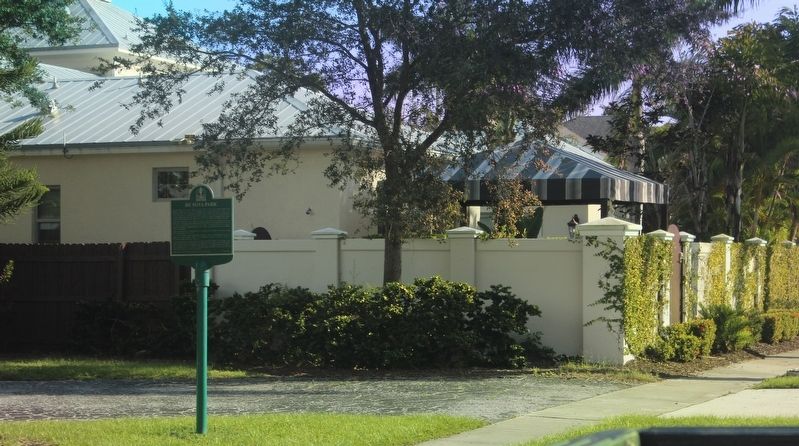
3. De Sota Park/Logan and Currin, Inc. Marker looking south
Location. 27° 18.911′ N, 82° 32.017′ W. Marker is in Sarasota, Florida, in Sarasota County. It is at the intersection of South Osprey Avenue and Hyde Park Street, on the right when traveling north on South Osprey Avenue. Touch for map. Marker is in this post office area: Sarasota FL 34236, United States of America. Touch for directions.

Regionally, this marker is on the Gulf Coast. It is also in the American South and on the Gulf Coast. Globally, it is in the North Atlantic Region, North America, a Gulf of Mexico state, the Western Hemisphere, the Western World, and the Anglosphere. Historically, it finds itself in what was once New Spain, the territory of the Mississippian Culture, one of the Confederate States of America, and the Antebellum South.
Other nearby markers. At least 8 other markers are within walking distance of this marker: A different marker also named De Sota Park / Logan and Currin, Inc. (approx. 0.2 miles away); Sarasota's First Post Office (approx. ¼ mile away); The Wallendas (approx. ¼ mile away); Dorothye Smith (approx. half a mile away); Cherokee Park (approx. half a mile away); Avondale (approx. 0.6 miles away); Sarasota High School (approx. ¾ mile away); In Loving Memory of of Sue Anna Kauffman (approx. 0.9 miles away). Touch for a list and map of all markers in Sarasota.
More about this marker. There is an identical marker nearby at the south entrance to the area.
Credits. This page was last revised on March 2, 2020. It was originally submitted on March 2, 2020, by Tim Fillmon of Webster, Florida. This page has been viewed 298 times since then and 25 times this year. Photos: 1, 2, 3. submitted on March 2, 2020, by Tim Fillmon of Webster, Florida. • Bernard Fisher was the editor who published this page.
