Marcus Hook in Delaware County, Pennsylvania — The American Northeast (Mid-Atlantic)
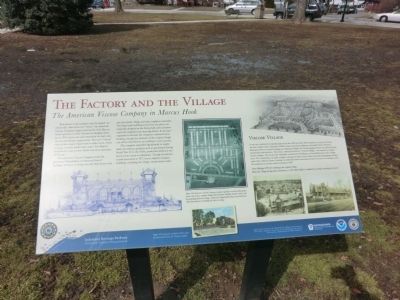
The Factory and the Village
The American Viscose Company in Marcus Hook
Photographed by Don Morfe, March 11, 2015
1. The Factory and the Village Marker
Best known as the company that developed “artificial silk,” later known as “rayon,” the American Viscose Company began construction of its Marcus Hook operation in 1912. Patented by English chemists in 1894, rayon was used extensively for both commercial and military applications. The term “viscose” refers to the organic liquid used to make rayon, which is viscous, or much thicker than water. The Marcus Hook factory was the first North American operation of Viscose.
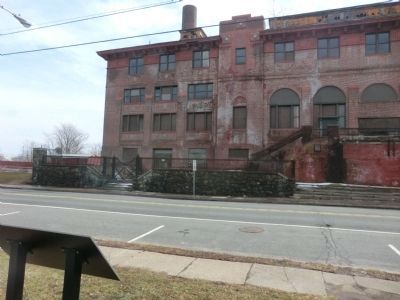
The American Viscose Company hired the prominent Philadelphia architectural firm of Ballinger & Perrot to design not only their factory, but also the nearby village and other employee amenities. The large brick building across the street from the plaza was originally designed as the dining hall and recreation center for employees (see drawing below). It was later expanded to become the company’s administration building, though the remnants of the original design can still be identified in the building’s center portion.
The company expanded significantly to supply fabric for military products such as parachutes during World War II. In the 1950s, production
this page online
Viscose Village
It was very common for manufacturers of the late 19th and early 20th centuries to construct housing for their workers close to factories. While in most cases these residents were plain brick rowhouses, Ballinger & Perrot wanted to design an “industrial village” for Viscose employees that was self-sustaining, inexpensive and attractive. The result, commonly known as “Viscose Village”, was inspired by English factory villages. The 20-acre site originally contained 215 dwellings, two boarding houses and a village store. The community was built complete with paved roads, sewers, back yards and landscaping, setting it apart from ordinary factory housing. As individual home ownership became the norm, the company sold the residences to private owners starting in 1949.
[Captions:]
Above: The American Viscose Company complex originally consisted of the factory (lower left corner), employee dining hall/recreation building (bottom center), and the sprawling industrial village. A half-circle shaped public plaza was provided on 10th Street between the dining hall and the village.
Right: This postcard, mailed in 1925, shows the American Viscose Co. Factory complex.
Above: Ballinger & Perrot’s rendering of the completed village.
Below left: Village housing under construction, ca. 1912. Below Right: A completed row of houses consisting of six units.
Postcard courtesy of the Keith Lockhart Collection.
Erected by Industrial

Photographed by Devry Becker Jones (CC0), July 25, 2026
2. The Factory and the Village Marker in front of remnants of the factory building
Topics. This historical marker is listed in these topic lists: Industry & Commerce • War, World II. A significant historical year for this entry is 1912.
Location. 39° 49.303′ N, 75° 24.719′ W. Marker is in Marcus Hook, Pennsylvania, in Delaware County. It is at the intersection of East 10th Street (Route 13) and Plaza Street, on the left when traveling east on East 10th Street. Touch for map. Marker is at or near this postal address: 17 Plaza St, Marcus Hook PA 19061, United States of America. Touch for directions.

Regionally, this marker is in Southeast Pennsylvania and in Greater Philadelphia. It is also in the American Northeast and in the Mid-Atlantic. Globally, it is in North America, the Western Hemisphere, the Western World, and the Anglosphere. Historically, it finds itself in what was once the Haudenosaunee (Iroquois) Confederacy, New Netherland, and one of the original Thirteen Colonies.
Other nearby markers. At least 8 other markers are within walking distance of this marker: American Viscose Co. (a few steps from this marker); Marcus Hook, PA (a few steps
Photographed by Don Morfe, March 11, 2015
3. The Factory and the Village Marker-The factory across the street
Credits. This page was last revised on July 26, 2026. It was originally submitted on March 20, 2015, by Don Morfe of Baltimore, Maryland. This page has been viewed 1,414 times since then and 183 times this year. Last updated on March 7, 2020, by Carl Gordon Moore Jr. of North East, Maryland. Photos: 1. submitted on March 20, 2015, by Don Morfe of Baltimore, Maryland. 2. submitted on July 26, 2026, by Devry Becker Jones of Washington, District of Columbia. 3. submitted on March 20, 2015, by Don Morfe of Baltimore, Maryland. • Bill Pfingsten was the editor who published this page.
