Flatiron District in Manhattan in New York County, New York — The American Northeast (Mid-Atlantic)
Theodore Roosevelt Birthplace
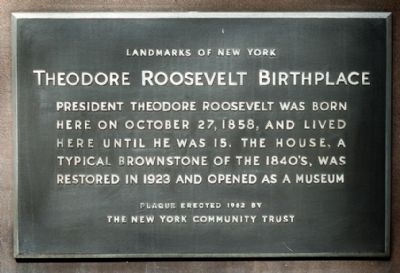
Photographed by R. C., February 5, 2011
1. Theodore Roosevelt Birthplace Marker
Erected 1962 by New York Community Trust.
Topics and series. This historical marker is listed in these topic lists: Government & Politics • Patriots & Patriotism. In addition, it is included in the Former U.S. Presidents: #26 Theodore Roosevelt series list. A significant historical month for this entry is October 1838.
Location. 40° 44.325′ N, 73° 59.338′ W. Marker is in Manhattan, New York, in New York County. It is in the Flatiron District. It is on East 20th Street east of Broadway, on the right when traveling east. Touch for map. Marker is at or near this postal address: 28 East 20th Street, New York NY 10003, United States of America. Touch for directions.

Regionally, this marker is in New York City. It is also in the American Northeast, in the Mid-Atlantic, and on the Eastern Seaboard. Globally, it is in the North Atlantic Region, North America, the Western Hemisphere, the Western World, and the Anglosphere. Historically,
this page online
Other nearby markers. At least 8 other markers are within walking distance of this marker: Theodore Roosevelt (here, next to this marker); Pirates of Penzance Composition Site (within shouting distance of this marker); Horace Greeley (within shouting distance of this marker); Gorham Apartments (about 300 feet away, measured in a direct line); Robert Henri (about 600 feet away); 133 Fifth Avenue (about 600 feet away); 105 East 19th Street (about 600 feet away); James Harper (about 600 feet away). Touch for a list and map of all markers in Manhattan.
Regarding Theodore Roosevelt Birthplace. The building is listed in the "AIA (American Institute of Architects) Guide to New York City, Fifth Edition".
Also see . . .
1. National Park Service Theodore Roosevelt Birthplace. (Submitted on February 8, 2011, by Ronald Claiborne of College Station, Texas.)
2. The Theodore Roosevelt House -- No. 28 East 20th Street. "Daytonian in Manhattan" entry. (Submitted on March 9, 2020, by Larry Gertner of New York, New York.)
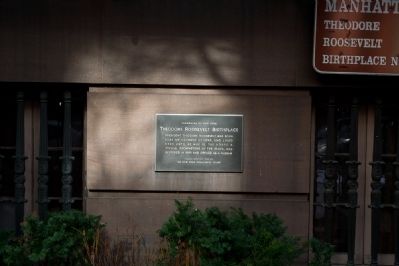
Photographed by R. C., February 5, 2011
2. Theodore Roosevelt Birthplace Marker
Marker is located on the lower left side of the front steps leading up to the main floor of the house.
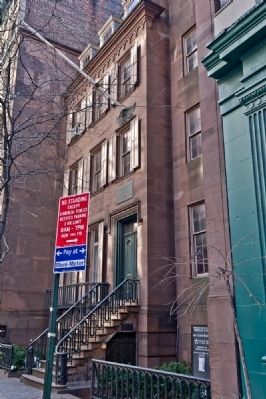
Photographed by R. C., February 5, 2011
3. Theodore Roosevelt Birthplace House
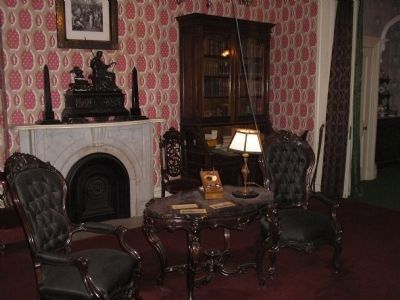
Photographed by Bill Coughlin, July 28, 2007
4. Library at Theodore Roosevelt Birthplace
Among the objects seen in the Roosevelt library are two obelisks bought during the family's trip to Egypt, which can be seen on the mantle, and a pair of horsehair chairs that often scratched young Teddy's legs.
Photographed by Bill Coughlin, July 28, 2007
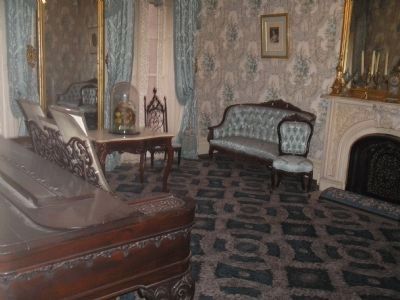
5. Theodore Roosevelt Birthplace Parlor
The parlor in Theodore Roosevelt's Birthplace is furnished in the popular Rococo Revival style, and is the most elegant room in the house.
Photographed by Allen C. Browne, August 9, 2015
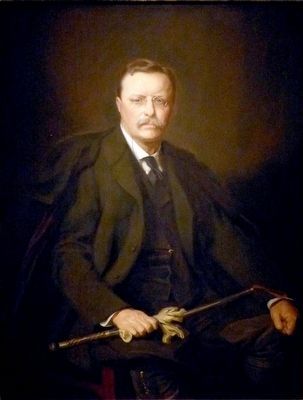
6. Theodore Roosevelt
This 1967 portrait of Theodore Roosevelt by Adrian Lamb after Philip de Lászlo's 1908 original hangs in the National Portrait Gallery in Washington DC.
“No one ever craved the presidency more than Theodore Roosevelt or used its powers more joyously. In early 1901, however, his rise toward that office was suddenly checked. Having gained national prominence as a civil service reformer, Spanish-American War hero, and reform-minded governor of New York, he was now relegated to being William McKinley's vice president. But McKinley's assassination several months later changed everything, and Roosevelt was soon rushing headlong into one of American history's most productive presidencies. By the time he left office in 1909, his accomplishments ranged from implementing landmark efforts to conserve the nation's disappearing natural heritage, to instituting some of the first significant curbs on the excesses of big business, to building the Panama Canal.
When Hungarian-born English artist Philip de Lászlo painted the original version of this portrait, he encouraged Roosevelt to have visitors chat with him during the sittings, apparently thinking that it made for a more animated likeness.” — National Portrait Gallery
“No one ever craved the presidency more than Theodore Roosevelt or used its powers more joyously. In early 1901, however, his rise toward that office was suddenly checked. Having gained national prominence as a civil service reformer, Spanish-American War hero, and reform-minded governor of New York, he was now relegated to being William McKinley's vice president. But McKinley's assassination several months later changed everything, and Roosevelt was soon rushing headlong into one of American history's most productive presidencies. By the time he left office in 1909, his accomplishments ranged from implementing landmark efforts to conserve the nation's disappearing natural heritage, to instituting some of the first significant curbs on the excesses of big business, to building the Panama Canal.
When Hungarian-born English artist Philip de Lászlo painted the original version of this portrait, he encouraged Roosevelt to have visitors chat with him during the sittings, apparently thinking that it made for a more animated likeness.” — National Portrait Gallery
Internet Archive
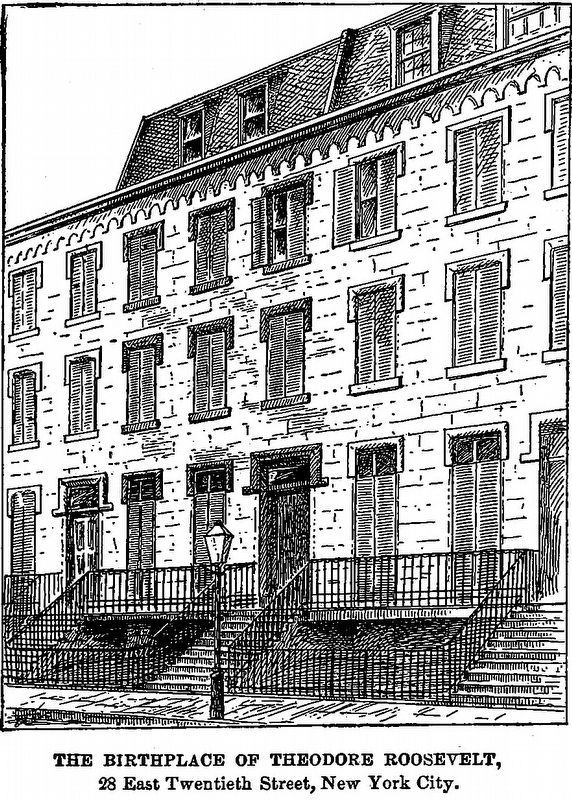
7. The Birthplace of Theodore Roosevelt
28 East Twentieth Street, New York City.
From Harper's Encyclopædia of United States History from 458 A.D. to 1902 by Benson John Lossing and Woodrow Wilson, 1902, Vol. 7, Page 462.
From Harper's Encyclopædia of United States History from 458 A.D. to 1902 by Benson John Lossing and Woodrow Wilson, 1902, Vol. 7, Page 462.
Photographed by R. C., February 5, 2011
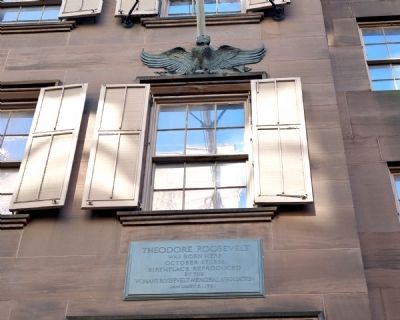
8. Theodore Roosevelt Birthplace Secondary Plaque
A secondary plaque is located above the threshold of the main entrance. It says: Theodore Roosevelt was born here October 27, 1858. Birthplace reproduced by the Womans Roosevelt Memorial Association, January 6, 1921.
Credits. This page was last revised on September 27, 2023. It was originally submitted on February 8, 2011, by Ronald Claiborne of College Station, Texas. This page has been viewed 1,262 times since then and 49 times this year. Last updated on March 7, 2020, by Larry Gertner of New York, New York. Photos: 1, 2, 3. submitted on February 8, 2011, by Ronald Claiborne of College Station, Texas. 4, 5. submitted on March 25, 2012, by Bill Coughlin of Woodland Park, New Jersey. 6. submitted on October 24, 2015, by Allen C. Browne of Silver Spring, Maryland. 7. submitted on September 17, 2023, by Allen C. Browne of Silver Spring, Maryland. 8. submitted on February 8, 2011, by Ronald Claiborne of College Station, Texas. • Michael Herrick was the editor who published this page.
