Midtown West in Manhattan in New York County, New York — The American Northeast (Mid-Atlantic)
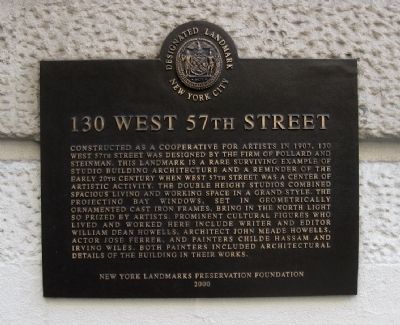
130 West 57th Street
Photographed by Andrew Ruppenstein, September 4, 2009
1. 130 West 57th Street Marker
2000
Erected 2000 by New York Landmarks Preservation Committee.
Topics. This historical marker is listed in this topic list: Notable Buildings. A significant historical year for this entry is 1907.
Location. 40° 45.89′ N, 73° 58.718′ W. Marker is in Manhattan, New York, in New York County. It is in Midtown West. It is on
this page online

Regionally, this marker is in New York City. It is also in the American Northeast, in the Mid-Atlantic, and on the Eastern Seaboard. Globally, it is in the North Atlantic Region, North America, the Western Hemisphere, the Western World, and the Anglosphere. Historically, it finds itself in what was once New Netherland and also one of the original Thirteen Colonies.
Other nearby markers. At least 8 other markers are within walking distance of this marker: Steinway Hall (within shouting distance of this marker); "The Writers' Room" (about 300 feet away, measured in a direct line); 163-165 West 57th Street (about 300 feet away); Carnegie Hall (about 400 feet away); Ignacy Jan Paderewski (about 400 feet away); Alwyn Court Apartments (about 400 feet away); City Center (about 500 feet away); Rodin Studios (about 600 feet away). Touch for a list and map of all markers in Manhattan.
Regarding 130 West 57th Street. From the 1999 Landmarks Preservation Commission designation: "...among
Photographed by Andrew Ruppenstein, September 4, 2009
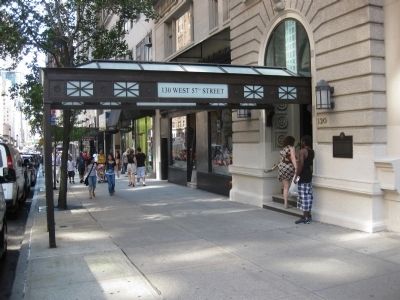
2. 130 West 57th Street - Wide Shot Showing Entryway and Marker
Photographed by Andrew Ruppenstein, September 4, 2009
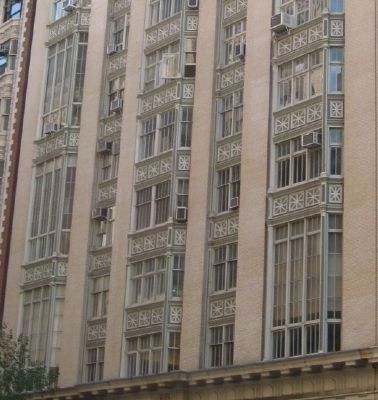
3. Closeup of Bay Windows Set in Ornamented Cast Iron Frames
On the south side of the street, with double-height windows, the front studios receive a northern light.
The building is listed in the "AIA (American Institute of Architects) Guide to New York City, Fifth Edition".
Also see . . . MY MANHATTAN; Life Is an Art On 57th Street. Sandee Brawarsky's 2002 New York Times article on the artistic and cultural attractions of 57th Street. (Submitted on September 10, 2009.)
Photographed by Andrew Ruppenstein, September 4, 2009
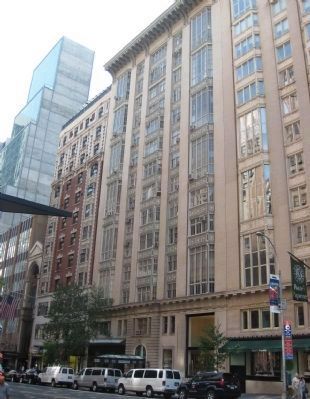
4. 130 West 57th Street
From the Landmarks Preservation Commission designation: In 1907, four lots on 57 Street were purchased by Robert Vonnoh, a painter who was living at 27 West 67 Street….. The four and five story masonry buildings on the site were torn down. A new building application was filed at the Department of Buildings in September, 1907, for a “high-class elevator apartment house.” Construction, by the William J. Taylor Co-Operative Building Company, was completed in October, 1908.
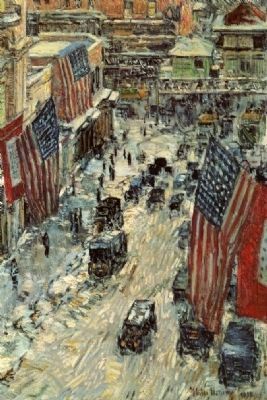
Source: Wikipedia.org
5. Flags on 57th Street by Childe Hassam, 1918
A view of 57th Street as painted by Childe Hassam, almost certainly as seen from his studio looking east towards what is now the Avenue of the Americas.
Credits. This page was last revised on January 31, 2023. It was originally submitted on September 9, 2009, by Andrew Ruppenstein of Lamorinda, California. This page has been viewed 1,964 times since then and 153 times this year. Last updated on March 12, 2020, by Larry Gertner of New York, New York. Photos: 1, 2, 3. submitted on September 9, 2009, by Andrew Ruppenstein of Lamorinda, California. 4, 5. submitted on September 10, 2009, by Andrew Ruppenstein of Lamorinda, California. • Michael Herrick was the editor who published this page.
