Near Boulder in Garfield County, Utah — The American Mountains (Southwest)
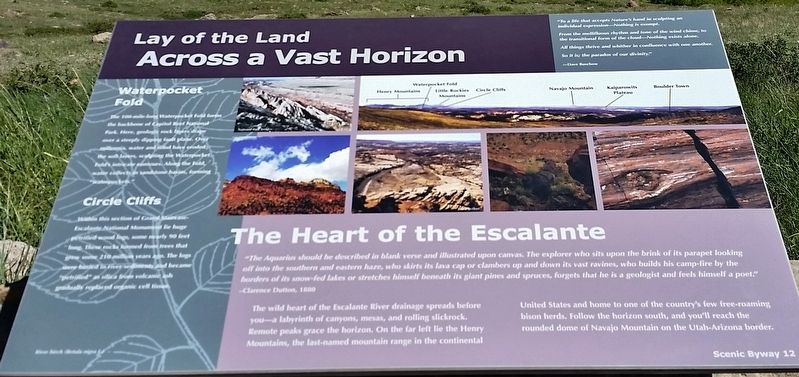
Across A Vast Horizon
Lay of the Land
Photographed by Cosmos Mariner, June 17, 2016
1. Across A Vast Horizon Marker
“To a life that accepts Nature’s hand in sculpting an
individual expression — Nothing is exempt.
From the mellifluous rhythm and tone of the wind chime, to the traditional form of the cloud — Nothing exists alone.
All things thrive and whither in confluence with one another.
So it is; the paradox of our divinity.”
—Dave Buschow
The Heart of the Escalante
"The Aquarius should be described in blank verse and illustrated upon canvas. The explorer who sits upon the brink of its parapet looking off into the southern and eastern haze, who skirts its lava cap or clambers up and down its vast ravines, who builds his campsite by the borders of its snow-fed lakes or stretches himself beneath its giant pines and spruces, forgets that he is a geologist and feels himself a poet.”
—Clarence Dutton, 1880
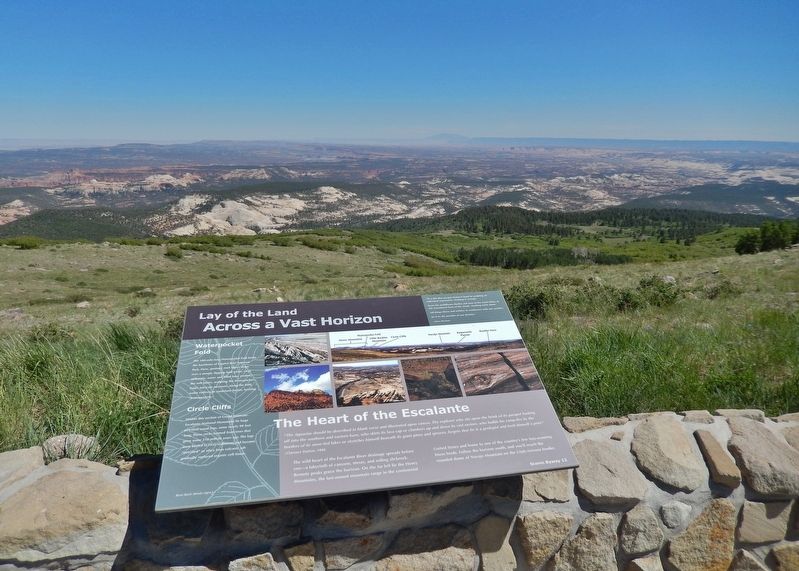
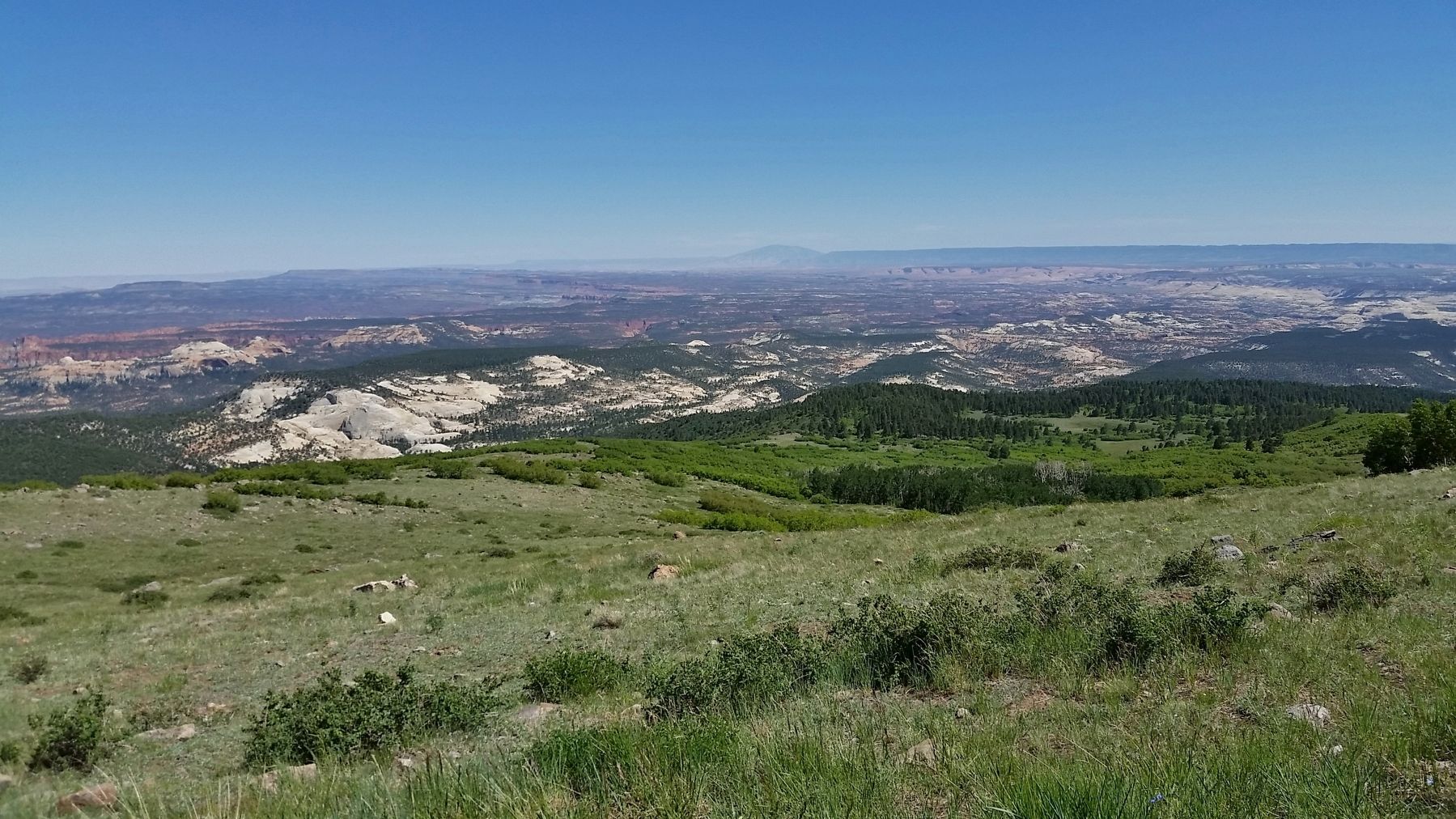
The wild heart of the Escalante River drainage spreads before you — a labyrinth of canyons, mesas, and rolling slickrock. Remote peaks grace the horizon. On the far left lie the Henry Mountains, the last-named mountain range in the continental United States and home to one of the country’s few
this page online
Waterpocket Fold
The 100-mile-long Waterpocket Fold forms the backbone of Capitol Reef National Park. Here, geologic rock layers drape over a steeply dipping fault plane. Over millennia, water and wind have eroded the soft layers, sculpting the Waterpocket Fold's intricate contours. Along the Fold, water collects in sandstone basins, forming "waterpockets."
Circle Cliffs
Within this section of Grand Staircase-Escalante National Monument lie huge petrified wood logs, some nearly 90 feet long. These rocks formed from trees that grew some 210 million years ago. The logs were buried in river sediments and became "petrified" as silica from volcanic ash gradually replaced organic cell tissue.
Topics. This historical marker is listed in this topic list: Natural Features.
Location. 38° 0.694′ N, 111° 21.522′ W. Marker is near Boulder, Utah, in Garfield County. It is on Point Lookout Road (Forest Road 1977) 0.2 miles south of Utah Route 12. Marker is located at
Photographed by Cosmos Mariner, June 17, 2016
2. Across A Vast Horizon Marker

Regionally, this marker is in Canyon Country and specifically in Color Country. It is also in the American Mountain West, on the Colorado Plateau, and at the Four Corners. Globally, it is in North America, the Western Hemisphere, the Western World, and the Anglosphere. Historically, it finds itself in what was once New Spain and also Mexico’s Alta California.

Other nearby markers. At least 6 other markers are within 17 miles of this marker, measured as the crow flies: Paving Boulder Mountain Road (here, next to this marker); The Coombs Site: A 12th Century Puebloan Village (approx. 7.8 miles away); Early Explorers (approx. 8.6 miles away); Changing Times (approx. 9.7 miles away); Boulder Utah (approx. 9.7 miles away); Passage Through Time (approx. 16.3 miles away).
Photographed by Cosmos Mariner, June 17, 2016
3. The Heart of the Escalante
Credits. This page was last revised on March 16, 2020. It was originally submitted on March 15, 2020, by Cosmos Mariner of Cape Canaveral, Florida. This page has been viewed 332 times since then and 13 times this year. Photos: 1. submitted on March 15, 2020, by Cosmos Mariner of Cape Canaveral, Florida. 2, 3. submitted on March 16, 2020, by Cosmos Mariner of Cape Canaveral, Florida.
