Spokane in Spokane County, Washington — The American West (Northwest)
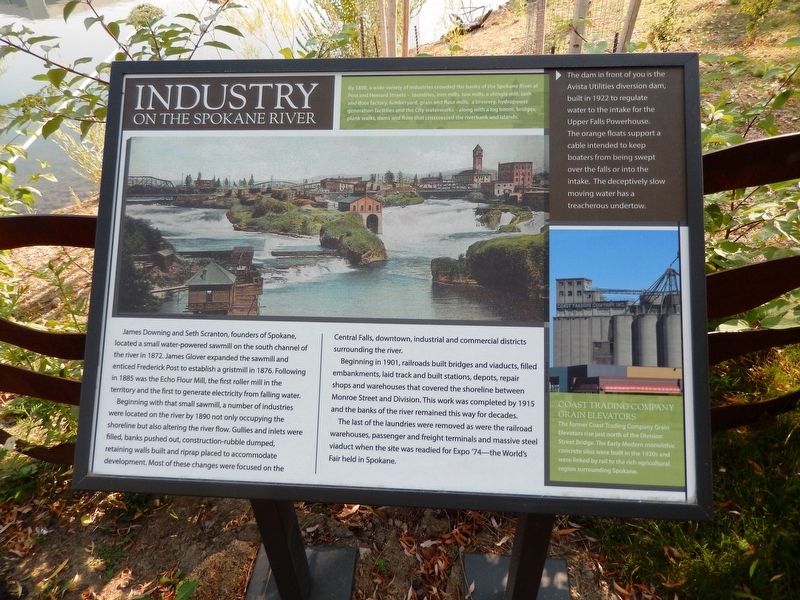
Industry on the Spokane River

Photographed by Cosmos Mariner, August 2, 2015
1. Industry on the Spokane River Marker
Beginning with that small sawmill, a number of industries were located on the river by 1890 not only occupying the shoreline but also altering the river flow. Gullies and inlets were filled, banks pushed out, construction-rubble dumped, retaining walls built and riprap placed to accommodate development. Most of these changes were focused on the Central Falls, downtown, industrial and commercial districts surrounding the river.
Beginning in 1901, railroads built bridges and viaducts, filled embankments, laid track and built stations, depots, repair shops and warehouses that covered the shoreline between Monroe Street and Division. This work was completed by 1915 and the banks of the river remained this way for decades.
The last of the laundries were removed
this page online
Topics. This historical marker is listed in these topic lists: Industry & Commerce • Railroads & Streetcars • Settlements & Settlers. A significant historical year for this entry is 1872.
Location. 47° 39.71′ N, 117° 24.884′ W. Marker is in Spokane, Washington, in Spokane County. It can be reached from North Spokane Falls Court 0.1 miles north of West Spokane Falls Boulevard. Marker is located on the Centennial Trail, overlooking the Spokane River. Touch for map. Marker is at or near this postal address: 322 North Spokane Falls Court, Spokane WA 99201, United States of America. Touch for directions.

Regionally, this marker is in the American Mountain West and in the Lewis & Clark Corridor. Globally, it is in North America, on the Pacific Rim, in the Western Hemisphere, in the Western World, and in the Anglosphere.
Other nearby markers. At least 8 other markers are within walking distance of this marker: A Legacy of Railroads (here, next to this marker);

2. Marker detail: Spokane circa 1890s
By 1890, a wide variety of industries crowded the banks of the Spokane River Post and Howard Streets — laundries, Iron mills, saw mills, a shingle mill, sash and door factory, lumberyard, grain and flour mills, a brewery, hydropower generation facilities and the City waterworks — along with a log boom, bridge plank walks, dams and flues that crisscrossed the riverbank and islands.
Also see . . .
1. J. J. Downing and S. R. Scranton file claims and build a sawmill at Spokane Falls in May 1871. In May 1871, J .J. Downing and S. R. Scranton file claims and build a sawmill at Spokane Falls. It is the first American settlement at what will become downtown Spokane. Downing and Scranton arrived along the south bank of the Spokane River leading strings of packhorses. The men were the subjects of arrest warrants held by the U.S. Marshal in Montana alleging livestock theft. They built a hand-powered sawmill using logs floated down the river. (Submitted on April 22, 2020, by Cosmos Mariner of Cape Canaveral, Florida.)
2. The History of Spokane Washington. The founding

3. Marker detail: Coast Trading Company Grain Elevators
The former Coast Trading Company Grain Elevators rise just north of the Division Street Bridge. The Early Modern monolithic concrete silos were built in the 1920s and were linked by rail to the rich agricultural region surrounding Spokane.
Photographed by Cosmos Mariner, August 2, 2015
4. Industry on the Spokane River Marker

Photographed by Cosmos Mariner, August 2, 2015
5. Avista Utilities Diversion Dam (view from near marker)
The dam in front of you is the Avista Utilities diversion dam, built in 1922 to regulate water to the intake for the Upper Falls Powerhouse. The orange floats support a cable intended to keep boaters from being swept over the falls or into the intake. The deceptively slow moving water has a treacherous undertow.
Credits. This page was last revised on April 22, 2020. It was originally submitted on April 21, 2020, by Cosmos Mariner of Cape Canaveral, Florida. This page has been viewed 616 times since then and 54 times this year. Photos: 1, 2, 3, 4, 5. submitted on April 22, 2020, by Cosmos Mariner of Cape Canaveral, Florida.
