Central East Austin in Travis County, Texas — The American South (West South Central)
Victory Grill
Photographed by Larry D. Moore, May 6, 2020
1. Victory Grill Marker
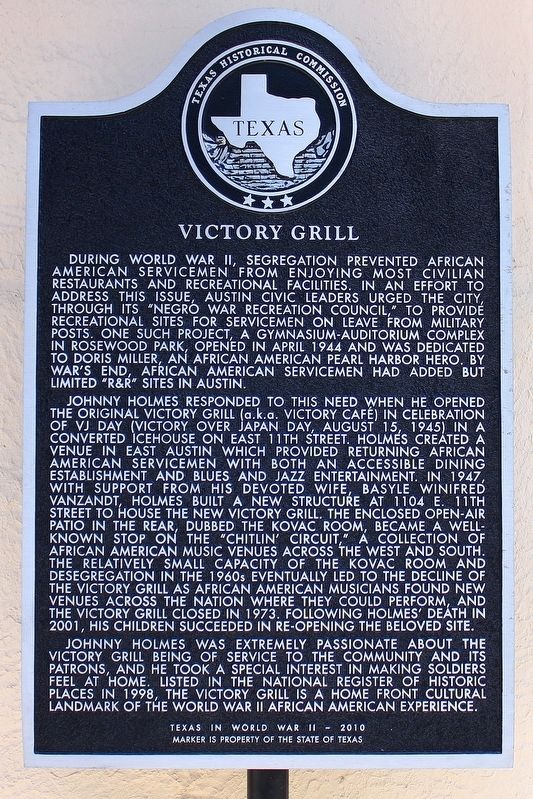
During World War II, segregation prevented African American servicemen from enjoying most civilian restaurants and recreational facilities. In an effort to address this issue, Austin civic leaders urged the city, through its “Negro War Recreation Council,” to provide recreational sites for servicemen on leave from military posts. One such project, a gymnasium-auditorium complex in Rosewood Park, opened in April 1944 and was dedicated to Doris Miller, an African American Pearl Harbor hero. By war’s end, African American servicemen had added but limited “R&R” sites in Austin.
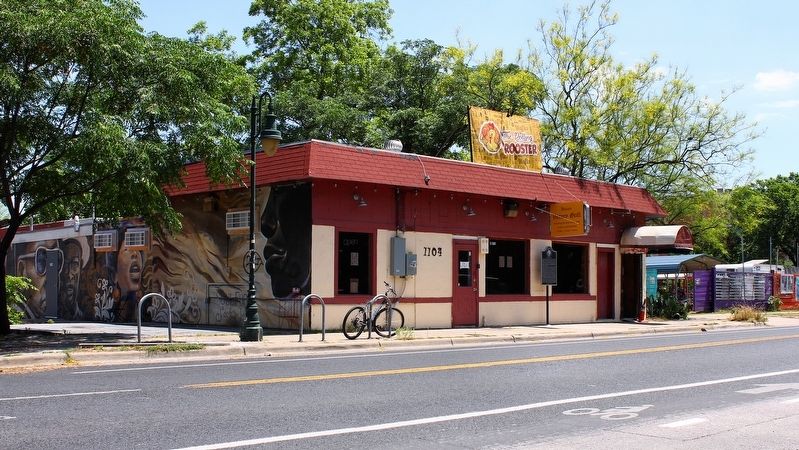
Johnny Holmes responded to this need when he opened the original Victory Grill (a.k.a. Victory Café) in celebration of VJ Day (Victory over Japan Day, August 15, 1945) in a converted icehouse on East 11th Street. Holmes created a venue in East Austin which provided returning African American servicemen with both an accessible dining establishment and blues and jazz entertainment. In 1947, with support from his devoted wife, Basyle Winifred Vanzandt, Holmes built a new structure at 1104 E. 11th Street to house the new Victory Grill. The enclosed open-air patio in the rear, dubbed the Kovac Room, became a well-known stop on the “Chitlin’ Circuit,” a collection of African American music venues across the west and south. The relatively small capacity of the Kovac Room and desegregation in the 1960s eventually led to the decline of the Victory Grill as African American musicians found new venues across the nation where they could perform, and the Victory Grill closed in 1973. Following Holmes’ death in 2001, his children succeeded in re-opening the beloved site.
Johnny Holmes was extremely passionate about the Victory Grill being of service to the community and its patrons, and he took a special interest
this page online
Texas in World War II - 2010
Marker is property of the State of Texas
Erected 2010 by Texas Historical Commission. (Marker Number 15520.)
Topics. This historical marker is listed in these topic lists: African Americans • Entertainment • War, World II. A significant historical date for this entry is August 15, 1945.
Location. 30° 16.143′ N, 97° 43.719′ W. Marker is in Austin, Texas, in Travis County. It is in Central East Austin. It is on East 11th Street near Waller Street, on the left when traveling east. Touch for map. Marker is at or near this postal address: 1104 E 11th Street, Austin TX 78702, United States of America. Touch for directions.

Regionally, this marker is in Central Texas. It is also in the American South. Globally, it is in North America, a Gulf of Mexico state, the Western Hemisphere, the Western World, and the Anglosphere. Historically, it finds itself in what was once New Spain, the Republic of Texas, one of
Photographed by Larry D. Moore, May 6, 2020
2. Victory Grill Marker Area
Other nearby markers. At least 8 other markers are within walking distance of this marker: Metropolitan African Methodist Episcopal Church (about 400 feet away, measured in a direct line); Ebenezer (Third) Baptist Church (about 700 feet away); Lynching in America / Lynching in Travis County (approx. 0.2 miles away); Wesley United Methodist Church (approx. 0.2 miles away); Winslow Turner (approx. 0.2 miles away); Dr. Gideon Lincecum (approx. 0.2 miles away); George Weedon (approx. 0.2 miles away); State Cemetery of Texas (approx. 0.2 miles away). Touch for a list and map of all markers in Austin.
Credits. This page was last revised on February 1, 2023. It was originally submitted on May 6, 2020, by Larry D. Moore of Del Valle, Texas. This page has been viewed 618 times since then and 66 times this year. Photos: 1, 2. submitted on May 6, 2020, by Larry D. Moore of Del Valle, Texas.
