Nibley in Cache County, Utah — The American Mountains (Southwest)
Original Church Farm
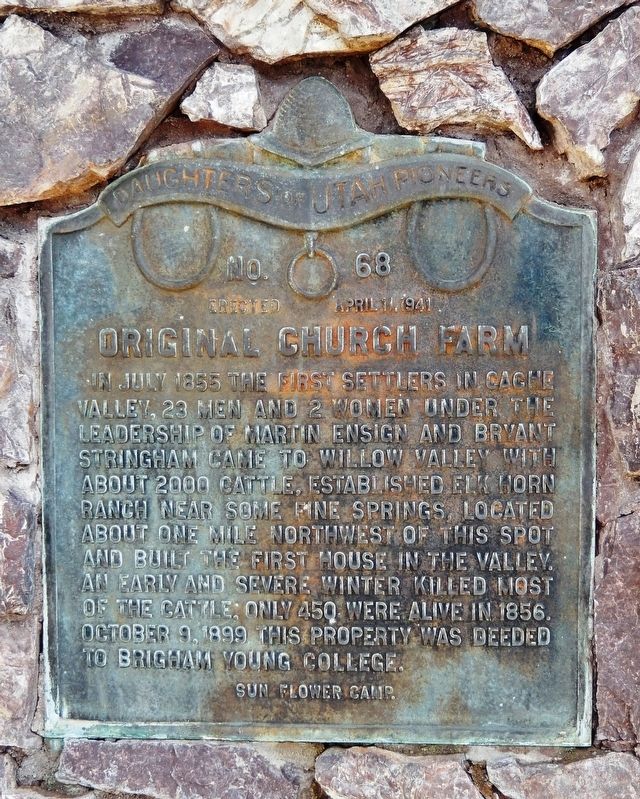
Photographed by Cosmos Mariner, July 22, 2016
1. Original Church Farm Marker
Erected 1941 by Daughters of Utah Pioneers. (Marker Number 68.)
Topics and series. This historical marker is listed in this topic list: Settlements & Settlers. In addition, it is included in the Daughters of Utah Pioneers series list. A significant historical month for this entry is July 1855.
Location. 41° 40.501′ N, 111° 50.861′ W. Marker is in Nibley, Utah, in Cache County. It is on West 3200 South west of South 600 West, on the right when traveling west. Marker is located beside the sidewalk, directly in front of the Nibley City Public Works building. Touch for map. Marker is at or near this postal address: 625 West 3200 South, Logan UT 84321, United
this page online

Regionally, this marker is in the Cache Valley. It is also in the American Mountain West and on the Colorado Plateau. Globally, it is in North America, the Rocky Mountains, the Western Hemisphere, the Western World, and the Anglosphere. Historically, it finds itself in what was once New Spain and also Mexico’s Alta California.
Other nearby markers. At least 8 other markers are within 3 miles of this marker, measured as the crow flies: Millville (approx. one mile away); Niels P. Hjorth Molasses Mill (approx. 1.9 miles away); Camp Hollow (approx. 2.3 miles away); Killed in Action WWII (approx. 2.7 miles away); The Old Rock Church (approx. 2.7 miles away); The Providence Players (approx. 2.7 miles away); Providence Pioneers (approx. 2.8 miles away); Providence Church (approx. 2.8 miles away).
Also see . . . Nibley, Utah (Wikipedia). In 1855, the Utah Territorial Legislature granted Cache Valley to Brigham Young as a herd ground for his increasing numbers of cattle. A company of cattle owners was organized to take cattle to Cache Valley. The site they chose was located
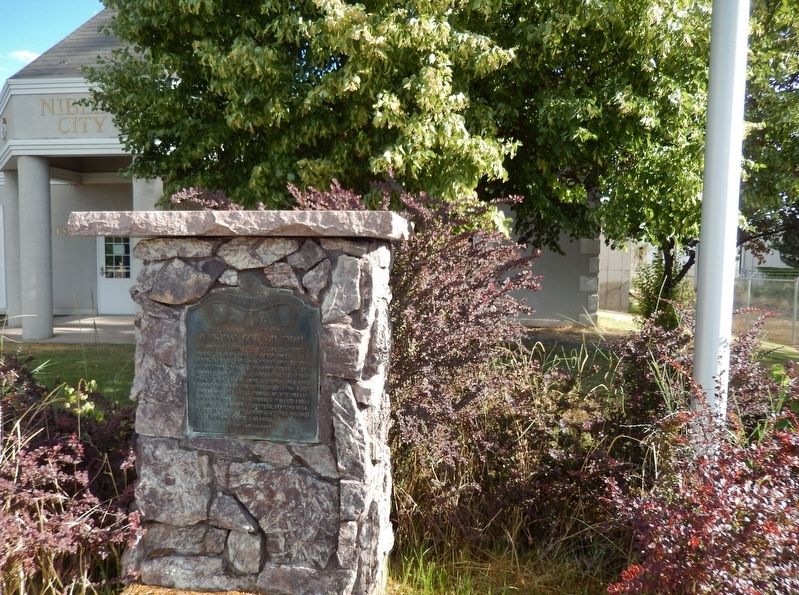
Photographed by Cosmos Mariner, July 22, 2016
2. Original Church Farm Marker

Photographed by Cosmos Mariner, July 22, 2016
3. Nibley City Public Works
Credits. This page was last revised on May 10, 2020. It was originally submitted on May 10, 2020, by Cosmos Mariner of Cape Canaveral, Florida. This page has been viewed 568 times since then and 44 times this year. Photos: 1, 2, 3. submitted on May 10, 2020, by Cosmos Mariner of Cape Canaveral, Florida.
