Cape Henlopen State Park near Lewes in Sussex County, Delaware — The American Northeast (Mid-Atlantic)
Aircraft Warning System
Civilian volunteers monitor the skies
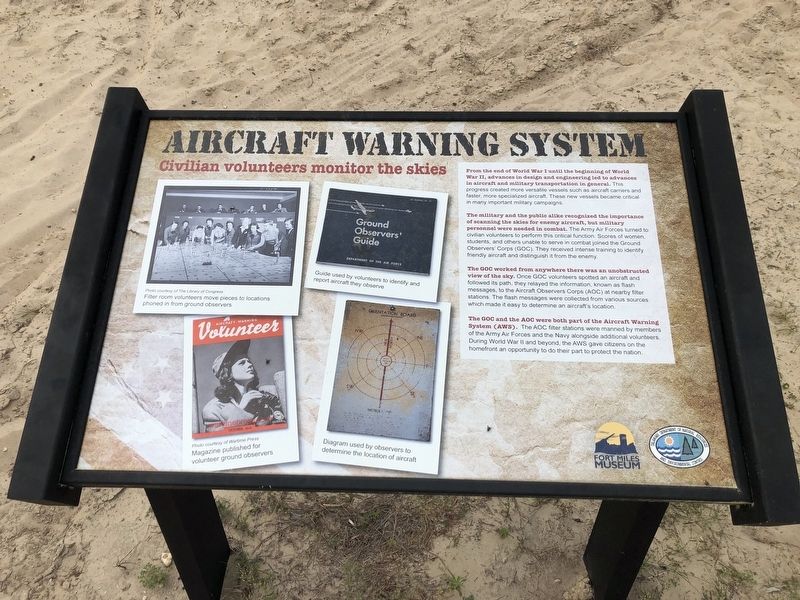
From the end of World War I until the beginning of World War II, advances in design and engineering led to advances in aircraft and military transportation in general. This progress created more versatile vessels such as aircraft carriers and faster, more specialized aircraft. These new vessels became critical in many important military campaigns.
The military and the public alike recognized the importance of scanning the skies for enemy aircraft, but military personnel were needed in combat. The Army Air Forces turned to civilian volunteers to perform this critical function. Scores of women, students, and others unable to serve in combat joined the Ground Observers' Corps (GOC). They received intense training to identify friendly aircraft and distinguish it from the enemy.
The GOC worked from anywhere there was an unobstructed view of the sky. Once GOC volunteers spotted an aircraft and followed its path, they relayed the information, known as flash messages, to the Aircraft Observers Corps (AOC) at nearby filter stations. The flash messages were collected from various sources, which made it easy to determine an
this page online
The GOC and the AOC were both part of the Aircraft Warning System (AWS). The AOC filter stations were manned by members of the Army Air Forces and the Navy alongside additional volunteers. During World War II and beyond, the AWS gave citizens on the homefront an opportunity to do their part to protect the nation.
[Captions:]
Filter room volunteers move pieces to locations phoned in from ground observers
Guide used by volunteers to identify and report aircraft they observe
Magazine published for volunteer ground observers
Diagram used by observers to determine the location of aircraft
Erected by Fort Miles Museum, Delaware Department of Natural Resources and Environmental Control.
Topics. This historical marker is listed in these topic lists: Air & Space • Communications • War, World II • Women.
Location. 38° 46.666′ N, 75° 5.364′ W. Marker is near Lewes, Delaware, in Sussex County. It is in Cape Henlopen State Park. It can be reached from Dune Road half a mile east of Campground Road, on the left when traveling east. Touch for map.

Regionally, this marker is on Delaware’s Beaches. It is also in the American Mid-Atlantic, on the Delmarva Peninsula, and on the Eastern Seaboard. Globally, it is in the North Atlantic Region, North America, the Western Hemisphere, the Western World, and the Anglosphere. Historically, it finds itself in what was once New Netherland, one of the original Thirteen Colonies, and the Antebellum South.
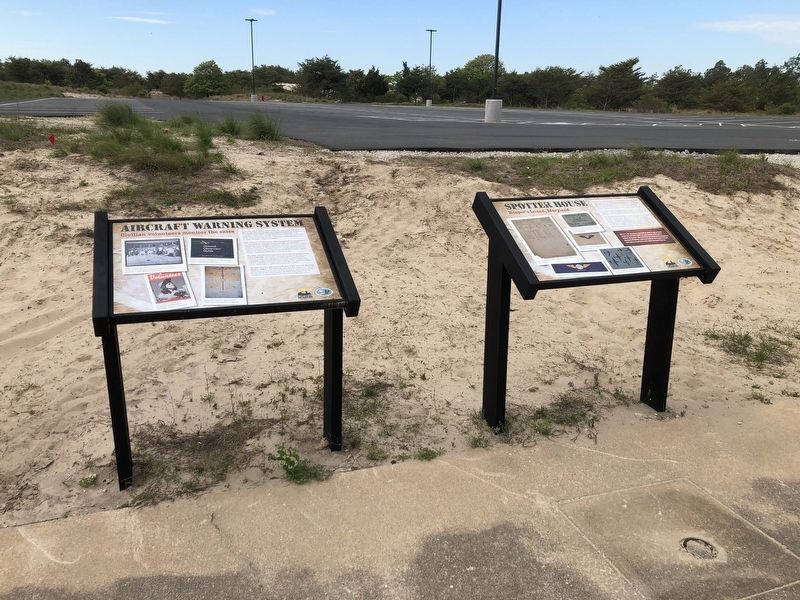
Other nearby markers. At least 8 other markers are within walking distance of this marker: Spotter House (here, next to this marker); Fort Miles Artillery Park (within shouting distance of this marker); 3-Inch Gun (within shouting distance of this marker); 155mm Gun (within shouting distance of this marker); 8-inch Gun (about 300 feet away, measured in a direct line); 90-MM Gun (about 300 feet away); 6-inch Gun (about 400 feet away); Proof Steel (about 400 feet away). Touch for a list and map of all markers in Lewes.
Credits. This page was last revised on September 18, 2023. It was originally submitted on May 17, 2020, by Devry Becker Jones of Washington, District of Columbia. This page has been viewed 373 times since then and 16 times this year. Photos: 1, 2. submitted on May 17, 2020, by Devry Becker Jones of Washington, District of Columbia.
