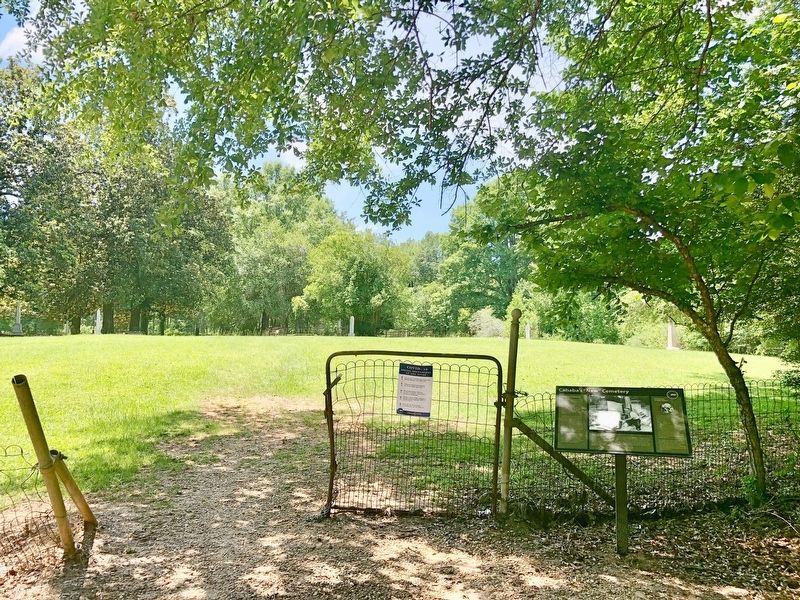
Cahaba's "New" Cemetery

Created by the Legislature
This cemetery was created by an act of Alabama's Legislature on January 31, 1852. Cahaba's town council selected this spot, but the Legislature had to confirm their choice because all public land within Cahaba - the town created to be Alabama's first capital - was still owned by the state. In 1820, an earlier cemetery in town was also created by legislative act.
Originally, this newer cemetery was surrounded by both a deep ditch and a hedge to protect the graves from wandering livestock. The current fence line was installed in 1929 by a group of well-meaning individuals, long after the cemetery had been abandoned. The location of this fence may bear little resemblance to the actual historic boundaries of the cemetery.
The self-guiding walking tour brochure will introduce you to some of Cahaba's perpetual residents. There are more people buried here that you might suspect. Ground penetrating radar has detected 294 unmarked graves.
Cahaba Breaks with Tradition
Tradtional [sic] Christian burials are oriented east to west, based on the belief that on judgement
this page online
Destroyed by Heartless Vandals
In the 1950s, the skull of a young girl
was found stuck on the top of a crowbar
in this historic cemetery. Graves were
repeatedly opened, monuments damaged,
and iron cemetery gates stolen. One
June night in 1960, S. E. Fisher, a man
who operated a hamburger stand nearby,
heard loud noises coming from the
cemetery. When he came to investigate,
a car sped out of the cemetery, almost
running him down. When the dust
cleared, Mr. Fisher discovered that nearly
every monument had been smashed with
a sledge hammer.
The culprits were never caught. To help protect the site, a gate was then installed and a caretaker was hired. In 201 Alabama's bicentennial
Erected by the Alabama Historical Commission.
Topics and series. This historical marker is listed in this topic list: Cemeteries & Burial Sites. In addition, it is included in the Alabama Historical Commission series list. A significant historical date for this entry is January 31, 1852.
Location. 32° 18.608′ N, 87° 6.237′ W. Marker is in Cahaba, Alabama, in Dallas County. It is on Oak Street 0.6 miles south of Capitol Avenue, on the right when traveling south. Located at Old Cahawba Archaeological Park. Touch for map. Marker is at or near this postal address: Oak Street, Orrville AL 36767, United States of America. Touch for directions.

Regionally, this marker is in the American South, specifically in the Deep South, and in the Black Belt. Globally, it is in North America, a Gulf of Mexico state, the Western Hemisphere, the Western World, and the Anglosphere. Historically, it finds itself in what was once New Spain, the territory of the Mississippian Culture, one of the Confederate States of America, and the Antebellum South.
Other nearby markers. At least 8 other markers are within walking distance of this marker: New Cemetery (within shouting distance of this marker); Castle Perine (approx. 0.3 miles away); Memorials for Prisoners of War (approx. 0.4 miles away); Old Cemetery (approx. 0.4 miles away); Lafayette's Tour (approx. 0.4 miles away); Working and Living in a "Dead Town" (approx. half a mile away); Anna Gayle Fry House (approx. half a mile away); Methodist Church (approx. half a mile away). Touch for a list and map of all markers in Cahaba.
Another marker is no longer nearby. Perine Well (was approx. 0.3 miles away but has been permanently removed).
More about this marker. This marker replaces an older small marker with the same title.
Credits. This page was last revised on June 2, 2020. It was originally submitted on June 2, 2020, by Mark Hilton of Montgomery, Alabama. This page has been viewed 542 times since then and 49 times this year. Photos: 1, 2. submitted on June 2, 2020, by Mark Hilton of Montgomery, Alabama.
