
Dayton in Rockingham County, Virginia — The American South (Mid-Atlantic)
Death of Lt. Meigs
The Heavy Hand of War
| — | 1864 Valley Campaigns | — |
Photographed by Bernard Fisher, December 27, 2008
1. Death Of Lt. Meigs
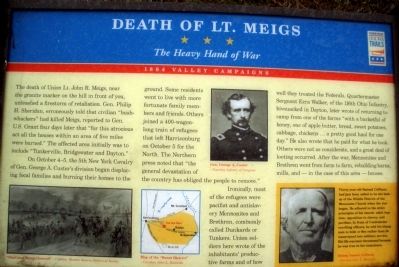
The death of Union Lt. John R. Meigs, near the granite marker on the hill in front of you, unleashed a firestorm of retaliation. Gen. Philip H. Sheridan, erroneously told that civilian “bushwhackers” had killed Meigs, reported to Gen. U.S. Grant four days later that “for this atrocious act all the houses within an area of five miles were burned.” The affected area initially was to include “Tunkerville, Bridgewater and Dayton.”
On October 4-5, the 5th New York Cavalry of Gen. George A. Custer’s division began displacing local families and burning their homes to the ground. Some residents went to live with more fortunate family members and friends. Others joined a 400-wagon-long train of refugees that left Harrisonburg on October 5 for the North. The Northern press noted that “the general devastation of the country has obliged the people to remove.”
Ironically, most of the refugees were pacifist and antislavery Mennonites and Brethren, commonly called Dunkards or Tunkers. Union soldiers here wrote of the inhabitants’ productive farms and of how well they treated the Federals. Quartermaster Sergeant Ezra Walker, of the 116th
this page online
(Sidebar):
Thirty-year-old Samuel Coffman had just been called to be the bishop of the Middle District of the Mennonite Church when the war began. He adhered to the strict principles of his church: adult baptism, opposition to slavery, and pacifism. In front of Confederate enrolling officers, he told his men to hide or flee rather than be conscripted into military service. His life was later threatened because he was true to his conscience.
Erected 2007 by Virginia Civil War Trails.
Topics and series. This historical marker is listed in this topic list: War, US Civil. In addition, it is included in the Former U.S. Presidents: #18 Ulysses S. Grant, and the Virginia Civil War Trails
Photographed by Bernard Fisher, December 27, 2008
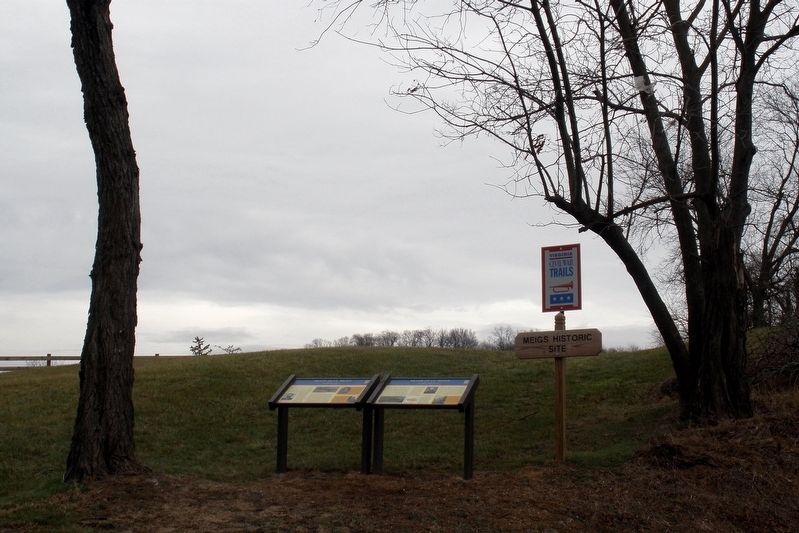
2. Meigs Historic Site
Location. Marker has been permanently removed. It was located near 38° 25.441′ N, 78° 55.32′ W. Marker was in Dayton, Virginia, in Rockingham County. It was on Meigs Lane 0.1 miles east of John Wayland Highway (Virginia Route 42), on the left when traveling east. Touch for map. Marker was in this post office area: Dayton VA 22821, United States of America.
We have been informed that this marker is no longer there and will not be replaced. This page is an archival view of what was.
Regionally, this marker was in Virginia’s Shenandoah Valley. It was also in the American South and specifically in the Upper South. Globally, it was in North America, the Western Hemisphere, the Western World, and the Anglosphere. Historically, it found itself in what was once the territory of the Mississippian Culture, one of the original Thirteen Colonies, one of the Confederate States of America, and the Antebellum South.

Other nearby markers. At least 8 other markers are within walking distance of this location: Deadly Encounter (a few steps from this marker); Site Where Lt. John Rodgers Meigs Was Killed
Photographed by John L. Heatwole
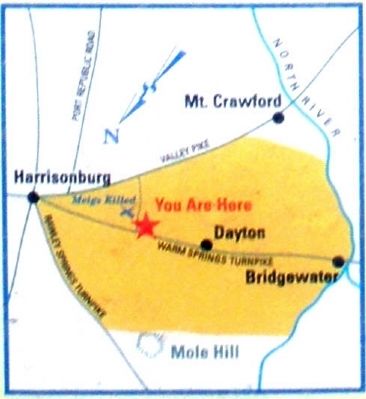
3. Map of "Burnt District"
Another marker is no longer nearby. Death of Lt. Meigs (has been replaced with this marker).
Regarding Death of Lt. Meigs. In the lower left is a sketch of “Sheridan Being Cheered”, courtesy Western Reserve Historical Society. In the upper center is a portrait of Gen. George A. Custer, Courtesy Library of Congress. In the lower center is a map of the “Burnt District”, courtesy John L Heatwole. In the sidebar is a photo of Bishop Samuel Coffman, courtesy John L Heatwole.
Photographed by Bradley Owen, July 22, 2025
4. Death of Lt. Meigs Marker
Marker has been removed. Only the "Deadly Encounter" remains at this location.
Credits. This page was last revised on July 30, 2025. It was originally submitted on January 8, 2009, by Bernard Fisher of Richmond, Virginia. This page has been viewed 1,871 times since then and 25 times this year. Photos: 1, 2, 3. submitted on January 8, 2009, by Bernard Fisher of Richmond, Virginia. 4. submitted on July 30, 2025, by Bradley Owen of Morgantown, West Virginia. • Craig Swain was the editor who published this page.
