Downtown in Hampton, Virginia — The American South (Mid-Atlantic)
Circle of Life
Cradle to Grave Experience
| — | Old North Hampton | — |
Photographed by Bernard Fisher, June 14, 2020
1. Circle of Life Marker
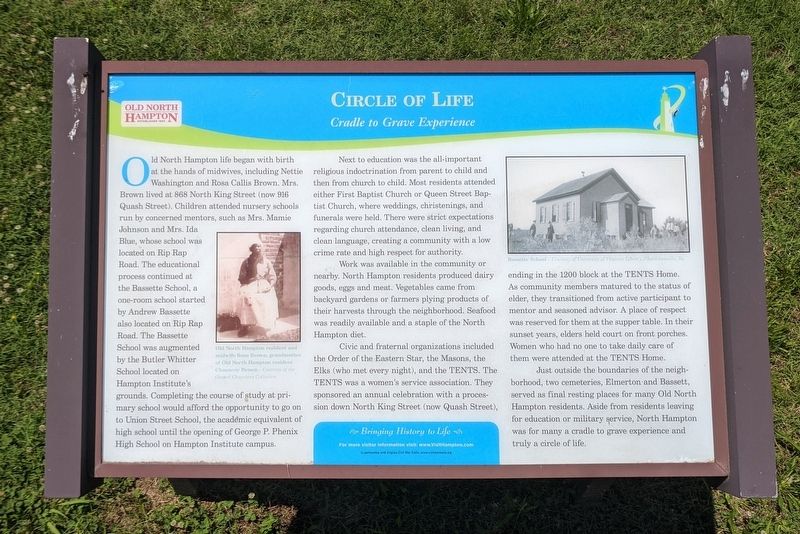
Next to education was the all-important religious indoctrination from parent to child and then from church to child. Most residents attended either First Baptist Church or Queen Street Baptist Church, where weddings, christenings, and funerals were held. There were strict expectations regarding church attendance, clean living, and clean
this page online
Work was available in the community or nearby. North Hampton residents produced dairy goods, eggs and meat. Vegetables came from backyard gardens or farmers plying products of their harvests through the neighborhood. Seafood was readily available and a staple of the North Hampton diet.
Civic and fraternal organizations included the Order of the Eastern Star, the Masons, the Elks (who met every night), and the TENTS. The TENTS was a women's service association. They sponsored an annual celebration with a procession down North King Street (now Quash Street) ending in the 1200 block at the TENTS Home. As community members matured to the status of elder, they transitioned from active participant to mentor and seasoned advisor. A place of respect was reserved for them at the supper table. In their sunset years, elders held court on front porches. Women who had no one to take daily care of them were attended at the TENTS Home.
Just outside the boundaries of the neighborhood, two cemeteries, Elmertone and Bassett, served as final resting places for
Photographed by Bernard Fisher, June 14, 2020
2. Circle of Life Marker
(captions)
Old North resident and midwife Rosa Brown, grandmother of Old North Hampton resident Chauncey Brown - Courtesy of the Gerard Chambers Collection
Bassette School — Courtesy of University of Virginia Library, Charlottesville,Va.
Erected by Bringing History to Life in partnership with Virginia Civil War Terails.
Topics. This historical marker is listed in these topic lists: African Americans • Education • Industry & Commerce • Religion & Religious Structures • Women.
Location. 37° 2.193′ N, 76° 21.033′ W. Marker is in Hampton, Virginia. It is in Downtown. It is at the intersection of Rip Rap Road and Quash Street, on the right when traveling north on Rip Rap Road. Touch for map. Marker is in this post office area: Hampton VA 23669, United States of America. Touch for directions.

Regionally, this marker is on Virginia’s Peninsula and in Coastal Virginia. It is also in the American South, specifically in the Upper South, in the Tidewater, and on the Eastern Seaboard. Globally, it is in the North Atlantic Region, North America, the Western Hemisphere, the Western World, and the Anglosphere. Historically, it finds itself in what was once the territory of the Mississippian Culture, one of the original Thirteen Colonies, one of the Confederate States of America, and the Antebellum South.
Other nearby markers. At least 8 other markers are within walking distance of this marker: Community Crossroads (here, next to this marker); John Mallory Phillips (here, next to this marker); Old North Hampton (a few steps from this marker); Mary Peake (approx. 0.4 miles away); Mary Smith Kelsey Peake (approx. half a mile away); Federation of Colored Women's Clubs (approx. 0.6 miles away); Virginia State Federation of Colored Women’s Clubs (approx. 0.6 miles away); First Baptist Church (approx. 0.6 miles away). Touch for a list and map of all markers in Hampton.
Credits. This page was last revised on February 1, 2023. It was originally submitted on June 15, 2020, by Bernard Fisher of Richmond, Virginia. This page has been viewed 383 times since then and 42 times this year. Photos: 1, 2. submitted on June 15, 2020, by Bernard Fisher of Richmond, Virginia.
