Near Cape Canaveral in Brevard County, Florida — The American South (South Atlantic)
Cape Canaveral Air Force Station
AIAA Historic Aerospace Site
Photographed by Craig Baker, 2017
1. Cape Canaveral Air Force Station Marker
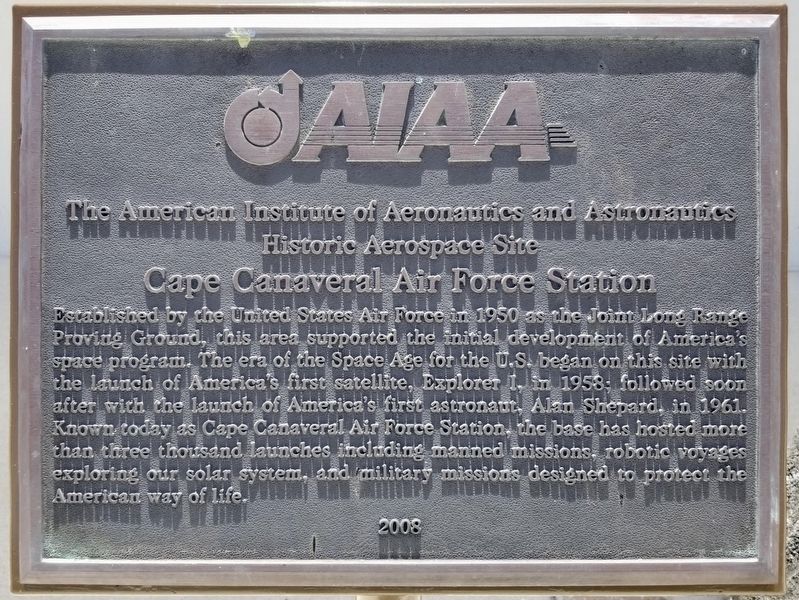
Established by the United States Air Force in 1950 as the Joint Long Range Proving Ground, this area supported the initial development of America’s space program. The era of the Space Age for the U.S. began on this site with the launch of America’s first satellite, Explorer I, in 1958; followed soon after with the launch of America’s first astronaut, Alan Shepard, in 1961. Known today as Cape Canaveral Air Force Station, the base has hosted more than three thousand launches including manned missions, robotic voyages exploring our solar system, and military missions designed to protect the American way of life.
Erected 2008 by American Institute of Aeronautics and Astronautics.
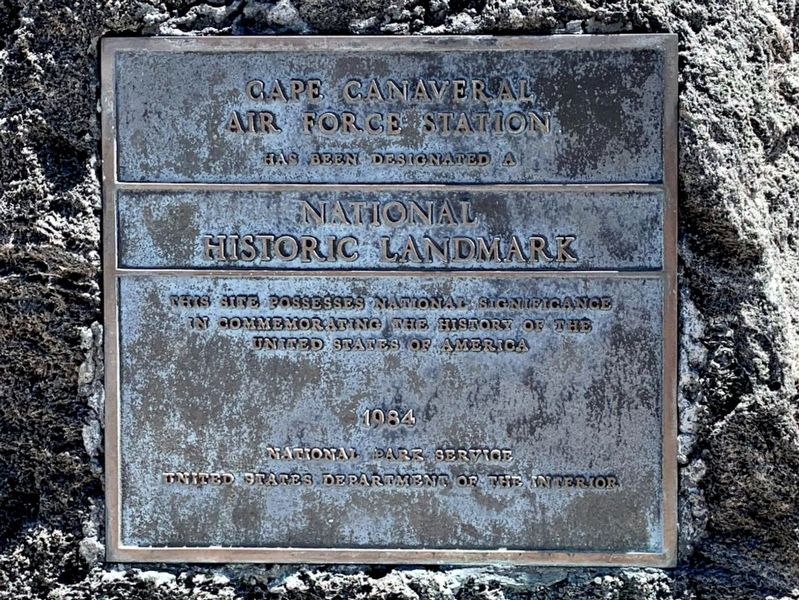
Topics and series. This historical marker is listed in this topic list: Air & Space. In addition, it is included in the AIAA Historic Aerospace Sites, and the National Historic Landmarks series lists. A significant historical year for this entry is 1950.
Location. 28° 26.671′ N, 80° 34.318′ W. Marker is near Cape Canaveral, Florida, in Brevard County. It can be reached from Museum Circle 0.2 miles south of Lighthouse Road, on the left when traveling
this page online

Regionally, this marker is in the Space Coast. It is also in the American South and on the Eastern Seaboard. Globally, it is in the North Atlantic Region, North America, a Gulf of Mexico state, the Western Hemisphere, the Western World, and the Anglosphere. Historically, it finds itself in what was once New Spain, the territory of the Mississippian Culture, one of the Confederate States of America, and the Antebellum South.
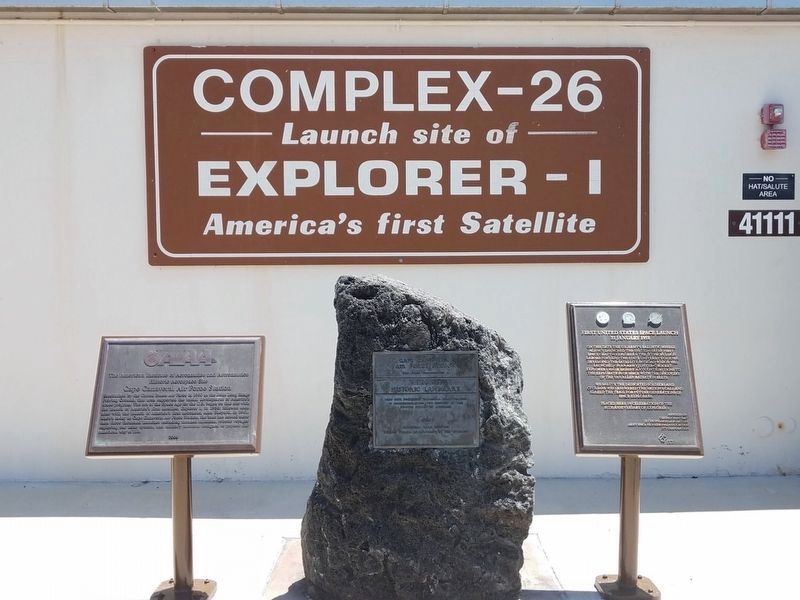
Other nearby markers. At least 8 other markers are within walking distance of this marker: First United States Space Launch (here, next to this marker); Launch Complex 26 (a few steps from this marker); Launch Site of America's First Satellite, Explorer I / The Space Race Begins (a few steps from this marker); a different marker also named Launch Complex 26 (within shouting distance of this marker); a different marker also named
Photographed by Craig Baker, 2017
2. Cape Canaveral Air Force Station Markers
Also see . . .
1. Cape Canaveral Space Force Museum. (Submitted on August 1, 2020.)
2. Cape Canaveral Air Force Station. Wikipedia (Submitted on August 3, 2020.)
3. AIAA Historic Aerospace Sites. List of 58 plaques dedicated by AIAA between 2000 and 2013. They began dedicating new plaques again in 2025. (Submitted on November 19, 2020.)
Photographed by Craig Baker, 2017
3. National Historic Landmark
Photographed by Craig Baker, 2017
4. Air Force Space and Missile Museum
Credits. This page was last revised on May 1, 2025. It was originally submitted on August 1, 2020, by Craig Baker of Sylmar, California. This page has been viewed 575 times since then and 30 times this year. Photos: 1, 2, 3, 4. submitted on August 1, 2020, by Craig Baker of Sylmar, California. • Bernard Fisher was the editor who published this page.
