What on Earth is a Levee?
Wyoming Valley Levee System
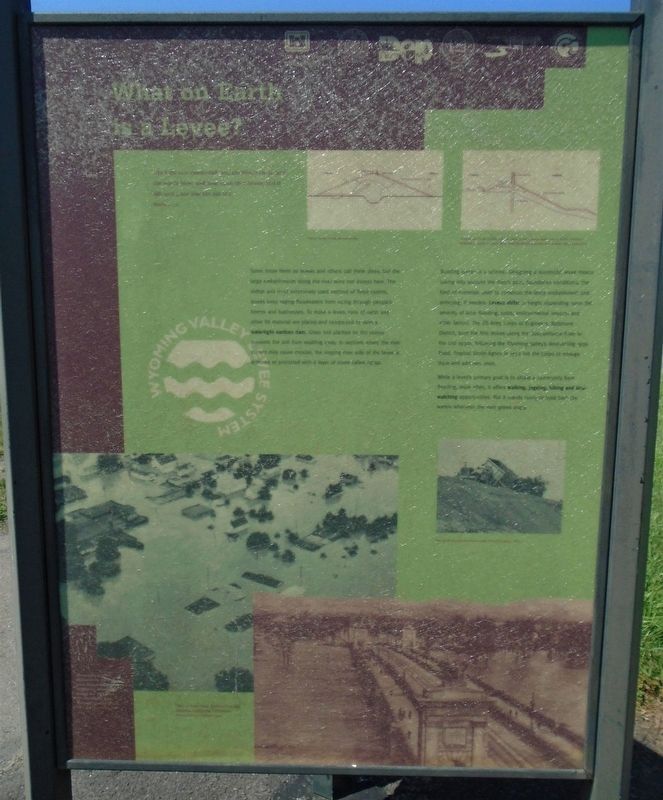
"And the rain descended, and the floods came, and the winds blew, and beat upon that house, and it fell; and great was the fall of it."
Matthew 7:27
Some know them as levees and others call them dikes, but the large embankments along the river were not always here. The oldest and most extensively used method of flood control, levees keep raging floodwaters from racing through people's homes and businesses. To make a levee, tons of earth and other fill material are placed and compacted to form a watertight earthen dam. Grass sod planted on the slopes prevents the soil from washing away. In sections where the river current may cause erosion, the sloping river side of the levee is armored or protected with a layer of stone called riprap.
Building levees is a science. Designing a successful levee means taking into account the river's path, foundation conditions, the kind of materials used to construct the levee embankment and armoring, if needed. Levees differ in height depending upon the severity of local flooding, costs, environmental impacts and other factors. The US Army Corps of Engineers, Baltimore District, built
this page online
While a levee's primary goal is to shield a community from flooding, more often, it offers walking, jogging, biking and bird-watching opportunities. But it stands ready to hold back the waters whenever the river grows angry.
[Illustrations, from top to bottom, read]
• Typical levee embankment profile
• Typical floodwall profile. Where there is not enough land area to build a levee of sufficient height a concrete or steel floodwall provides the needed flood protection.
• Placing fill to build the Swoyersville-Forty Fort levee, 1953.
• Aerial view of South Wilkes-Barre showing some homes almost completely submerged during the 1972 flood.
• View of Kirby Park, Nesbitt Park and Kingston during the 1936 flood.
Erected by Delaware & Lehigh National Heritage Corridor and Others.
Topics. This historical marker is listed in these topic lists: Charity & Public Work • Disasters • Waterways & Vessels. A significant historical year for this entry is 1936.
Location. 41° 15.339′ N,
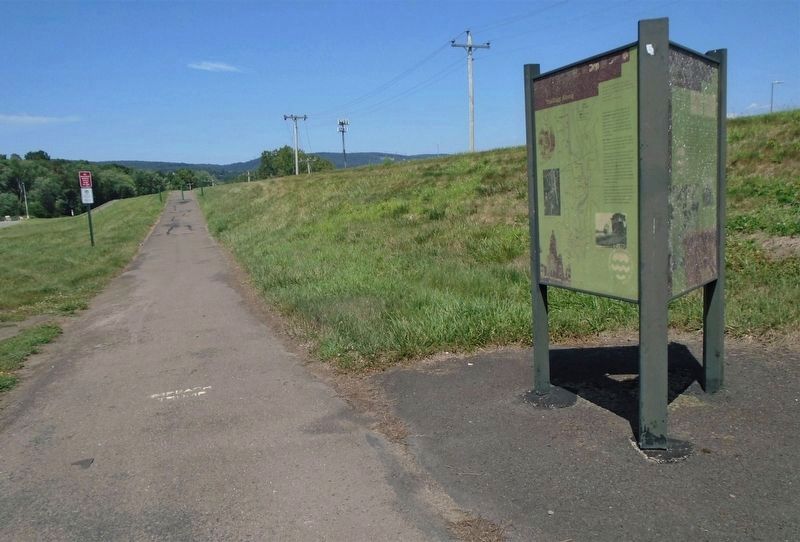

Regionally, this marker is in Pennsylvania’s Anthracite Coal Region, in the Wyoming Valley, and in Greater Scranton and Wilkes-Barre. It is also in the American Northeast, in the Mid-Atlantic, in Appalachia, and specifically in Northern Appalachia. Globally, it is in North America, the Western Hemisphere, the Western World, and the Anglosphere. Historically, it finds itself in what was once the Haudenosaunee (Iroquois) Confederacy and also one of the original Thirteen Colonies.
Other nearby markers. At least 8 other markers are within walking distance of this marker: Welcome to the Anthracite Heritage Walk (here, next to this marker); Trailing Along (here, next to this marker); Anning Owen (approx. 0.7 miles away); Wyoming Seminary (approx. 0.7 miles away); Shafer House (approx. 0.7 miles away); Philip Jaisohn, M.D. (approx. 0.7 miles away); The Korean Garden (approx. 0.7 miles away); The Kirby Common (approx. 0.7 miles away). Touch for a list and map of all markers in Kingston.
Also see . . . Hurricane Agnes documentary on WBRE-TV (1992). (Submitted on August 11, 2020, by William Fischer, Jr. of Reynoldsburg, Ohio.)
Credits. This page was last revised on July 5, 2023. It was originally submitted on August 11, 2020, by William Fischer, Jr. of Reynoldsburg, Ohio. This page has been viewed 204 times since then and 13 times this year. Photos: 1, 2. submitted on August 11, 2020, by William Fischer, Jr. of Reynoldsburg, Ohio.
