Cross Keys in Rockingham County, Virginia — The American South (Mid-Atlantic)
Battle of Cross Keys
Trimble’s Ravine
| — | 1862 Valley Campaign | — |
Photographed by Robert H. Moore, II, January 30, 2009
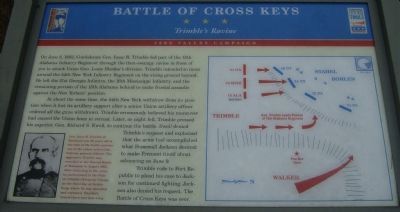
1. Battle of Cross Keys Marker
At about the same time, the 54th New York withdrew from its position when it lost its artillery support after a senior Union artillery officer ordered all guns withdrawn. Trimble erroneously believed his maneuver had caused the Union force to retreat. Later, as night fell, Trimble pressed his superior, Gen. Richard S. Ewell, to continue the battle. Ewell denied Trimble’s request and explained that the army had accomplished what Stonewall Jackson desired: to make Fremont timid about advancing on June 9.
Trimble rode to Port Republic to plead his case to Jackson for continued fighting. Jackson also denied his request. The Battle of Cross Keys was over. Caption:
this page online
Erected 2003 by Shenandoah Valley Battlefields Foundation & Virginia Civil War Trails.
Topics and series. This historical marker is listed in this topic list: War, US Civil. In addition, it is included in the Virginia Civil War Trails series list. A significant historical month for this entry is June 1926.
Location. This marker has been replaced by another marker nearby. It was located near 38° 21.144′ N, 78° 49.052′ W. Marker was in Cross Keys, Virginia, in Rockingham County. It could be reached from Goods Mill Road (County Route 708), on the right when traveling south. This is the third of three markers found at this site (Goods Mill Interpretive Area/Owen D. Graves Memorial Cross Keys Battlefield Wayside). Touch for map. Marker
Photographed by Robert H. Moore, II, January 30, 2009
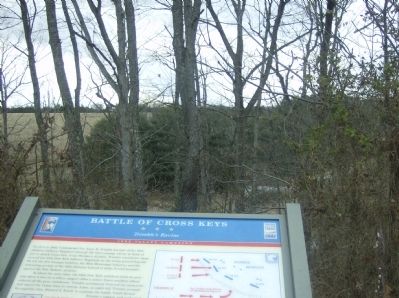
2. View of Trimble's Ravine

Regionally, this marker was in the Shenandoah Valley. It was also in the American South and specifically in the Upper South. Globally, it was in North America, the Western Hemisphere, the Western World, and the Anglosphere. Historically, it found itself in what was once the territory of the Mississippian Culture, one of the original Thirteen Colonies, one of the Confederate States of America, and the Antebellum South.
Other nearby markers. At least 8 other markers are within walking distance of this location: The Attack on Buell's Battery (about 300 feet away, measured in a direct line); Walker's Flank Attack (about 400 feet away); The Battle Dies Out (about 400 feet away); The 8th New York Advances (approx. 0.3 miles away); Marching to Disaster (approx. 0.4 miles away); Death in the Clover (approx. 0.4 miles away); The Attack's Aftermath (approx. 0.4 miles away); The Confederate Barrage (approx. 0.4 miles away). Touch for a list and map of all markers in Cross Keys.
Other markers no longer nearby. Battle of Cross Keys (was about 300 feet away but has been replaced with another marker now near it); a different marker also named Battle of Cross Keys (was about 400 feet away but has been replaced with another marker now near it).
More about this marker. In the lower left is a portrait of Gen. Isaac R. Trimble of Maryland who was 60 years old at the time of the battle and was one of the oldest active Confederate general officers. The aggressive Trimble was wounded at the Second Battle of Manassas in August 1862. After returning to the army, he participated in the Pickett-Trimble-Pettigrew Charge on the third day at Gettysburg, where he was wounded and captured. Trimble's wound there cost him a leg. On the right side of the marker is a map illustrating the advance of Tremble's and Walker's commands.
Related marker. Click here for another marker that is related to this marker. This marker has been replaced by another nearby.
Credits. This page was last revised on July 27, 2025. It was originally submitted on February 17, 2009, by Robert H. Moore, II of Winchester, Virginia. This page has been viewed 3,169 times since then and 34 times this year. Last updated on August 12, 2020, by Bradley Owen of Morgantown, West Virginia. Photos: 1, 2. submitted on February 17, 2009, by Robert H. Moore, II of Winchester, Virginia. • Bernard Fisher was the editor who published this page.
