Cross Keys in Rockingham County, Virginia — The American South (Mid-Atlantic)
Mill Creek Church
War Strikes Peaceful Homes and Fields
Photographed by Robert H. Moore, II, January 30, 2009
1. Mill Creek Church Marker
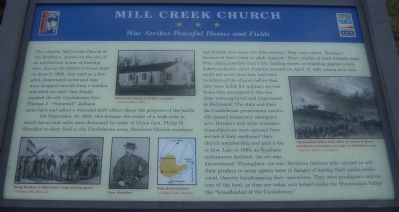
On September 30, 1864, this became the center of a wide area in which barns and mills were destroyed by order of Union Gen. Philip H. Sheridan to deny food to the Confederate army. Brethren Church members had farmed here since the 18th century. They were called “Dunkers” because of their belief in adult baptism. Their articles of faith forbade them from taking another man’s life, holding slaves, or rebelling against established authority. After Virginia seceded on April 17, 1861, young men who could not prove that they had been members of the church before that date were liable for military service. Some who attempted to flee the state were captured and imprisoned in Richmond. The state and then the Confederate
this page online
Erected by Shenandoah Valley Battlefields Foundation and Virginia Civil War Trails.
Topics and series. This historical marker is listed in this topic list: War, US Civil. In addition, it is included in the Virginia Civil War Trails series list. A significant historical month for this entry is April 1926.
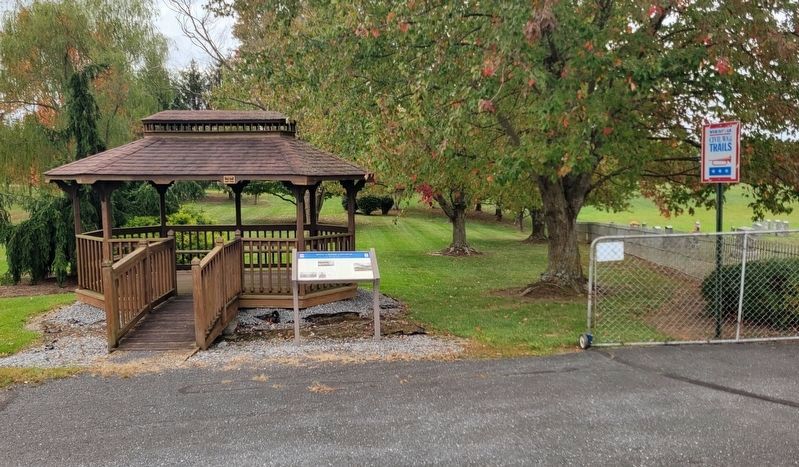
Location. This marker has been replaced by another marker nearby. It was located near 38° 20.252′ N, 78° 49.193′ W. Marker was in Cross Keys, Virginia, in Rockingham County. It was on Port Republic Road (Route 659), on the right when traveling east. Touch for map. Marker
Photographed by Bradley Owen, October 18, 2023
2. Mill Creek Church Marker

Regionally, this marker was in the Shenandoah Valley. It was also in the American South and specifically in the Upper South. Globally, it was in North America, the Western Hemisphere, the Western World, and the Anglosphere. Historically, it found itself in what was once the territory of the Mississippian Culture, one of the original Thirteen Colonies, one of the Confederate States of America, and the Antebellum South.
Other nearby markers. At least 8 other markers are within walking distance of this location: A different marker also named Mill Creek Church (here, next to this marker); Mill Creek Church and Cemetery (within shouting distance of this marker); Port Republic Battlefield (approx. 0.4 miles away); Cross Keys Battlefield (approx. 0.4 miles away); Visiting the Battlefields (approx. 0.4 miles away); Trimble Moves North (approx. 0.4 miles away); a different marker also named Cross Keys Battlefield (approx. 0.8 miles away); a different marker also named Visiting the Battlefields (approx. 0.8 miles away). Touch for a list and map
Photographed by Bradley Owen, October 13, 2012
3. Widow Pence Home
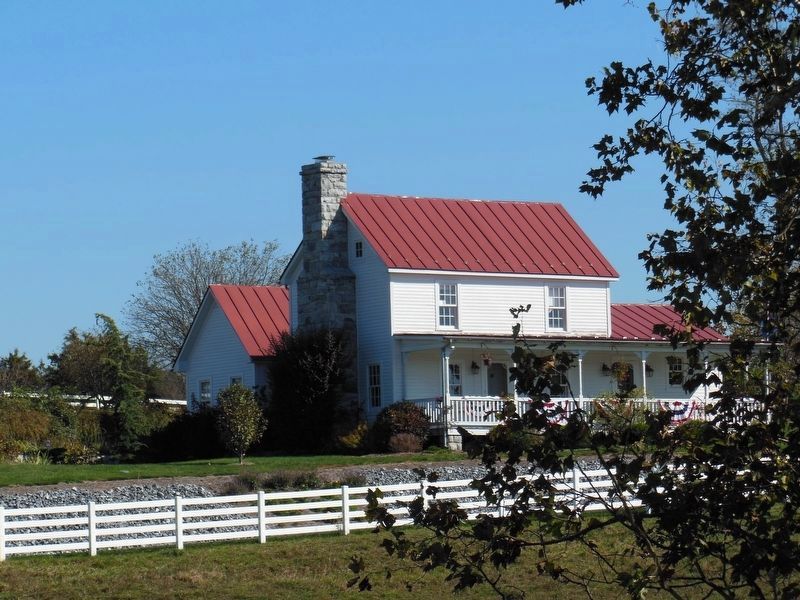
This war-time home is located on Port Republic Road, just north of Artillery Road. Confederate troops crossed the Pence property while heading north to meet the Union Army.
More about this marker. In the upper center is a photo of Mill Creek Church, Civil War-era photo – Courtesy Janet Downs. On the lower left is a sketch of Young Dunkers in Sheridan’s camp seeking passes – Courtesy John Heatwole. Next to it is a portrait of Gen. Sheridan and a map of the burned area, also courtesy John Heatwole. On the right is “Shenandoah Valley, Sept. 1864," by Alfred R. Waud, showing the devastation wrought by Sheridan’s army. – Courtesy Library of Congress
Related marker. Click here for another marker that is related to this marker. This marker has been replaced by another at this location.
Credits. This page was last revised on July 29, 2025. It was originally submitted on February 17, 2009, by Robert H. Moore, II of Winchester, Virginia. This page has been viewed 2,755 times since then and 77 times this year. Last updated on August 13, 2020, by Bradley Owen of Morgantown, West Virginia. Photos: 1. submitted on February 17, 2009, by Robert H. Moore, II of Winchester, Virginia. 2. submitted on October 18, 2023, by Bradley Owen of Morgantown, West Virginia. 3. submitted on April 17, 2021, by Bradley Owen of Morgantown, West Virginia. • Bernard Fisher was the editor who published this page.
