
Near Mabie in Randolph County, West Virginia — The American South (Appalachia)
Camp Garnett
Rich Mountain Battlefield Civil War Site
Photographed by Craig Swain, October 11, 2009
1. Camp Garnett Marker
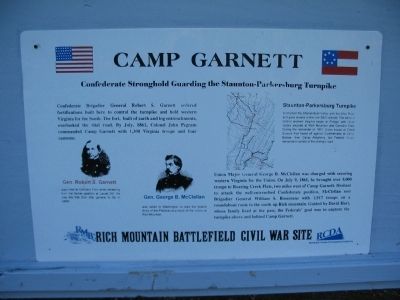
Confederate Stronghold Guarding the Staunton-Parkersburg Turnpike
Confederate Brigadier General Robert S. Garnett ordered fortifications built here to control the turnpike and hold western Virginia for the South. The fort, built of earth and log entrenchments, overlooked the vital road. By July, 1861, Colonel John Pegram commanded Camp Garnett with 1,300 Virginia troops and four cannon.
Union Major General George B. McClellan was charged with securing western Virginia for the Union. On July 9, 1861, he brought over 5,000 troops to Roaring Creek Flats, two miles west of Camp Garnett. Hesitant to attack the well-entrenched Confederate position, McClellan sent Brigadier General William S. Rosecrans with 1,917 troops on a roundabout route to the south up Rich mountain. Guided by David Hart, whose family lived at the pass, the Federals' goal was to capture the turnpike above and behind Camp Garnett.
Gen. Robert S. Garnett
was killed at Corrick's Ford while retreating from his former position at Laurel Hill. He was the first Civil War general to fall in battle.
Gen. George B. McClellan
was called to Washington to lead the federal
this page online
Staunton-Parkersburg Turnpike
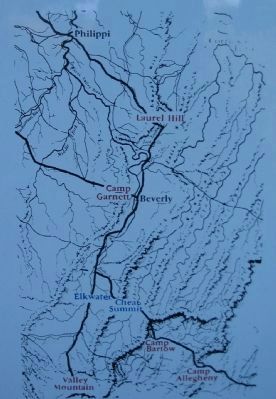
connected the Shenandoah Valley with the Ohio River and gave access to the vital B&O railroad. The battle to control western Virginia began at Philippi, with Union victory secured at Rich Mountain and Corrick's Ford. During the remainder of 1861, Union troops at Cheat Summit Fort faced off against Confederates at Camp Barlow, then Camp Allegheny, but Federal forces remained in control of the strategic road.
Topics. This historical marker is listed in this topic list: War, US Civil. A significant historical month for this entry is July 1861.
Location. Marker is missing. It was located near 38° 52.207′ N, 79° 57.359′ W. Marker was near Mabie, West Virginia, in Randolph County. It was on Rich Mountain Road / Files Creek Road (County Route 37/8), on the right when traveling west. Located in the Rich Mountain Battlefield's Camp Garnett section. Touch for map. Marker was in this post office area: Mabie WV 26278, United States of America. Touch for directions.

Regionally, this marker was in West Virginia’s Potomac Highlands. It was also in the American
Photographed by Craig Swain, October 11, 2009
2. Close Up of the Map
Other nearby markers. At least 8 other markers are within 2 miles of this location, measured as the crow flies: Staunton-Parkersburg Turnpike (within shouting distance of this marker); Fortifications (about 300 feet away, measured in a direct line); a different marker also named Camp Garnett (about 300 feet away); Battle of Rich Mountain (approx. 1.2 miles away); Rich Mountain (approx. 1.2 miles away); a different marker also named Battle of Rich Mountain (approx. 1.2 miles away); The Stable Yard (approx. 1.2 miles away); General William S. Rosecrans (approx. 1.2 miles away). Touch for a list and map of all markers in Mabie.
Other markers no longer nearby. General George B. McClellan (was a few steps from this marker but has been confirmed missing); Artillery (was about 300 feet away but has been confirmed missing); Welcome to Rich Mountain Battlefield
Photographed by Craig Swain, October 11, 2009
3. Camp Garnett Marker
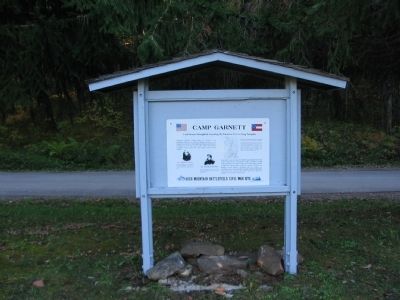
More about this marker. On the left are portraits of Gens. Garnett and McClellan. On the right is a map of the portion of West Virginia described in the text, with the turnpike and other place names mentioned indicated.
Also see . . . Rich Mountain Battlefield. An overview of the battle. (Submitted on October 25, 2009, by Craig Swain of Leesburg, Virginia.)

Photographed by Bradley Owen, February 4, 2025
4. Camp Garnett Marker
Marker is missing.
Photographed by Craig Swain, October 11, 2009
5. Trail Over Roaring Creek
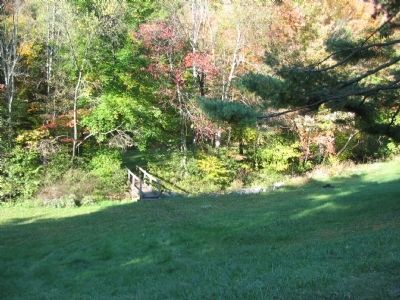
Looking out from the parking area at the bridge over Roaring Creek. Confederate trenches defended the high ground on the opposite side. In 1861, much of the hill side was bare pastures and many existing trees were felled for the defensive works.
Credits. This page was last revised on February 5, 2025. It was originally submitted on October 25, 2009, by Craig Swain of Leesburg, Virginia. This page has been viewed 1,668 times since then and 44 times this year. Last updated on September 13, 2020, by Bradley Owen of Morgantown, West Virginia. Photos: 1, 2, 3. submitted on October 25, 2009, by Craig Swain of Leesburg, Virginia. 4. submitted on February 5, 2025, by Bradley Owen of Morgantown, West Virginia. 5. submitted on October 25, 2009, by Craig Swain of Leesburg, Virginia. • Devry Becker Jones was the editor who published this page.
