
Manchester in Coffee County, Tennessee — The American South (East South Central)
War Comes to Manchester
Duck River Defense Line — A Tale of Two Occupations
| — | Tullhoma Campaign | — |
Photographed by Duane and Tracy Marsteller, September 12, 2020
1. War Comes to Manchester Marker
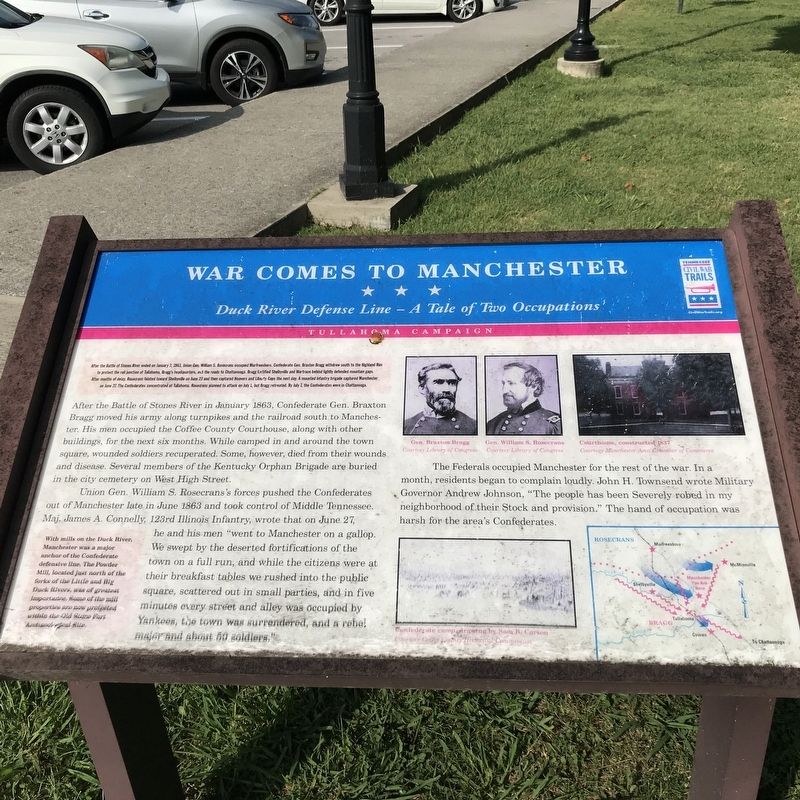
After the Battle of Stones River on January 2, 1863, Union Gen. William S. Rosecrans occupied Murfreesboro. Confederate Gen. Braxton Bragg withdrew south to the Highland Rim to protect the rail junction at Tullahoma, Bragg's headquarters, and the roads to Chattanooga. Bragg fortified Shelbyville and Wartrace behind lightly defended mountain gaps. After months of delay, Rosecrans feinted toward Shelbyville on June 23 and then captured Hoovers and Liberty Gaps the next day. A mounted infantry brigade captured Manchester on June 27. The Confederates concentrated at Tullahoma. Rosecrans planned to attack on July 1, but Bragg retreated. By July 7, the Confederates were in Chattanooga.
After the Battle of Stones River in January 1863, Confederate Gen. Braxton Bragg moved his army along turnpikes and the railroad south to Manchester. His men occupied the Coffee County Courthouse, along with other buildings, for the next six months. While camped in and around the town square, wounded soldiers recuperated. Some, however, died from their wounds and disease. Several members of the Kentucky Orphan Brigade are buried in the city
this page online
Union Gen. William S. Rosecrans's forces pushed the Confederates out of Manchester late in June 1863 and took control of Middle Tennessee. Maj. James A. Connelly, 123rd Illinois Infantry, wrote that on June 27, he and his men “went to Manchester on a gallop. We swept by the deserted fortifications of the town on a full run, and while the citizens were at their breakfast tables we rushed into the public square, scattered out in small parties, and in five minutes every street and alley was occupied by Yankees, the town was surrendered, and a rebel major and about 50 soldiers.”
The Federals occupied Manchester for the rest of the war. In a month, residents began to complain loudly . John H. Townsend wrote Military Governor Andrew Johnson, “The people has been Severely robed in my neighborhood of their Stock and provision.” The hand of occupation was harsh for the area's Confederates.
With mills on the Duck River, Manchester was a major anchor of the Confederate defensive line. The Powder Mill, located just north of the forks of the Little and Big Duck Rivers, was of greatest importance. Some of the mill properties are now protected within the Old Stone Fort Archaelogical Site.
Captions:
Top left:
Photographed by Duane and Tracy Marsteller, September 12, 2020
2. War Comes to Manchester Marker
Top middle: Gen. William S. Rosecrans Courtesy Library of Congress
Top right: Courthouse, constructed 1837 Courtesy Manchester Area Chamber of Commerce
Bottom left: Confederate camp drawing by Sam B. Carson Courtesy Coffee County Historical Commission
Erected by Tennessee Civil War Trails.
Topics and series. This historical marker is listed in this topic list: War, US Civil. In addition, it is included in the Tennessee Civil War Trails series list. A significant historical date for this entry is January 2, 1863.
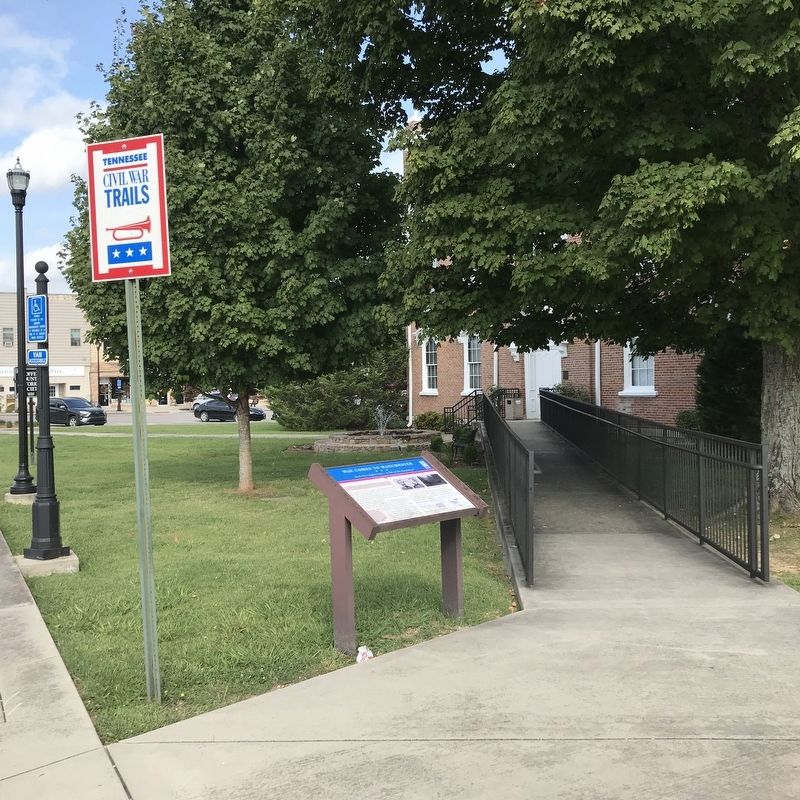
Location. 35° 28.983′ N, 86° 5.315′ W. Marker is in Manchester, Tennessee, in Coffee County. It is at the intersection of North Spring Street and West Main Street, on the left when traveling north on North Spring Street. Touch for map. Marker is at or near this postal address: 100 West Main Street, Manchester TN 37355, United States of America. Touch for directions.

Regionally, this marker is in Middle Tennessee and in the Highland Rim. It is also in the American South and specifically in the Upper South. Globally, it is in North America, the Western Hemisphere, the Western World, and the Anglosphere. Historically, it finds itself in what was once the territory of the Mississippian Culture, one of the Confederate States of America, and the Antebellum South.
Other nearby markers. At least 8 other markers are within walking distance of this marker: The Civilian Conservation Corps (a few steps from this marker); Corporal Brian James Schoff (a few steps from this marker); Desert Storm (a few steps from this marker); Korean War (within shouting distance of this marker); World War I and II Marker (within shouting distance of this marker); Vietnam War Memorial (within shouting distance of this marker); Coffee County UDC Memorial (within shouting distance of this marker); Tullahoma Campaign (within shouting distance of this marker). Touch for a list and map of all markers in Manchester.
Credits. This page was last revised on November 10, 2024. It was originally submitted on September 13, 2020, by Duane and Tracy Marsteller of Murfreesboro, Tennessee. This page has been viewed 1,451 times since then and 88 times this year. Photos: 1, 2. submitted on September 13, 2020, by Duane and Tracy Marsteller of Murfreesboro, Tennessee. • Bernard Fisher was the editor who published this page.
