Tuscaloosa in Tuscaloosa County, Alabama — The American South (East South Central)
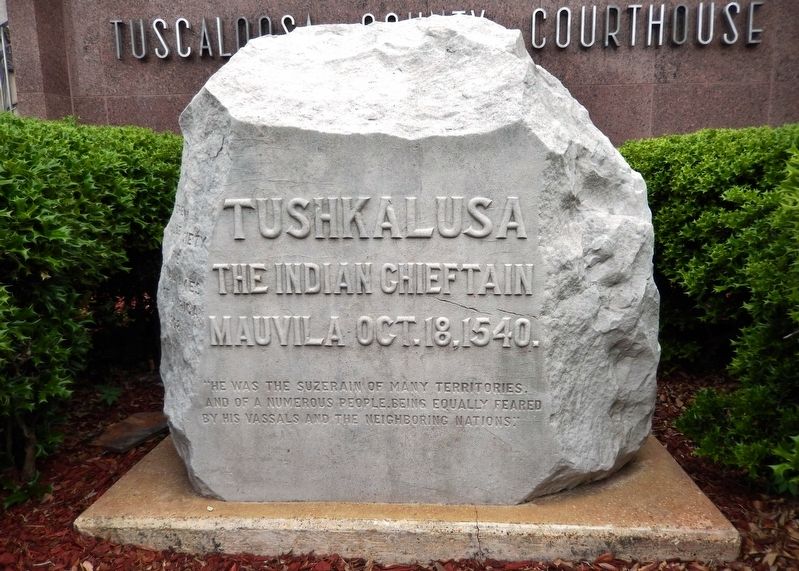
Tushkalusa
The Indian Chieftain
| — | Mauvila Oct. 18, 1540 | — |
Photographed by Cosmos Mariner, May 11, 2015
1. Tushkalusa Marker
“He was the suzerain of many territories, and of a numerous people, being equally feared by his vassals and the neighboring nations.”
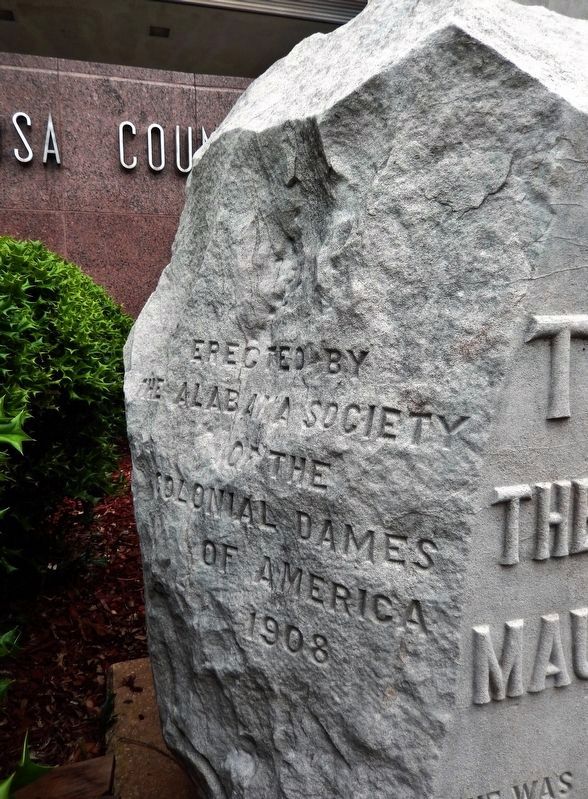
Erected 1908 by Alabama Society of the Colonial Dames of America.
Topics and series. This historical marker is listed in these topic lists: Government & Politics • Indigenous Peoples and Communities. In addition, it is included in the The Colonial Dames of America, and the The Colonial Dames of America, National Society of series lists. A significant historical date for this entry is October 18, 1540.
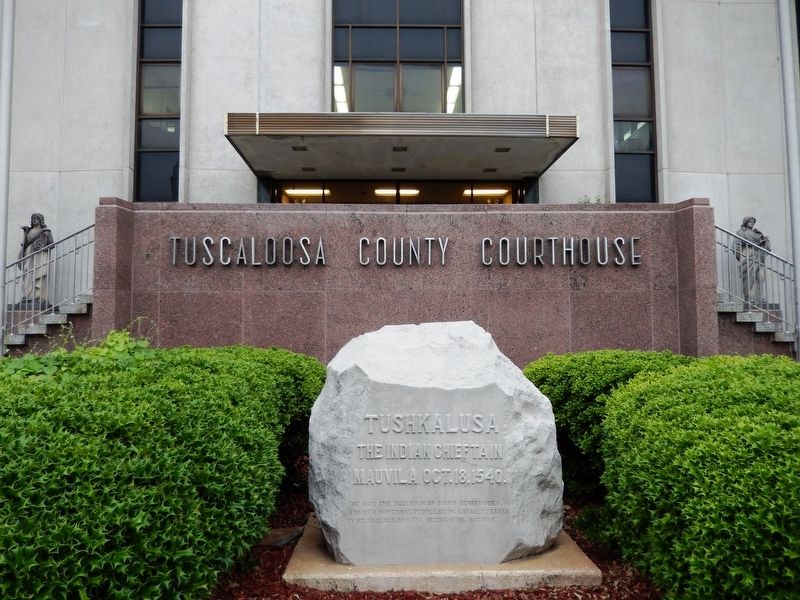
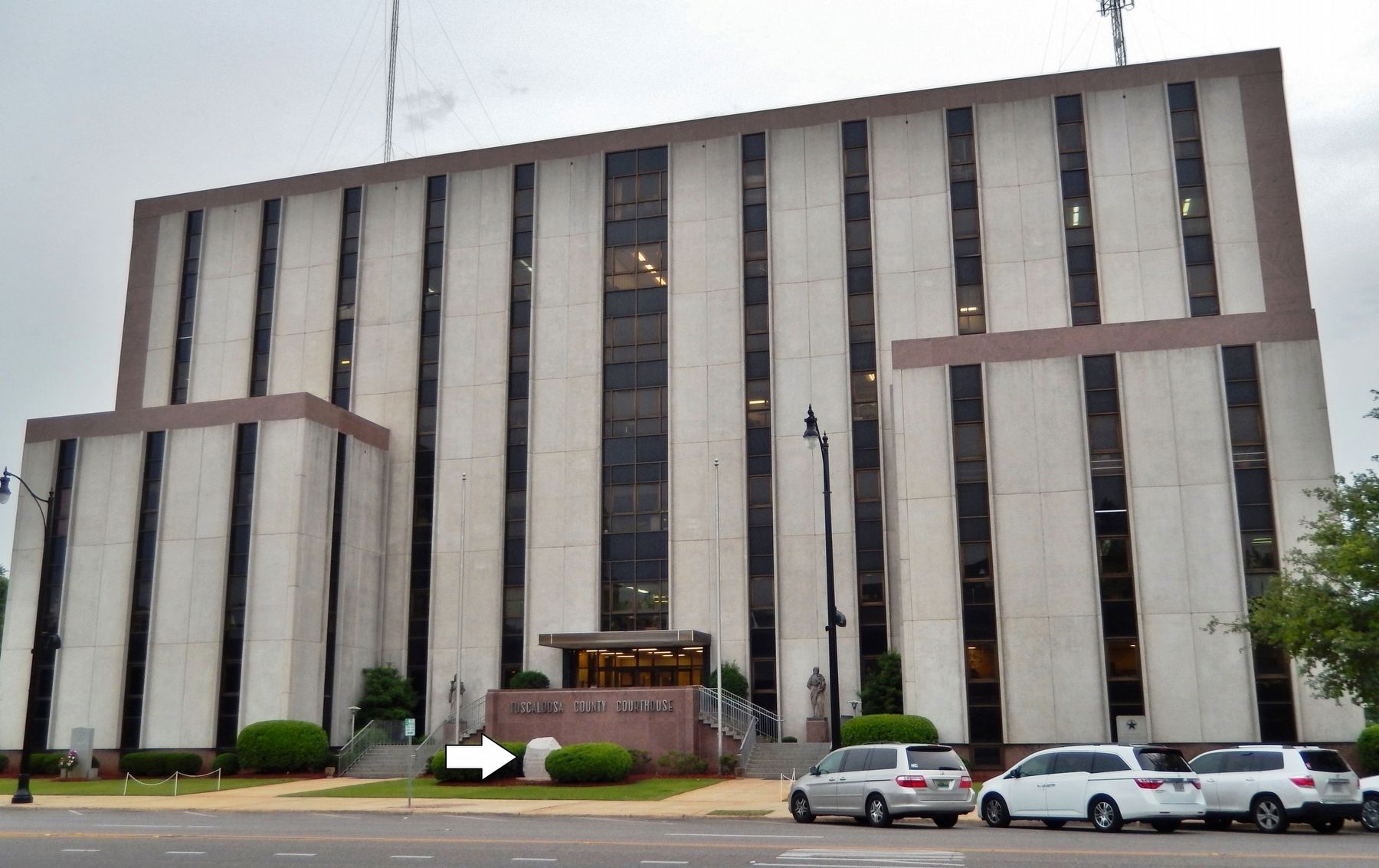
Location. 33° 12.441′ N, 87° 34.06′ W. Marker is in Tuscaloosa, Alabama, in Tuscaloosa County. It is on Greensboro Avenue (24th Avenue) south of 7th Street, on the right when traveling south. Marker is located directly in front of the Tuscaloosa County Courthouse entrance. Touch for map. Marker is at or near this postal address: 714 Greensboro Avenue, Tuscaloosa AL 35401, United States of America. Touch for directions.

Regionally, this marker is in the American South and specifically in the Deep South. Globally, it is in North America, a Gulf of Mexico state, the Western Hemisphere, the
this page online
Other nearby markers. At least 8 other markers are within walking distance of this marker: First Baptist Church (within shouting distance of this marker); Tuscaloosa First United Methodist Church (about 300 feet away, measured in a direct line); St. John The Baptist Catholic Church (about 500 feet away); Christ Episcopal Church (about 600 feet away); First Presbyterian Church (about 600 feet away); Brown's Dollar Store (approx. 0.2 miles away); April 2011 Tornado Outbreak (approx. 0.2 miles away); Alabama Corps Of Cadets Defends Tuscaloosa (approx. 0.2 miles away). Touch for a list and map of all markers in Tuscaloosa.
Also see . . .
1. Chief Tuskaloosa. His name is derived from the western Muskogean language elements "taska" and "losa," which means "Black Warrior." Also known as Tushkalusa, Tuskalusa, Tastaluca, or Tuskaluza, he was a principal chief of the ancestral Choctaw and Creek Native American confederacies who lived
Photographed by Cosmos Mariner, May 11, 2015
2. Tushkalusa Marker (left side)
The Alabama Society
of the
Colonial Dames
of America
1908
2. Tuskaloosa and Hernando De Soto’s expedition. The main sources of information about Tuskaloosa and his people are the chronicles of Hernando de Soto’s expedition to the North American mainland. By the fall of 1540, the expedition had reached the middle of modern-day Alabama. (Submitted on September 21, 2020, by Cosmos Mariner of Cape Canaveral, Florida.)
3. Battle of Mabila (Wikipedia). On October 18, 1540, de Soto and the expedition arrived at Mabila. The Spaniards burned down Mabila, and nearly all the Mabilians and their allies were killed. The natives had made two serious mistakes: they had not realized the Spaniards' advantage when mounted on horses, and they had relied too heavily on their palisade. (Submitted on September 21, 2020, by Cosmos Mariner of Cape Canaveral, Florida.)
Photographed by Cosmos Mariner, May 11, 2015
3. Tushkalusa Marker
Photographed by Cosmos Mariner, May 11, 2015
4. Tuscaloosa County Courthouse
Credits. This page was last revised on February 16, 2026. It was originally submitted on September 18, 2020, by Cosmos Mariner of Cape Canaveral, Florida. This page has been viewed 1,338 times since then and 101 times this year. Photos: 1, 2, 3, 4. submitted on September 21, 2020, by Cosmos Mariner of Cape Canaveral, Florida.
