Oneonta in Blount County, Alabama — The American South (East South Central)
Welcome to Oneonta
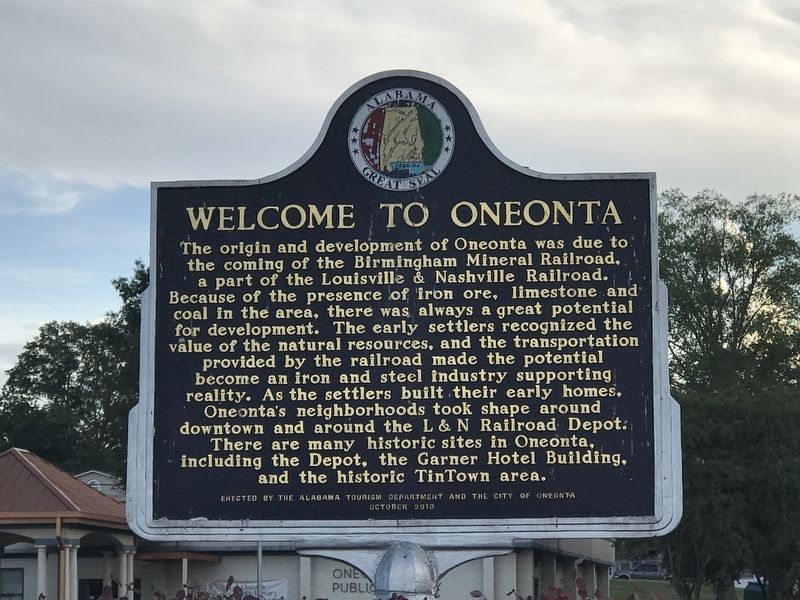
Photographed by Duane and Tracy Marsteller, September 12, 2020
1. Welcome to Oneonta Marker
Erected 2010 by Alabama Tourism Department and City of Oneonta.
Topics and series. This historical marker is listed in these topic lists: Industry & Commerce • Railroads & Streetcars • Settlements & Settlers. In addition, it is included in the Alabama Tourism Department series list.
Location. 33° 56.666′ N, 86° 28.545′ W. Marker is in Oneonta, Alabama, in Blount County.
this page online

Regionally, this marker is in North Alabama and in the Birmingham Metropolitan Area. It is also in the American South and specifically in the Deep South. Globally, it is in North America, a Gulf of Mexico state, the Western Hemisphere, the Western World, and the Anglosphere. Historically, it finds itself in what was once the original Cherokee Nation, the territory of the Mississippian Culture, one of the Confederate States of America, and the Antebellum South.
Other nearby markers. At least 8 other markers are within 9 miles of this marker, measured as the crow flies: Historic Oneonta L & N Railroad Depot (here, next to this marker); Blount County (approx. 0.2 miles away); Champion Mines (approx. one mile away); The Gamble School (approx. 1.1 miles away); Antioch Cemetery (approx. 4.4 miles away); Bailey School (approx. 8.1 miles away); Holly Springs School (approx. 8.2 miles
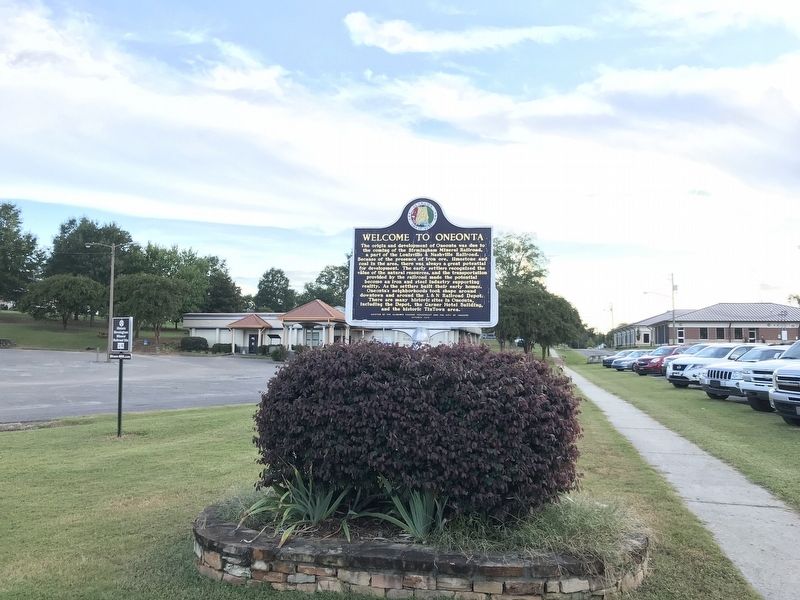
Photographed by Duane and Tracy Marsteller, September 12, 2020
2. Welcome to Oneonta Marker
Credits. This page was last revised on September 18, 2020. It was originally submitted on September 18, 2020, by Duane and Tracy Marsteller of Murfreesboro, Tennessee. This page has been viewed 1,474 times since then and 55 times this year. Photos: 1, 2. submitted on September 18, 2020, by Duane and Tracy Marsteller of Murfreesboro, Tennessee. • Mark Hilton was the editor who published this page.
