University in Minneapolis in Hennepin County, Minnesota — The American Midwest (Upper Plains)
The Liberal Arts
Driven to Discover
| — | University of Minnesota | — |
Photographed by McGhiever, June 11, 2020
1. The Liberal Arts marker
From the Beginning
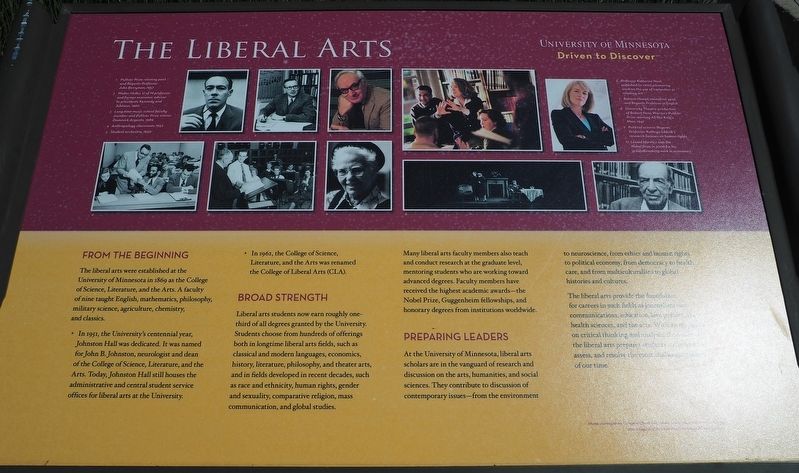
The liberal arts were established at the University of Minnesota in 1869 as the College of Science, Literature, and the Arts. A faculty of nine taught English, mathematics, philosophy, military science, agriculture, chemistry, and classics.
• In 1951, the University's centennial year, Johnston Hall was dedicated. It was named for John B. Johnston, neurologist and dean of the College of Science, Literature, and the Arts. Today, Johnston Hall still houses the administrative and central student service offices for liberal arts at the University.
• In 1962, the College of Science, Literature, and the Arts was renamed the College of Liberal Arts (CLA).
Broad Strength
Liberal arts students now earn roughly one-third of all degrees granted by the University. Students choose from hundreds of offerings both in longtime liberal arts fields, such as classical and modern languages, economics, history, literature, philosophy, and theater arts, and in fields developed in recent decades, such as race and ethnicity, human rights, gender and sexuality, comparative religion, mass communication, and global
this page online
Many liberal arts faculty members also teach and conduct research at the graduate level, mentoring students who are working toward advanced degrees. Faculty members have received the highest academic awards–the Nobel Prize, Guggenheim fellowships, and honorary degrees from institutions worldwide.
Preparing Leaders
At the University of Minnesota, liberal arts scholars are in the vanguard of research and discussion on the arts, humanities, and social sciences. They contribute to discussion of contemporary issues–from the environment to neuroscience, from ethics and human rights to political economy, from democracy to health care, and from multiculturalism to global histories and cultures.
The liberal arts provide the foundation for careers in such fields as journalism and communications, education, law, politics, the health sciences, and the arts. With emphasis on critical thinking and analysis, the study of the liberal arts prepares students to describe, assess, and resolve the most challenging issues of our time.
Photo captions
1. Pulitzer Prize-winning poet and Regents Professor John Berryman, 1957
2. Walter Heller, U of M professor and former economic adviser to presidents Kennedy and Johnson, 1960
3. Long-time music school faculty member and Pulitzer Prize winner Dominick Argento, 1989
4. Anthropology classroom, 1952
5. Student orchestra, 1956
6. Professor Katherine Nash published (in 1970) pioneering work on the use of computers in creating art
7. Patricia Hampl, memoirist, poet, and Regents Professor in English
8. University Theatre production of Robert Penn Warren's Pulitzer Prize-winning
Photographed by McGhiever, June 11, 2020
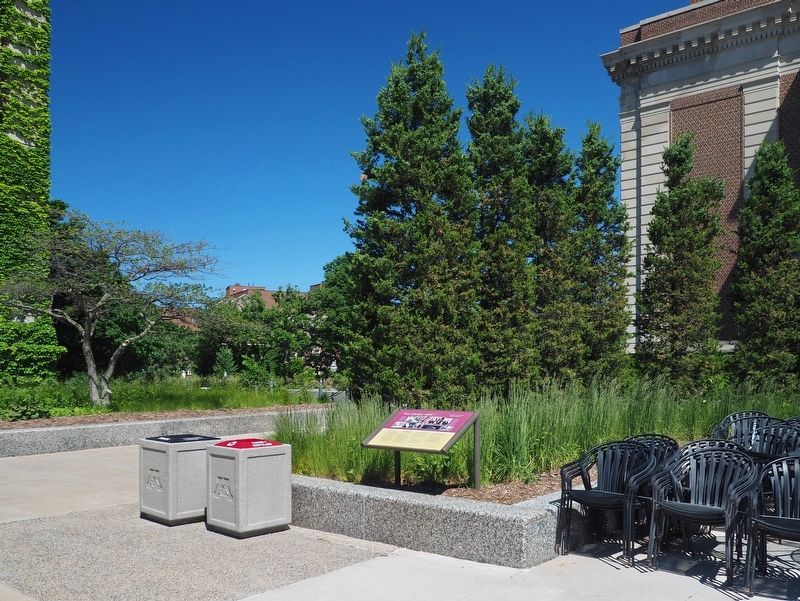
2. Marker between Johnston Hall (left) and the Northrup Auditorium (right)
9. Political science Regents Professor Kathryn Sikkink's research focuses on human rights
10. Leonid Hurwicz won the Nobel Prize in 2008 for his groundbreaking work in economics
Erected 2009 by Regents of the University of Minnesota.
Topics. This historical marker is listed in this topic list: Education. A significant historical year for this entry is 1869.
Location. 44° 58.555′ N, 93° 14.139′ W. Marker is in Minneapolis, Minnesota, in Hennepin County. It is in University. It can be reached from Pleasant Street SE. The marker is on the East Bank campus of the University of Minnesota, at the NW corner of Northrup Mall, between Johnston Hall and the Northrup Auditorium. Touch for map. Marker is at or near this postal address: 101 Pleasant St SE, Minneapolis MN 55455, United States of America. Touch for directions.

Regionally, this marker is in the Twin Cities Metropolitan Area. It is also in the American Midwest, in the Corn Belt, and in the Great River Road Region. Globally, it is in North America, the Western Hemisphere, the Western World, and the Anglosphere. Historically, it finds itself in what was once Rupert’s Land, the territory of the Mississippian Culture, and the Louisiana Purchase.
Other nearby markers. At least 8 other markers are within walking distance of this marker: Campus Design (within shouting distance of this marker); Opening Doors (within shouting distance of this marker); Spanning the Sciences (about 400 feet away, measured in a direct line); Continuing Education (about 700 feet away); Spanish-American War Memorial (approx. 0.2 miles away); The Armory Building / Military Training at the University (approx. 0.2 miles away); Education (approx. 0.2 miles away); University of Minnesota Spanish-American War Memorial (approx. 0.2 miles away). Touch for a list and map of all markers in Minneapolis.
Credits. This page was last revised on April 24, 2024. It was originally submitted on September 24, 2020, by McGhiever of Minneapolis, Minnesota. This page has been viewed 286 times since then and 14 times this year. Photos: 1, 2. submitted on September 24, 2020, by McGhiever of Minneapolis, Minnesota. • Mark Hilton was the editor who published this page.
