The Battles of Fort Henderson and Sulphur Creek Trestle
Fort Henderson and Trinity School
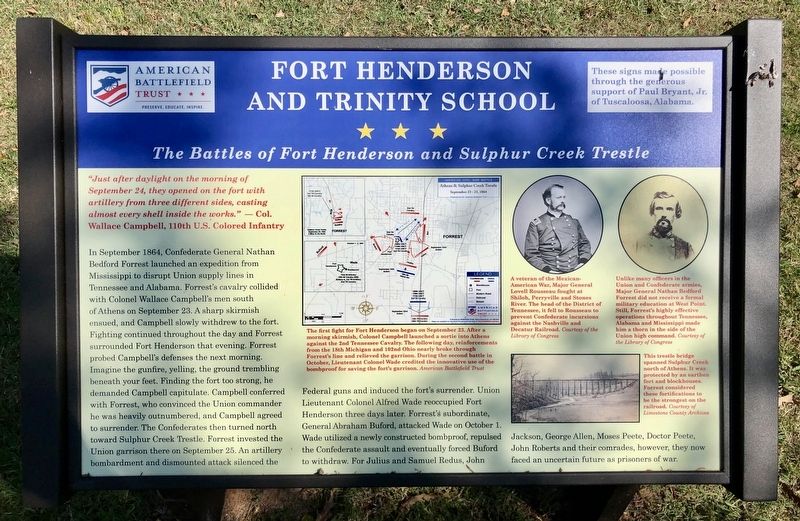
In September 1864, Confederate General Nathan Bedford Forrest launched an expedition from Mississippi to disrupt Union supply lines in Tennessee and Alabama. Forrest's cavalry collided with Colonel Wallace Campbell's men south of Athens on September 23. A sharp skirmish ensued, and Campbell slowly withdrew to the fort. Fighting continued throughout the day and Forrest surrounded Fort Henderson that evening. Forrest probed Campbell's defenses the next morning. Imagine the gunfire, yelling, the ground trembling beneath your feet. Finding the fort too strong, he demanded Campbell capitulate. Campbell conferred with Forrest, who convinced the Union commander he was heavily outnumbered, and Campbell agreed to surrender. The Confederates then turned north toward Sulphur Creek Trestle. Forrest invested the Union garrison there on September 25. An artillery bombardment and
this page online
[Photo captions]
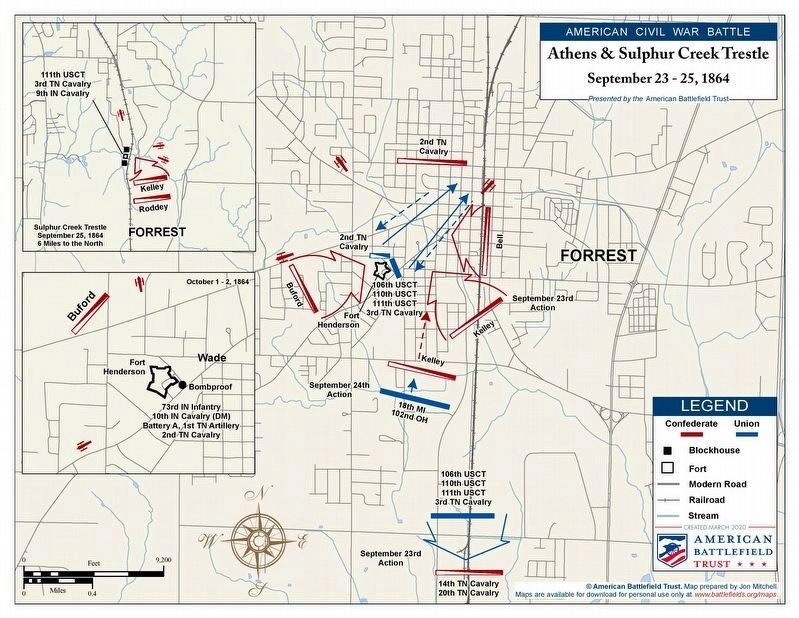
Map: The first fight for Fort Henderson began on September 23. After a
morning skirmish, Colonel Campbell launched a sortie into Athens
against the 2nd Tennessee Cavalry. The following day, reinforcements
from the 18th Michigan and 102nd Ohio nearly broke through
Forrest's line and relieved the garrison. During the second battle in
October, Lieutenant Colonel Wade credited the innovative use of the
bombproof for saving the fort's garrison. American Battlefield Trust
Portrait left: A veteran of the Mexican- American War, Major General Lovell Rousseau fought at Shiloh, Perryville and Stones River. The head of the District of Tennessee, it fell to Rousseau to prevent Confederate incursions against the Nashville and Decatur Railroad. Courtesy of the Library of Congress
Portrait right: Unlike many officers in the Union and Confederate armies, Major General Nathan Bedford Forrest did not receive a formal military education at West Point. Still, Forrest's highly effective operations throughout Tennessee, Alabama and Mississippi made him a thorn in the side of the Union high command. Courtesy of the Library of Congress
Bottom right: This trestle bridge
spanned Sulphur Creek
north of Athens. It was
protected by an earthen
fort and blockhouses.
Forrest considered
these fortifications to
be the strongest on the
railroad. Courtesy of
Limestone County Archives
Erected 2020

Topics. This historical marker is listed in this topic list: War, US Civil. A significant historical date for this entry is September 24, 1864.
Location. 34° 47.89′ N, 86° 58.811′ W. Marker is in Athens, Alabama, in Limestone County. It can be reached from Trinity Circle north of Browns Ferry Street (County Road 29), on the left when traveling east. Touch for map. Marker is at or near this postal address: 606 Trinity Cir, Athens AL 35611, United States of America. Touch for directions.

Regionally, this marker is in North Alabama and in the Huntsville Metropolitan Area. It is also in the American South, specifically in the Deep South, in Appalachia, and specifically in Southern Appalachia. Globally, it is in North America, a Gulf of Mexico state, the Western Hemisphere, the Western World, and the Anglosphere. Historically, it finds itself in what was once the original Cherokee Nation, the territory of the Mississippian Culture, one of the Confederate States of America, and the Antebellum South.
Other nearby markers. At least 8 other markers are within walking distance of this marker: Prisoners of War
Related markers. Click here for a list of markers that are related to this marker.
Also see . . .
1. Battle of Fort Henderson - from American Battlefield Trust website. (Submitted on October 19, 2020, by Mark Hilton of Montgomery, Alabama.)
2. Battle of Sulphur Creek Trestle. From the American Battlefield Trust website. (Submitted on October 19, 2020, by Mark Hilton of Montgomery, Alabama.)
Credits. This page was last revised on October 20, 2020. It was originally submitted on October 19, 2020, by Mark Hilton of Montgomery, Alabama. This page has been viewed 1,932 times since then and 165 times this year. Photos: 1, 2. submitted on October 19, 2020, by Mark Hilton of Montgomery, Alabama. 3. submitted on October 20, 2020, by Mark Hilton of Montgomery, Alabama.
