Eddystone in Delaware County, Pennsylvania — The American Northeast (Mid-Atlantic)
Eddystone: A True Factory Town
Photographed by Carl Gordon Moore Jr., November 3, 2020
1. Eddystone: A True Factory Town Marker
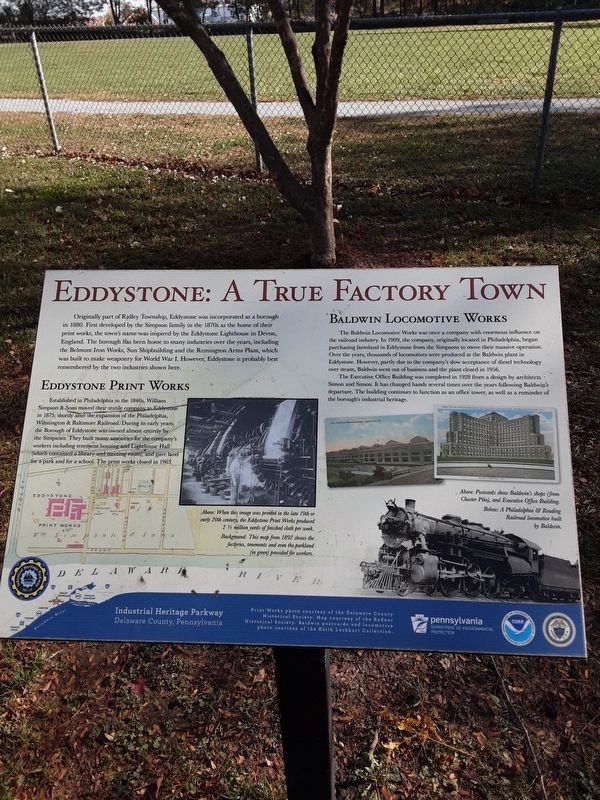
Eddystone Print Works
Established in Philadelphia in the 1840s, William Simpson & Sons moved their textile company to Eddystone in 1875, shortly after the expansion of the Philadelphia, Wilmington & Baltimore Railroad. During its early years, the Borough of Eddystone was owned almost entirely by the Simpsons. They built many amenities for the company's workers including tenement housing and Lighthouse Hall (which contained a library and meeting room), and gave land for a park and for a school. The print works closed in 1963.
[photo captions]
Above: When this image was printed in the late 19th or early 20th century, the Eddystone Print Works produced 22 million yards of finished cloth per week.
Background: This map from 1892 shows the factories, tenements and even the parkland (in green) provided for workers.
Baldwin Locomotive Works
The
this page online
The Executive Office Building was completed in 1928 from a design by architects
Simon and Simon. It has changed hands several times over the years following Baldwin's
departure. The building continues to function as an office tower, as well as a reminder of the borough's industrial heritage.
[photo captions]
Above: Postcards show Baldwin's shops (from
Chester Pike), and Executive Office Building.
Below: A Philadelphia & Reading Railroad locomotive built
by Baldwin.
Print Works photo courtesy of the Delaware County
Historical Society. Map courtesy of the Radnor
Historical Society. Baldwin postcards and locomotive
photo courtesy of the Keith Lockhart
Photographed by Carl Gordon Moore Jr., November 3, 2020
2. Eddystone: A True Factory Town Marker
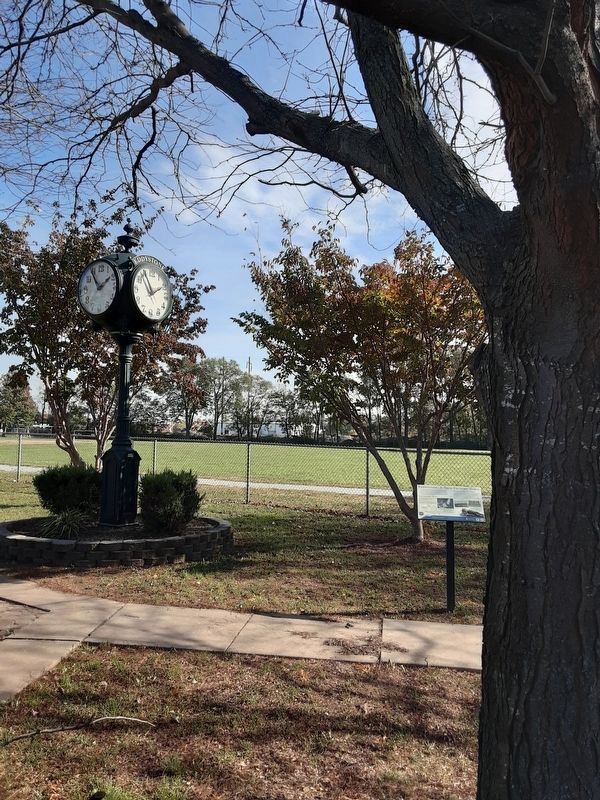
Marker is next to a tree at right. Eddystone United Methodist Church is off camera to right (west).
Pennsylvania
Department of Environmental
Protection
Erected by Industrial Heritage Parkway, Delaware County, Pennsylvania.
Topics. This historical marker is listed in this topic list: Industry & Commerce. A significant historical year for this entry is 1880.
Location. 39° 51.577′ N, 75° 20.495′ W. Marker is in Eddystone, Pennsylvania, in Delaware County. It is on 9th Street 0.1 miles west of Simpson Street, on the right when traveling east. Touch for map. Marker is at or near this postal address: 1401_9th Street, Crum Lynne PA 19022, United States of America. Touch for directions.

Regionally, this marker is in Southeast Pennsylvania and in Greater Philadelphia. It is also in the American Northeast and in the Mid-Atlantic. Globally, it is in North America, the Western Hemisphere, the Western World, and the Anglosphere. Historically, it finds itself in what was once the Haudenosaunee (Iroquois) Confederacy, New Netherland, and one of the original Thirteen Colonies.
Other nearby markers. At least 8 other markers are within walking distance of this marker: Eddystone Rifle Plant (approx. 0.3 miles away);
Photographed by Carl Gordon Moore Jr., November 3, 2020
3. Eddystone: A True Factory Town Marker
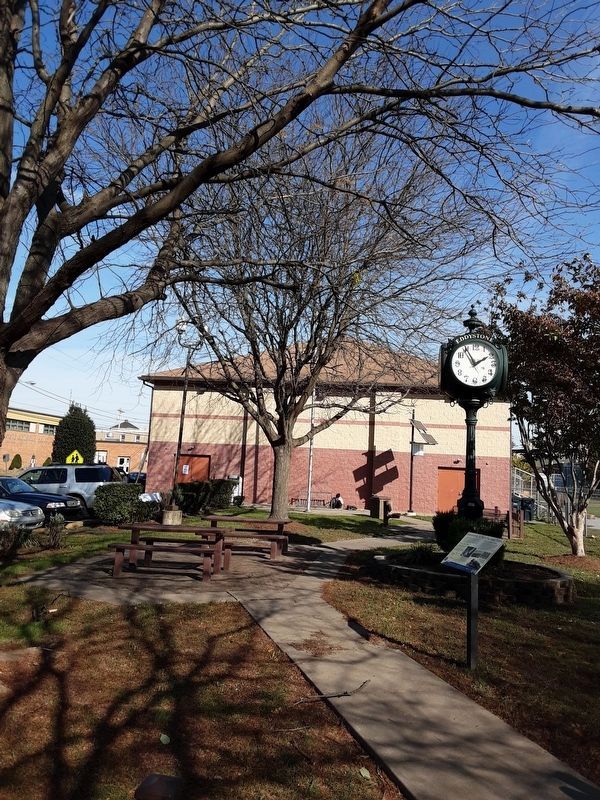
Looking east to Lighthouse Hall.
More about this marker. The address used is that of Lighthouse Hall just to east.
Additional commentary.
1.
Notice "The Factory and The Village" marker in Marcus Hook in this same county.
— Submitted November 4, 2020, by Carl Gordon Moore Jr. of North East, Maryland.
Credits. This page was last revised on November 5, 2020. It was originally submitted on November 3, 2020, by Carl Gordon Moore Jr. of North East, Maryland. This page has been viewed 1,544 times since then and 164 times this year. Photos: 1. submitted on November 3, 2020, by Carl Gordon Moore Jr. of North East, Maryland. 2, 3. submitted on November 4, 2020, by Carl Gordon Moore Jr. of North East, Maryland. • Bill Pfingsten was the editor who published this page.
