
Death Valley National Park in Inyo County, California — The American West (Pacific Coastal)
Wildrose CCC Camp
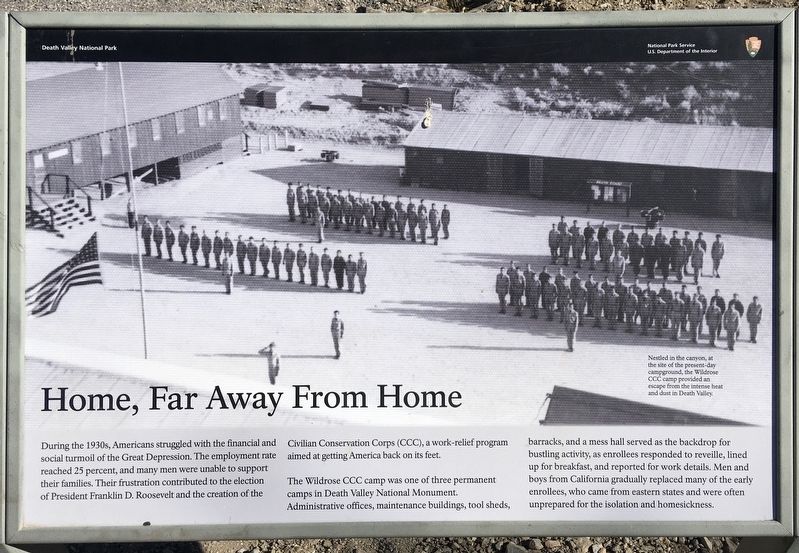
Home, Far Away From Home
Photographed by Craig Baker, October 26, 2020
1. Wildrose CCC Camp Marker
During the 1930s, Americans struggled with the financial and social turmoil of the Great Depression. The employment rate reached 25 percent, and many men were unable to support their families. Their frustration contributed to the election of President Franklin D. Roosevelt and the creation of the Civilian Conservation Corps (CCC), a work-relief program aimed at getting America back on its feet.
The Wildrose CCC camp was one of three permanent camps in Death Valley National Monument. Administrative offices, maintenance buildings, tool sheds, barracks, and a mess hall served as the backdrop for bustling activity, as enrollees responded to reveille, lined up for breakfast, and reported for work details. Men and boys from California gradually replaced many of the early enrollees, who came from eastern states and were often unprepared for the isolation and homesickness.
Nestled in the canyon, at the site of the present-day campground, the Wildrose CCC camp provided an escape from the intense heat and dust in Death Valley.
Erected by National Park Service.
Topics and series. This historical marker is
this page online
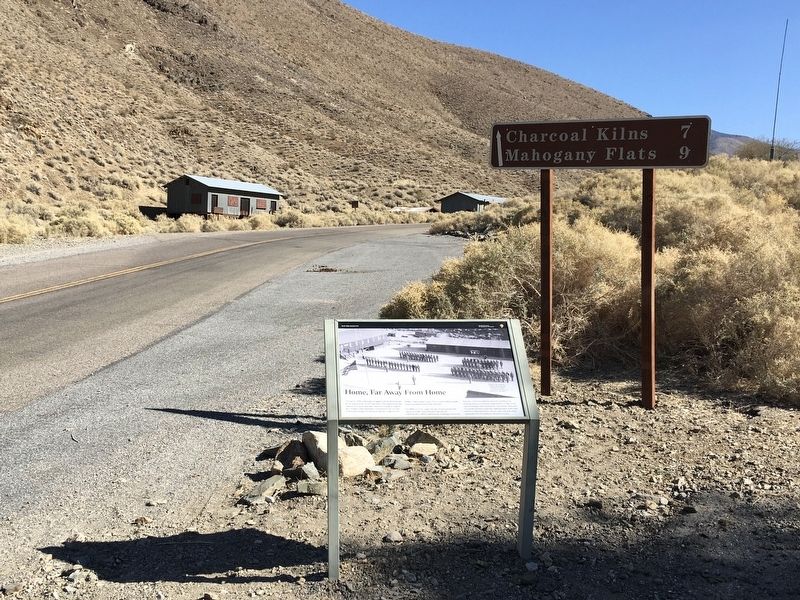
Location. 36° 15.91′ N, 117° 11.146′ W. Marker is in Death Valley National Park, California, in Inyo County. It is on Charcoal Kiln Road 0.4 miles east of Emigrant Canyon Road, on the right when traveling east. Touch for map. Marker is in this post office area: Death Valley CA 92328, United States of America. Touch for directions.

Regionally, this marker is in California’s Sierra Nevada. It is also in the American Mountain West. Globally, it is in North America, on the Ring of Fire, in the Pacific Rim, in the Western Hemisphere, in the Western World, and in the Anglosphere. Historically, it finds itself in what was once New Spain and also Mexico’s Alta California.
Other nearby markers. At least 8 other markers are within 12 miles of this marker, measured as the crow flies: Skidoo Pipeline (approx. 3.2 miles away); Wildrose Charcoal Kilns (approx. 6.3 miles away); Aguereberry Camp (approx. 8 miles away); The Eureka Mine
Photographed by Craig Baker, October 26, 2020
2. Camp Marker and Buildings
Photographed by Craig Baker, October 26, 2020
3. Cabin
Photographed by Craig Baker, October 26, 2020
4. Tree
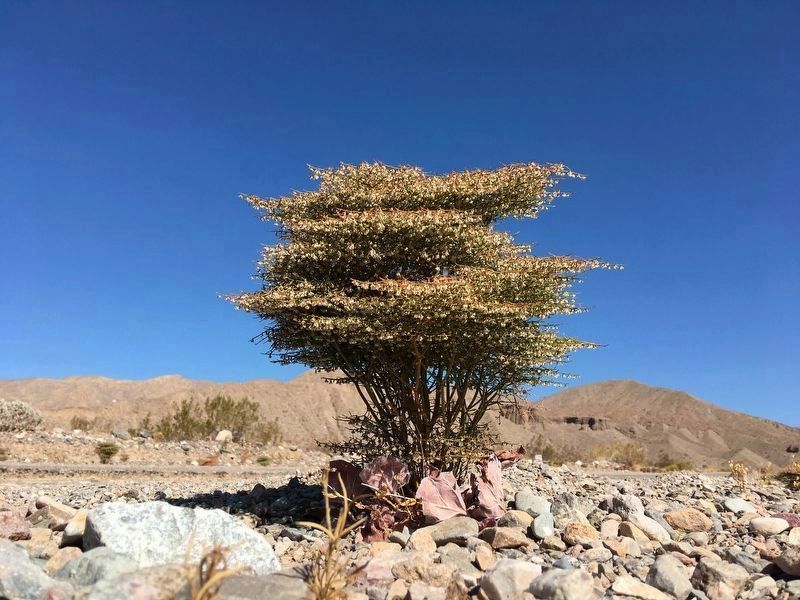
Growing near Wildrose Spring, this tree-like bush is only four inches tall. Common name: Pagoda Buckwheat.
Credits. This page was last revised on April 9, 2025. It was originally submitted on November 5, 2020, by Craig Baker of Sylmar, California. This page has been viewed 664 times since then and 45 times this year. Photos: 1, 2, 3, 4. submitted on November 5, 2020, by Craig Baker of Sylmar, California. • J. Makali Bruton was the editor who published this page.
