Fitzrovia in City of Westminster in Greater London, England, United Kingdom — Northwestern Europe (the British Isles)
Harry Errington
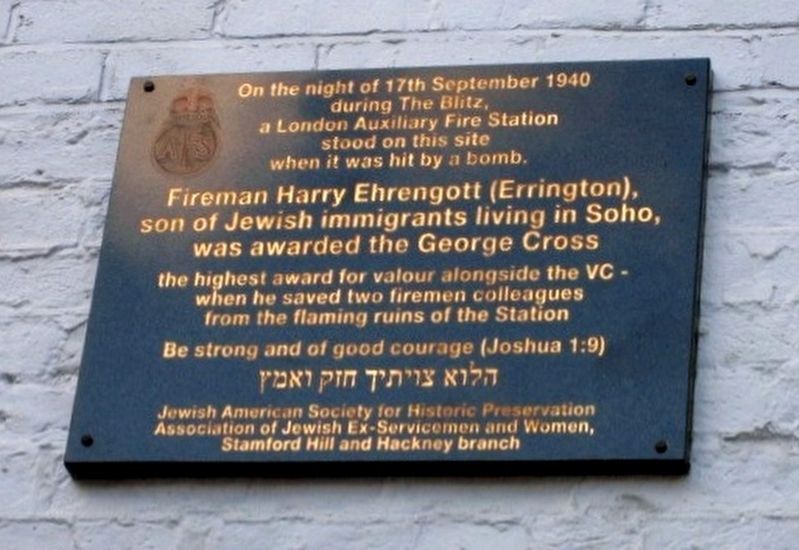
Photographed by Jerry Klinger, November 3, 2020
1. Harry Errington Marker
Errington was the only London Firefighter to have won the George Cross for heroism during the German Blitz of World War II.
On the night of 17th September 1940 during The Blitz, at London Auxiliary Fire Station stood on this site when it was hit by a bomb
Fireman Harry Ehrengott (Errington), son of Jewish immigrants living in Soho, won the George Cross
the highest award for valour alongside the VC – when he saved two firemen colleagues from the flaming ruins of the Station
Be strong and of good courage (Joshua 1:9)
הלוא צויתיך חזק ואמץ
Jewish American Society for Historic Preservation
Association of Jewish Ex-Servicemen and Women, Stamford Hill and Hackney branch
Erected 2020 by Jewish American Society for Historic Preservation.
Topics and series. This historical marker is listed in this topic list: War, World II. In addition, it is included in the Jewish American Society for Historic Preservation., and the Victoria Cross and George Cross Recipients series lists. A significant historical date for this entry is September 17, 1940.
Location. 51° 31.071′ N, 0° 8.073′ W. Marker is in City of Westminster, England, in Greater London. It is in Fitzrovia. It is on Rathbone
this page online

Regionally, this marker is in London and in the Greater South East. Globally, it is on the Atlantic Ocean, in the North Atlantic Region, in Europe, in Atlantic Europe, on one of the British Isles, in the Western World, and in the Anglosphere. Historically, it finds itself in what was once the Roman Empire.
Other nearby markers. At least 8 other markers are within walking distance of this marker: Rathbone Street Firemen Memorial (here, next to this marker); Marquis of Granby (a few steps from this marker); The Newman Arms (within shouting distance of this marker); Thomas Stothard (about 90 meters away, measured in a direct line); Coventry Patmore (about 120 meters away); Charles Laughton (about 120 meters away); Thomas Hodgkin (approx. 0.3 kilometers away); Olaudah Equiano (approx. 0.3 kilometers away). Touch for a list and map of all markers in City of Westminster.
Regarding Harry Errington. Harry Errington is the only

Photographed by Andrew Ruppenstein, April 26, 2026
2. Harry Errington Marker - wide view
Also see . . . Firemen Remembered: Harry Errington and the George Cross (Blitzwalkers). Excerpt:
On 17 September 1940, Harry and some twenty colleagues were awaiting their next "shout" in the basement of Jackson's Garage, along with around thirty members of the public who were sheltering there. At 00:14, the floors above crashed into the basement as the building received a direct hit from a high explosive bomb. The garage petrol store was also located above the basement and the burning fuel created a fireball that swept through the basement. Harry was blown across the floor and knocked unconscious but quickly awoke to find himself unhurt but stunned. The cellar was burning and smoke-filled and although the main exit was blocked, he was able to make his way to the emergency exit but on his way, heard screams for help; he saw his friend John Hollingshead laying face down in great pain with his legs trapped by masonry. Without hesitation, Harry found a blanket and placed it over his head to try and get a measure of protection from the flames and returned to help his friend.(Submitted on April 26, 2026.)
Harry was able to scrape away and lift the rubble with his bare hands, seriously burning and cutting them in the process. Freeing Hollingshead, he then carried him out into the street but on his way, noticed another friend, John Terry, trapped beneath a heavy radiator. Having taken Hollingshead to safety, Harry then returned into the burning basement, by then in danger of imminent collapse and freed Terr, dragging him out of the building.
Harry was by this time in serious pain from his cut and burned hands, which he must have surely known could end his peacetime livelihood. The injured men, including Harry were taken to the nearby Middlesex Hospital for treatment but later transferred to the relative safety of a hospital in Cheshunt, Hertfordshire. It was whilst recovering here that he recalled being given copious supplies of beer, courtesy of some Canadian soldiers who were also patients here. The Canadians didn't think much of English beer and so were happy to give it away to the English firemen!
Harry was eventually discharged by the AFS as his wounds failed to heal in the thirteen weeks allowed by the Civil Injuries Act and as his parents had moved to Bromsgrove, near Birmingham, he moved there and got a job working at Austin Aero, which manufactured Lancaster bombers. He also attempted to join the Army at this time but was refused as medically unfit due to his injured hands. Harry later re-joined the now-nationalised National Fire Service in Bromsgrove as a part-timer and remained with them until the end of the war.
Harry's George Cross was gazetted on 8 August 1941 based on the recommendation of Hollingshead and Terry, the two men he had rescued, who had reported his actions to a senior officer. Despite his injuries (he had third degree burns to his hands and arms), Harry had modestly not mentioned his act of rescue to his superiors. His GC was awarded to him in October 1942 by the King in a ceremony at Buckingham Palace.
Credits. This page was last revised on April 26, 2026. It was originally submitted on November 17, 2020, by Jerry Klinger of Boynton Beach, Florida. This page has been viewed 329 times since then and 22 times this year. Photos: 1. submitted on November 17, 2020, by Jerry Klinger of Boynton Beach, Florida. 2. submitted on April 26, 2026, by Andrew Ruppenstein of Lamorinda, California. • J. Makali Bruton was the editor who published this page.
