Amity Township near Douglassville in Berks County, Pennsylvania — The American Northeast (Mid-Atlantic)
Morlatton Village
An 18th Century Crossroads
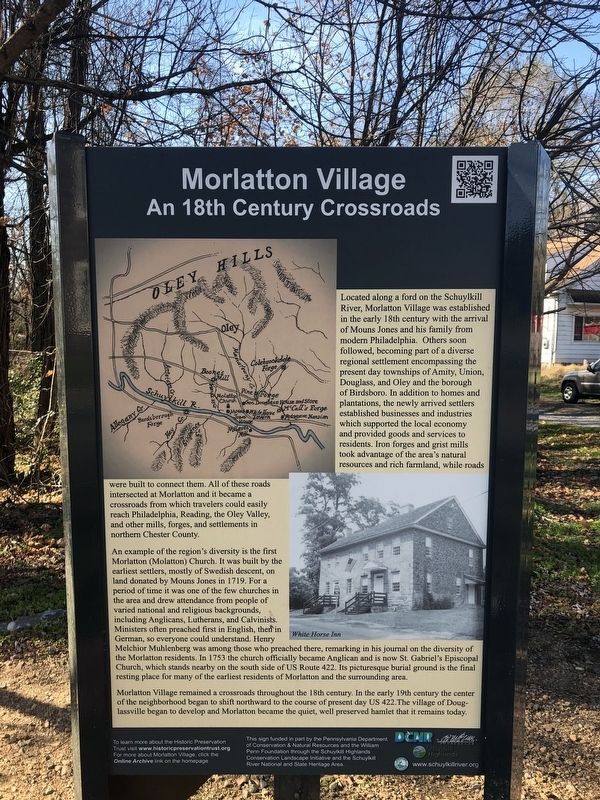
Located along a ford on the Schuylkill River, Morlatton Village was established in the 18th century with the arrival of Mouns Jones and his family from modern Philadelphia. Others soon followed, becoming a part of a diverse regional settlement encompassing the present day townships of Amity, Union, Douglass, and Oley and the borough of Birdsboro. In addition to homes and plantations, and newly arrived settlers established businesses and industries which supported the local economy and provided goods and services to residents. Iron forges and grist mills took advantage of the area's natural resources and rich farmland, while roads were built to connect them. All of these roads intersected at Morlatton and it became a crossroads from which travelers could easily reach Philadelphia, Reading, they Oley Valley, and other mills, forges, and settlements in northern Chester County.
An example of the region's diversity is the first Morlatton (Molatton) Church. It was built by the earliest settlers, mostly of Swedish descent, on land donated by Mouns Jones in 1719. For a period of time it was one of the few churches in the area
this page online
Morlatton Village remained a crossroads throughout the 18th century. In the early 19th century the center of the neighborhood began to shift northward to the course of present day US 422. The village of Douglassville began to develop and Morlatton became the quiet, well preserved hamlet that it remains today.
Erected by Pennsylvania Department of Conservation and Natural Resources and the William Penn Foundation through the Schuylkill Highlands Conservation Landscape Initiative and the Schuylkill National and State Heritage Area.
Topics. This historical marker is listed in these topic lists: Colonial Era •
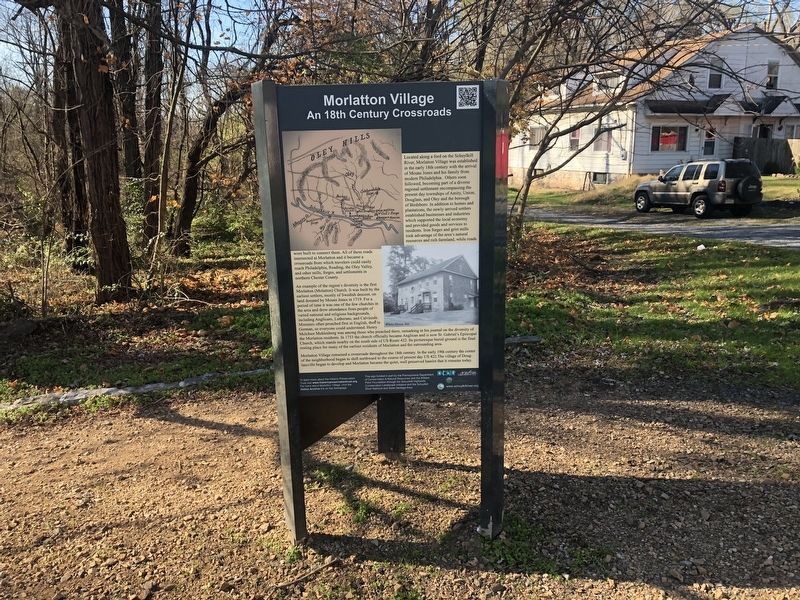
Location. 40° 15.245′ N, 75° 43.58′ W. Marker is near Douglassville, Pennsylvania, in Berks County. It is in Amity Township. It is on Old Philadelphia Pike 0.1 miles north of Britton Street, on the left when traveling north. Touch for map. Marker is at or near this postal address: 701 Old Philadelphia Pike, Douglassville PA 19518, United States of America. Touch for directions.

Regionally, this marker is in Southeast Pennsylvania and specifically in Pennsylvania Dutch Country. It is also in the American Northeast and in the Mid-Atlantic. Globally, it is in North America, the Western Hemisphere, the Western World, and the Anglosphere. Historically, it finds itself in what was once the Haudenosaunee (Iroquois) Confederacy and also one of the original Thirteen Colonies.
Other nearby markers. At least 8 other markers are within walking distance of this marker: Morlatton Village Trailhead (here, next to this marker); Old Swedes House (a few steps from this marker); George Douglass Home (a few steps from this marker); Welcome to Morlatton Village (about 300 feet away, measured in a direct line); Feuding Railroads (about 300 feet away); White Horse Inn (about 300 feet away); Mouns Jones House (about 500 feet away); Michael Fulp House (about 500 feet away). Touch for a list and map of all markers in Douglassville.
Credits. This page was last revised on January 27, 2026. It was originally submitted on November 21, 2020, by Devry Becker Jones of Washington, District of Columbia. This page has been viewed 424 times since then and 32 times this year. Photos: 1, 2. submitted on November 21, 2020, by Devry Becker Jones of Washington, District of Columbia.
