Lower Ninth Ward in Arabi in St. Bernard Parish, Louisiana — The American South (West South Central)
Jackson Barracks
Photographed by Cajun Scrambler, September 11, 2020
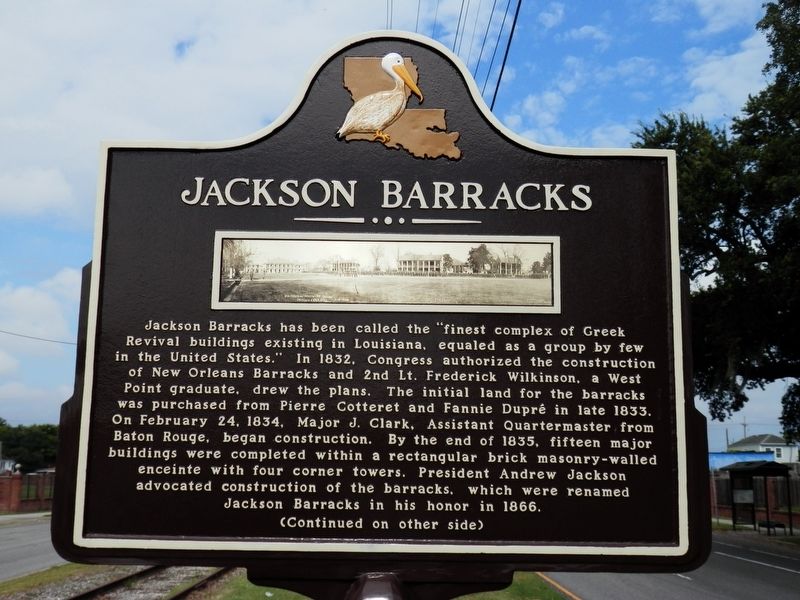
1. Jackson Barracks Marker
Jackson Barracks has been called the "finest complex of Greek Revival buildings existing in Louisiana, equaled as a group by few in the United States.” In 1832, Congress authorized the construction of New Orleans Barracks and 2nd Lt. Frederick Wilkinson, a West Point graduate, drew the plans. The initial land for the barracks was purchased from Pierre Cotteret and Fannie Duprê in late 1833. On February 24, 1834, Major J. Clark, Assistant Quartermaster from Baton Rouge, began construction. By the end of 1835, fifteen major buildings were completed within a rectangular brick masonry-walled enceinte with four corner towers. President Andrew Jackson advocated construction of the barracks, which were renamed Jackson Barracks in his honor in 1866.
(Continued on other side)
Side B
(Continued from other side)
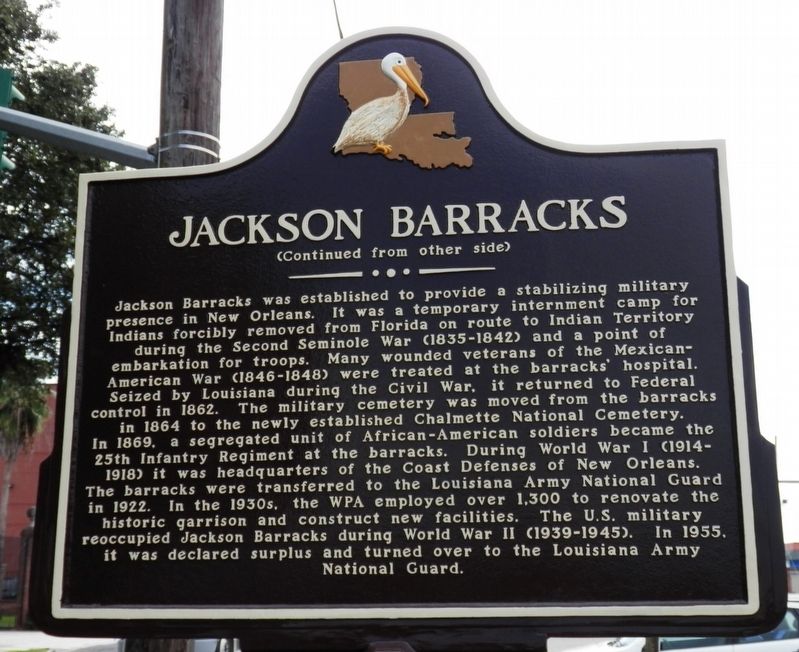
Jackson Barracks was established to provide a stabilizing military presence in New Orleans. It was a temporary internment camp for Indians forcibly removed from Florida on route to Indian Territory during the Second Seminole War (1835-1842) and a point of embarkation for troops. Many wounded veterans of
this page online
Topics. This historical marker is listed in these topic lists: Forts and Castles • Military. A significant historical date for this entry is February 24, 1834.
Location. 29° 57.499′ N, 90° 0.401′ W. Marker is in Arabi, Louisiana, in St. Bernard Parish. It is in the Lower Ninth Ward. It is on St. Claude Avenue (State Highway 46) near
Photographed by Cajun Scrambler, September 11, 2020
2. Jackson Barracks Marker

Regionally, this marker is in Bayou Country and in Greater New Orleans. It is also in the American South, specifically in the Deep South, and on the Gulf Coast. Globally, it is in North America, a Gulf of Mexico state, the Western Hemisphere, the Western World, and the Anglosphere. Historically, it finds itself in what was once New Spain, the Viceroyalty of New France, the territory of the Mississippian Culture, the Louisiana Purchase, one of the Confederate States of America, and the Antebellum South.
Other nearby markers. At least 8 other markers are within walking distance of this marker: ZiS2 M1943 Anti-Tank Gun (within shouting distance of this marker); M1938 (M30) Field Howitzer (within shouting distance of this marker); ZPU 4 (within shouting distance of this marker); M1937 Anti-Tank Gun (within shouting distance of this marker); M2 Heavy Anti-Aircraft Gun (within shouting distance of this marker); Skoda 37 mm Kanon P.U.V. vz 37.L/47.6 (within shouting distance
Photographed by Cajun Scrambler, September 11, 2020
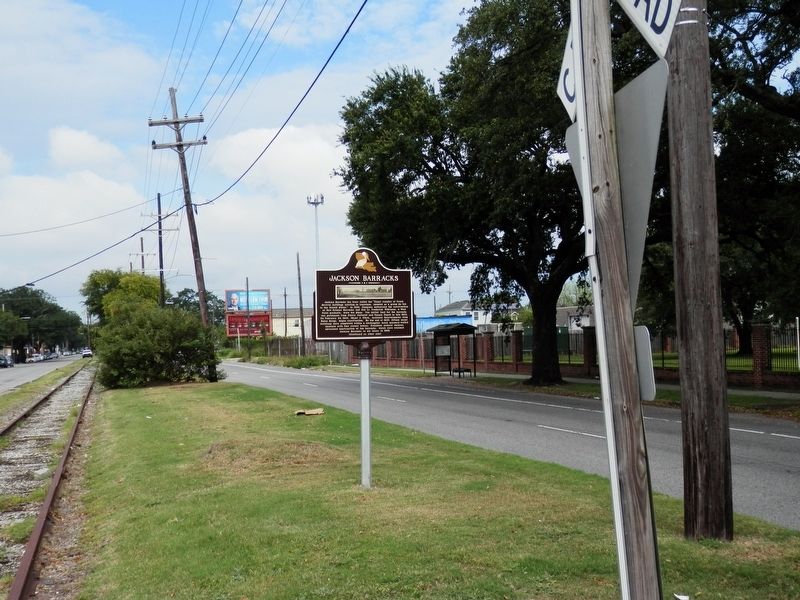
3. Jackson Barracks Marker
Photographed by Cajun Scrambler, September 11, 2020
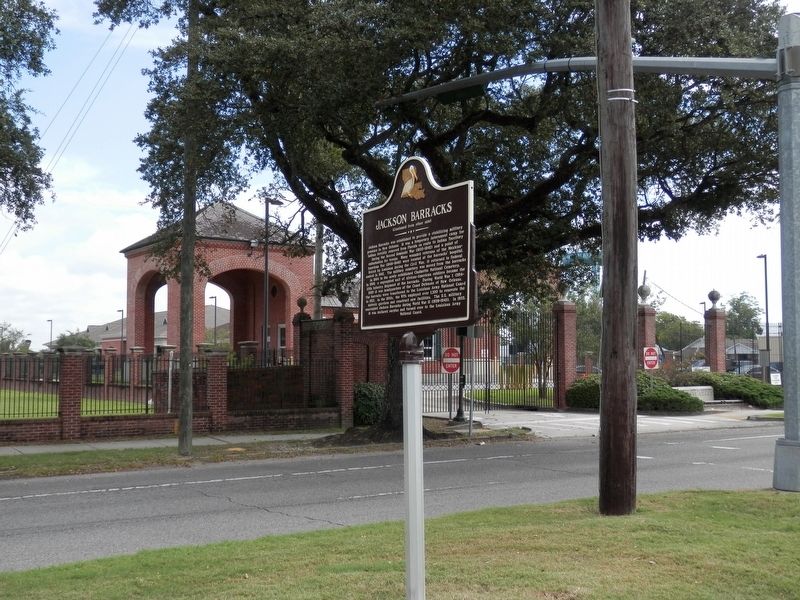
4. Jackson Barracks Marker
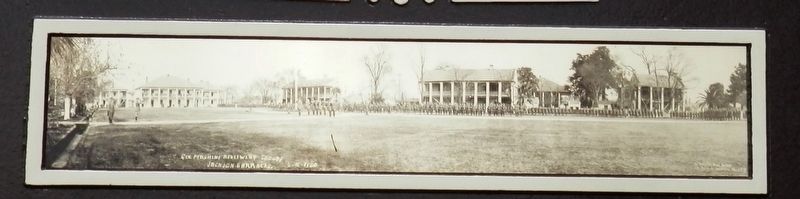
Photographed by Cajun Scrambler, September 11, 2020
5. Jackson Barracks Marker
Credits. This page was last revised on February 12, 2023. It was originally submitted on November 26, 2020, by Cajun Scrambler of Assumption, Louisiana. This page has been viewed 667 times since then and 42 times this year. Photos: 1, 2, 3, 4, 5. submitted on November 26, 2020, by Cajun Scrambler of Assumption, Louisiana.
